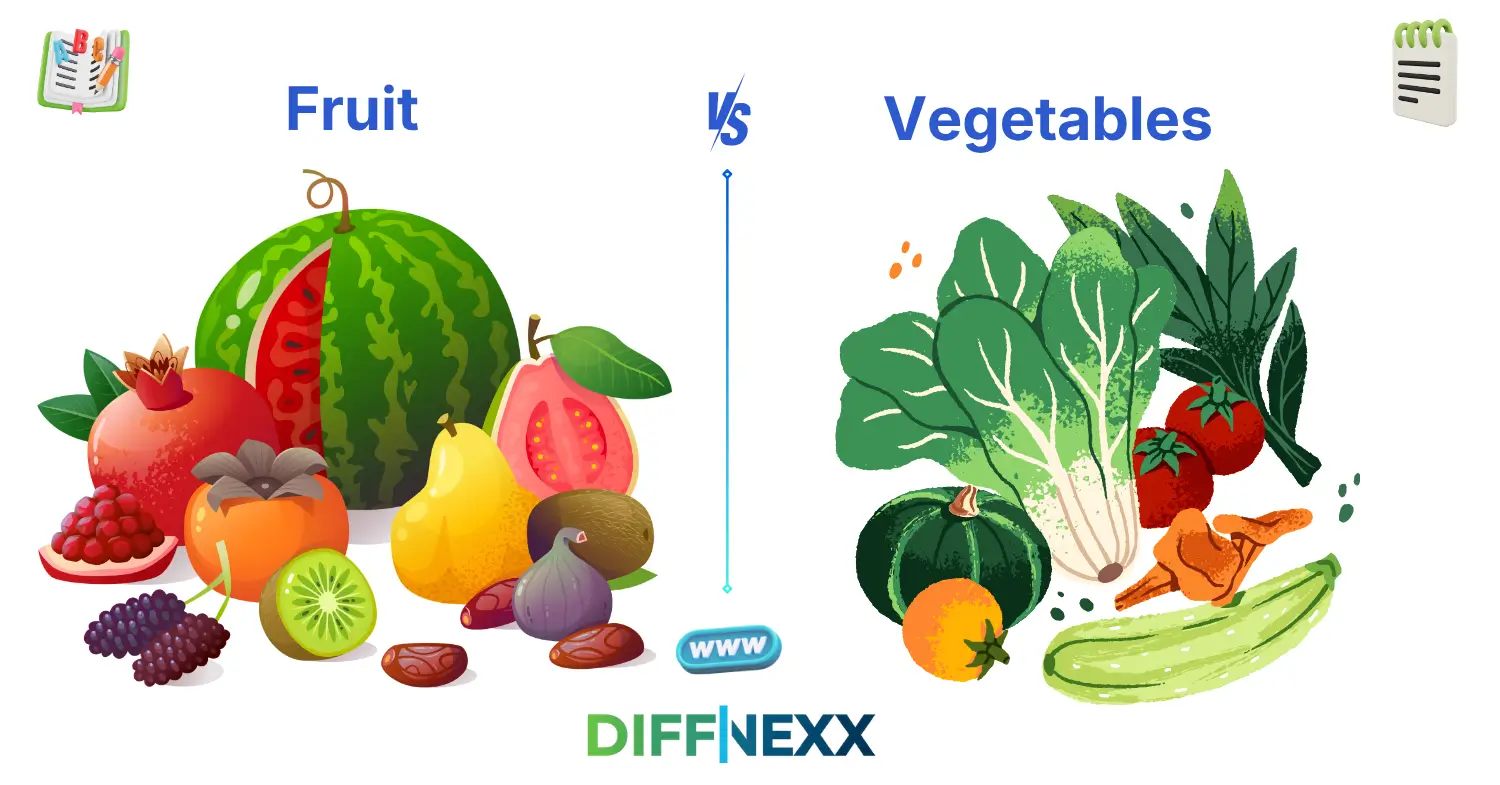
The difference between fruit and vegetables often comes up when you are in the kitchen or at the market. You pick up a tomato and suddenly wonder fruit or vegetable?
We eat fruits and vegetables every day. Fruits usually taste sweet, while vegetables often taste mild or savory. But the real difference is not just about taste.
The difference between fruit and vegetables is based on science and usage. In simple terms, fruits come from flowers, while vegetables come from other parts of plants.
Understanding the difference between fruit and vegetables helps you speak clearly and learn better. Now, let’s explore the details step by step.
🔑 Key Difference Between the Both
The main difference lies in biology. Fruits develop from the flower of a plant and contain seeds. Vegetables come from roots, stems, or leaves.
In everyday language, fruits are sweet and eaten as snacks. Vegetables are often cooked and served with meals.
So, the difference is both scientific and practical.
🌍 Importance – Why Knowing the Difference Matters
Knowing the difference helps students understand science and nutrition better. It also improves accuracy in exams and daily conversations.
For professionals like chefs, farmers, and nutritionists, this distinction is very important. It helps in planning meals and explaining food categories.
In society, clear understanding avoids confusion. It also helps people make better food choices and communicate more effectively.
🔊 Pronunciation Section
Fruit
US: /fruːt/
UK: /fruːt/
Vegetables
US: /ˈvedʒtəblz/
UK: /ˈvedʒtəbəlz/
Now that you know how to say both words, let’s define them clearly.
📚 Core Definitions
Fruit
A fruit is the part of a plant that develops from a flower and contains seeds. It often tastes sweet or juicy.
Fruits usually feel fresh and refreshing.
Example: An apple is a fruit.
Vegetables
Vegetables are other edible parts of plants, such as roots, stems, and leaves. They often taste less sweet.
Vegetables feel more earthy and filling.
Example: A carrot is a vegetable.
📚 10 Clear Differences Between Fruit and Vegetables
1. Scientific Origin 🌱
Fruits grow from flowers and contain seeds. Vegetables grow from other plant parts.
- Fruit: A mango grows from a flower.
- Vegetable: A potato grows underground.
2. Presence of Seeds 🌰
Fruits always have seeds inside or outside. Vegetables may not have seeds.
- Fruit: A watermelon has seeds.
- Vegetable: Spinach has no visible seeds.
3. Taste Profile 🍎
Fruits are usually sweet or tangy. Vegetables are often savory or mild.
- Fruit: Grapes taste sweet.
- Vegetable: Broccoli tastes mild.
4. Culinary Use 🍽️
Fruits are eaten raw or as desserts. Vegetables are often cooked.
- Fruit: People eat bananas as snacks.
- Vegetable: People cook cabbage in meals.
5. Nutritional Focus 🥗
Fruits provide natural sugars and vitamins. Vegetables provide fiber and minerals.
- Fruit: Oranges give vitamin C.
- Vegetable: Spinach gives iron.
6. Plant Part 🌿
Fruits come from the reproductive part. Vegetables come from roots, stems, or leaves.
- Fruit: Tomatoes come from flowers.
- Vegetable: Carrots come from roots.
7. Usage in Language 🗣️
Fruit is used in both science and daily speech. Vegetable is more common in cooking and nutrition.
- Fruit: Apple is a fruit.
- Vegetable: Onion is a vegetable.
8. Texture 🍉
Fruits are often juicy and soft. Vegetables can be crunchy or firm.
- Fruit: A peach is soft.
- Vegetable: A cucumber is crunchy.
9. Growing Conditions 🌍
Fruits often need pollination. Vegetables may grow without it.
- Fruit: Bees help grow apples.
- Vegetable: Lettuce grows easily.
10. Examples Overlap ⚠️
Some foods are both scientifically fruits but used as vegetables.
- Fruit: Tomato is a fruit scientifically.
- Vegetable: Tomato is used as a vegetable in cooking.
🎯 Why Knowing the Difference Matters
Students need this knowledge for science classes. It helps them understand plant biology and food groups clearly.
Professionals like chefs and dietitians use this difference daily. It helps them plan menus and explain nutrition.
In daily life, correct usage improves communication. It also helps you make smarter food choices.
Real-world consequences of confusion
Calling a fruit a vegetable in exams can lead to mistakes. In cooking, it may change how people prepare dishes.
🧠 Why People Get Confused
Similar Usage
People group fruits and vegetables together in meals. This creates confusion.
Context-Based Meaning
Science defines them differently than cooking. This difference causes misunderstanding.
Informal Speech
People use the terms loosely in daily talk. This reduces clarity.
🎭 Connotation & Emotional Tone
(Connotation = the emotional meaning attached to a word.)
Fruit
- Positive: Fresh and healthy
- Example: Fruits make you feel energized.
- Negative: Rare, but can imply softness
- Example: The fruit spoiled quickly.
- Neutral: A plant product
- Example: This is a fruit.
Vegetables
- Positive: Nutritious and strong
- Example: Vegetables keep you healthy.
- Negative: Sometimes seen as less tasty
- Example: Kids avoid vegetables.
- Neutral: A food group
- Example: Eat your vegetables.
🗣 Usage in Metaphors, Similes & Idioms
- “Fruit of your labor” (result of hard work)
Example: This success is the fruit of your labor. - “Cool as a cucumber” (calm person)
Example: He stayed cool as a cucumber.
These phrases show how both words appear in everyday language.
📊 Comparison Table
| Feature | Fruit | Vegetables |
|---|---|---|
| Meaning | From flowers with seeds | Other plant parts |
| Tone | Fresh and sweet | Earthy and healthy |
| Usage | Snacks, desserts | Meals, cooking |
| Context | Biology and diet | Cooking and nutrition |
| Formality | Neutral | Neutral |
⚖️ Which Is Better in What Situation?
When to use Fruit
Use fruit when talking about sweet foods or plant science. It works well in both daily and academic contexts.
Example: Fruits are rich in vitamins.
When to use Vegetables
Use vegetables when discussing meals, cooking, or nutrition. It fits well in health and food discussions.
Example: Vegetables are good for digestion.
Situational Clarity
Choose based on context. Science needs accuracy. Cooking needs practical usage.
Contextual Correctness
Think about audience and purpose. Use the correct term to avoid confusion.
📖 Literary or Cultural References
- Book: “The Very Hungry Caterpillar” (Children’s Book, Eric Carle, 1969) – shows fruits in storytelling.
- Movie: “Ratatouille” (USA, 2007) – highlights vegetables in cooking.
❓ FAQs
1. Is a tomato a fruit or a vegetable?
Scientifically, a tomato is a fruit because it grows from a flower and has seeds. In cooking, people treat it as a vegetable.
2. Why are fruits sweet but vegetables are not?
Fruits contain natural sugars to attract animals. Vegetables do not need this, so they taste less sweet.
3. Are all fruits healthy?
Most fruits are healthy because they contain vitamins and fiber. However, eating too much sugar from fruits is not ideal.
4. Can vegetables be eaten raw like fruits?
Yes, some vegetables like carrots and cucumbers can be eaten raw. Others taste better when cooked.
5. Why do schools teach this difference?
Schools teach it to explain plant biology. It helps students understand how plants grow and produce food.
🏁 Conclusion
The difference between fruit and vegetables is simple once you understand the basics. Fruits come from flowers and contain seeds, while vegetables come from other plant parts.
This difference is important in both science and daily life. It helps you choose the right words and understand food better.
Using the correct term improves communication and learning. It also builds confidence in speaking and writing.
Keep practicing this knowledge in real life. With time, identifying fruits and vegetables will become easy and natural.

Anton Reyes is a contributing writer at DiffNexx.com, where he explores meaningful differences in language, culture, and everyday concepts. With a background in creative nonfiction, Anton brings clarity and balance to complex comparisons. His writing helps readers understand subtle distinctions in words and ideas, making learning both insightful and engaging.