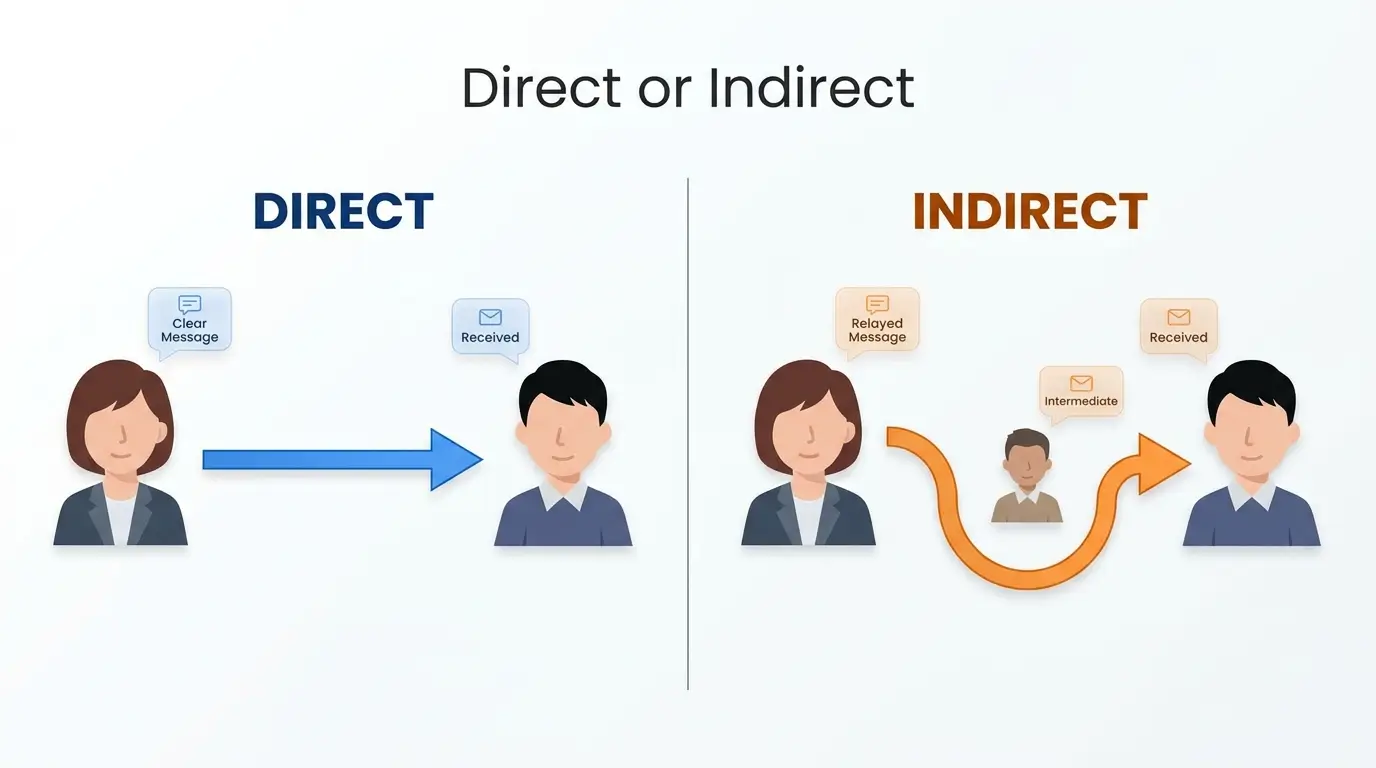
The choice between direct or indirect can change the meaning, tone, and clarity of a sentence. These words look closely related because they share the same base word, but they describe different ways of reaching a point, giving information, showing a result, or communicating an idea.
People often search for direct or indirect because the two words appear in many areas of English. You may see them in conversations, emails, grammar lessons, business writing, reports, directions, and academic texts. The confusion becomes greater when expressions such as “direct speech,” “indirect speech,” “direct question,” and “indirect question” are added.
Understanding direct or indirect is therefore useful for both native and non-native English speakers. The basic difference is simple: direct usually means straight, immediate, or without something in between, while indirect means not straight, not immediate, or involving an intermediate step.
In this guide, we will explain direct or indirect in detail, including pronunciation, word origins, British and American usage, common mistakes, everyday examples, and practical rules for choosing the right word.
Quick Answer
Direct means straight, immediate, clear, or without an intermediate step.
Indirect means not straight, not immediate, or involving something between the starting point and the final result.
For example:
She gave me a direct answer.
The person answered clearly and without avoiding the main point.
She gave me an indirect answer.
The response did not address the point in a straightforward way.
The difference can also describe movement:
We took a direct route to the airport.
This means the route went toward the destination without an unnecessary detour.
We took an indirect route to the airport.
This means the route involved a less direct path.
The same contrast appears in communication:
- Direct question: “Where do you live?”
- Indirect question: “Could you tell me where you live?”
The first asks the question plainly. The second uses a more polite or less direct structure.
Part of Speech
Direct can function as an adjective, adverb, or verb.
As an adjective:
She gave a direct answer.
As an adverb:
The money went direct to the bank.
As a verb:
He will direct the team.
Merriam-Webster lists all three uses and gives meanings involving straight movement, straightforward communication, guidance, and management.
Indirect is mainly an adjective.
We used an indirect method.
Its adverb form is indirectly.
The decision indirectly affected the company.
Merriam-Webster defines indirect as “not direct” and includes meanings such as roundabout, not straightforward, not directly caused, and expressed through an intermediate form.
Pronunciation
The two words are not homophones.
Direct is commonly pronounced with stress on the second syllable in many varieties of English, though pronunciation varies by region and speaker.
Indirect follows a similar pattern but adds the prefix in-.
The important point for learners is that indirect is formed from direct with the negative prefix in-. The spelling therefore provides a useful clue to the meaning.
The Origin of Direct or Indirect
The words direct and indirect are closely related historically.
Origin of Direct
Direct entered English through French from Latin directus, meaning “straight” or “directed.” It is the past participle of Latin dirigere, meaning to direct, guide, or set straight. Merriam-Webster records direct in English from the Middle English period, with the verb dating to the 14th century and the adjective to the 15th century.
Oxford also traces the word to Latin directus, from dirigere, with the basic idea of putting something straight or guiding it.
This historical idea of “straightness” helps explain many modern meanings:
- a direct road goes straight toward a destination;
- a direct answer goes straight to the point;
- a direct connection has no middle step;
- a direct quotation gives the speaker’s exact words.
The word developed several related meanings over time, but the central idea of a straight or immediate path remains visible.
Origin of Indirect
Indirect was formed from direct with the Latin negative prefix in-.
Merriam-Webster traces it through Middle English and Medieval Latin indirectus, from Latin in- + directus. It records the word in English from the 14th century.
The prefix in- in this word carries a negative sense. Therefore, the basic historical contrast is easy to understand:
- direct → straight or immediate
- indirect → not straight or not immediate
This is why indirect can describe a roundabout route, a less obvious cause, an indirect answer, or speech that changes the original structure.
There is no spelling mystery between the two words. The difference comes from the addition of the prefix in-.
British English vs American English Spelling
There is no meaningful British-American spelling difference between direct and indirect.
Both British English and American English normally use:
- direct
- indirect
- directly
- indirectly
- directness
- indirectness
The spelling stays the same because these words do not belong to a group such as color/colour, center/centre, or organize/organise, where regional spelling conventions commonly differ.
| Word | American English | British English | Meaning |
| Direct | direct | direct | Straight, immediate, or clear |
| Indirect | indirect | indirect | Not straight or involving an intermediate step |
| Directly | directly | directly | In a direct way |
| Indirectly | indirectly | indirectly | In an indirect way |
| Directness | directness | directness | Quality of being direct |
| Indirectness | indirectness | indirectness | Quality of being indirect |
Examples in Both Varieties
American English:
Please give me a direct answer.
British English:
Please give me a direct answer.
American English:
The report indirectly affected the company’s decision.
British English:
The report indirectly affected the company’s decision.
There is no need to change the spelling.
There can still be differences in usage, style, or preferred phrasing between individual speakers and regions, but these are not standard spelling differences. The core vocabulary remains the same.
Which Spelling Should You Use?
Because direct and indirect have the same spelling in major varieties of English, choosing between them is not a US-versus-UK spelling decision.
Instead, choose the word based on meaning.
Use Direct When You Mean:
- straight
- immediate
- clear
- without an intermediary
- without a detour
- closely connected
Examples:
We need a direct answer.
This is the direct cause of the problem.
She took a direct flight.
Please contact me directly.
Use Indirect When You Mean:
- not straight
- roundabout
- less obvious
- involving an intermediate step
- not immediately caused
- communicated in a less straightforward way
Examples:
He gave an indirect response.
The company suffered an indirect loss.
We received the information indirectly.
She made an indirect reference to the problem.
A Simple Decision Test
Ask yourself:
Is there something in between?
If the answer is no, direct may be the better choice.
If there is another step, person, route, cause, or layer involved, indirect may be appropriate.
For example:
I heard the news directly from Sarah.
Sarah was the source.
I heard the news indirectly from Sarah’s colleague.
The information passed through another person.
Common Mistakes
Mistake 1: Thinking Direct Always Means Rude
A direct person may communicate clearly, but direct does not automatically mean rude.
She was direct about the problem.
This simply means she spoke openly and clearly.
Tone determines whether direct communication feels polite, neutral, or harsh.
Mistake 2: Thinking Indirect Always Means Dishonest
Indirect does not necessarily mean dishonest.
An indirect statement may simply be less explicit.
He indirectly suggested that we should leave.
The speaker communicated the idea without stating it openly.
Indirect language is often used for politeness, caution, diplomacy, or subtlety.
Mistake 3: Using Direct and Directly in the Same Way
Direct can be an adjective or adverb, while directly is an adverb.
Compare:
She gave a direct answer.
Here, direct describes the noun answer.
She answered directly.
Here, directly describes the verb answered.
This distinction is important in formal writing.
Mistake 4: Confusing Direct Speech with Indirect Speech
Direct speech repeats the speaker’s original words.
Maria said, “I am tired.”
Indirect speech reports the meaning without repeating the exact original wording.
Maria said that she was tired.
The second sentence changes the grammatical structure to fit the reporting sentence.
Mistake 5: Assuming Indirect Means Wrong
An indirect route is not necessarily a bad route.
An indirect method may be chosen because it is safer, more polite, more practical, or better suited to the situation.
The direct route was blocked, so we took an indirect route.
The indirect route was simply less straightforward.
Mistake 6: Adding “To” After Direct in Every Situation
Some learners write:
He went direct to the office.
This construction exists, especially in informal or regional usage.
In many standard contexts, however, learners will more commonly see:
He went directly to the office.
Do not assume that direct and directly are always interchangeable. Their use depends on the sentence and the variety of English.
Direct or Indirect in Everyday Examples
These words appear across everyday English, professional communication, grammar, business, education, and media.
In Emails
Direct communication:
Please send me the final document by Friday.
This is clear and specific.
Indirect communication:
I was wondering if you might be able to send the final document by Friday.
The second version is more indirect and may sound softer or more polite.
Neither is automatically better. The best choice depends on the relationship, situation, and purpose.
In Workplace Communication
Direct:
The project is behind schedule.
Indirect:
The current timeline may be difficult to maintain.
The first statement is clearer and stronger. The second is more cautious.
Managers, coworkers, and clients often choose between direct and indirect wording based on the sensitivity of the subject.
In News Writing
News reports may use direct evidence when a source or document clearly establishes a fact.
The report provides direct evidence of the change.
An indirect connection may be described differently:
The findings provide indirect evidence that the policy had an effect.
The terms therefore help readers understand the strength or type of connection being described.
In Social Media
Social media posts often use direct language:
I disagree with this decision.
An indirect version might be:
Some decisions are easier to understand than others.
The second sentence may communicate criticism without openly naming the target.
In Formal Writing
Academic and professional writing often distinguishes direct from indirect evidence, effects, causes, and statements.
For example:
The study found a direct relationship between the two variables.
Another example:
The results suggest an indirect relationship between the factors.
The distinction helps readers understand how strong or immediate the connection is.
In Grammar
The contrast is especially important in reported speech.
Direct speech:
John said, “I need help.”
Indirect speech:
John said that he needed help.
Direct speech preserves the speaker’s original wording. Indirect speech reports the message using a different grammatical structure.
Key Differences at a Glance
| Feature | Direct | Indirect |
| Basic idea | Straight or immediate | Not straight or not immediate |
| Communication | Clear and straightforward | Less explicit or roundabout |
| Route | Short or straight path | Route involving a detour |
| Cause | Immediate connection | Connection through another factor |
| Evidence | Closely establishes something | Supports something less directly |
| Speech | Uses original wording | Reports the meaning differently |
| Question | Asked plainly | Often uses a softer structure |
| Adjective | Yes | Yes |
| Adverb form | Directly | Indirectly |
| British spelling | Direct | Indirect |
| American spelling | Direct | Indirect |
Direct vs Indirect Questions
One of the most useful grammar applications of these words is the difference between direct and indirect questions.
Direct Question
A direct question asks for information plainly.
Where is the station?
What time does the meeting start?
Is the report finished?
These questions are short and clear.
Indirect Question
An indirect question places the question inside a larger sentence.
Could you tell me where the station is?
Do you know what time the meeting starts?
Could you tell me whether the report is finished?
Notice an important grammar change.
Direct:
Where is the station?
Indirect:
Could you tell me where the station is?
The word order changes in the embedded question. We do not normally say:
Could you tell me where is the station?
That is a common learner error.
Direct vs Indirect Speech
Direct and indirect speech are also called direct and reported speech.
In direct speech, quotation marks normally show the exact words:
Emma said, “I will call you tomorrow.”
In indirect speech:
Emma said that she would call me the next day.
The reporting structure may require changes in pronouns, verb tense, time expressions, and other grammatical elements.
This is why understanding the basic meaning of direct and indirect is useful beyond vocabulary. The same contrast appears throughout English grammar.
FAQs
1. What is the main difference between direct and indirect?
Direct means straight, immediate, or straightforward. Indirect means not straight, less immediate, or involving another step or connection.
2. Is direct the opposite of indirect?
Yes. Indirect is formed with the negative prefix in-, and dictionaries define it fundamentally as “not direct.”
3. Are direct and indirect spelled differently in British and American English?
No. Both words have the same spelling in British and American English. The regional distinction is mainly about meaning and context, not spelling.
4. Is indirect language more polite than direct language?
It can be. People often use indirect wording to sound softer or more diplomatic. However, indirect language is not automatically more polite, and direct language is not automatically rude.
5. What is a direct question?
A direct question asks for information in the normal question form, such as “Where do you live?”
6. What is an indirect question?
An indirect question reports or embeds a question inside a larger sentence, such as “Could you tell me where you live?”
7. Is direct an adjective or an adverb?
It can be both, and it can also be a verb. For example, direct answer uses direct as an adjective, while go direct can use it adverbially. Directly is the standard adverb form in many contexts.
Conclusion
Understanding direct and indirect language makes English easier to use with confidence. The key idea is simple: direct is immediate or clear, while indirect involves another step or less direct wording.
These words are useful far beyond grammar lessons. They describe routes, causes, evidence, communication, questions, speech, business decisions, and everyday relationships.
Remember that indirect does not always mean weak or dishonest, and direct does not always mean rude. Context, tone, and purpose shape how each word feels.
Keep practicing these useful contrasts in emails, essays, and daily conversations. The more you use them naturally, the easier clear English becomes.

Aamer Shahzad is the founder of Diffnexx.com, a fast-growing educational platform focused on high-intent “difference between” topics. With over 8 years of experience in English language education and analytical writing, I specialize in breaking down complex “difference between” topics into clear, structured, and easy-to-understand explanations. Diffnexx.com is your go-to resource for enhancing English skills and writing with confidence.
I specializes in building search-optimized, research-driven comparison content designed for clarity, authority, and long-term digital asset value.







