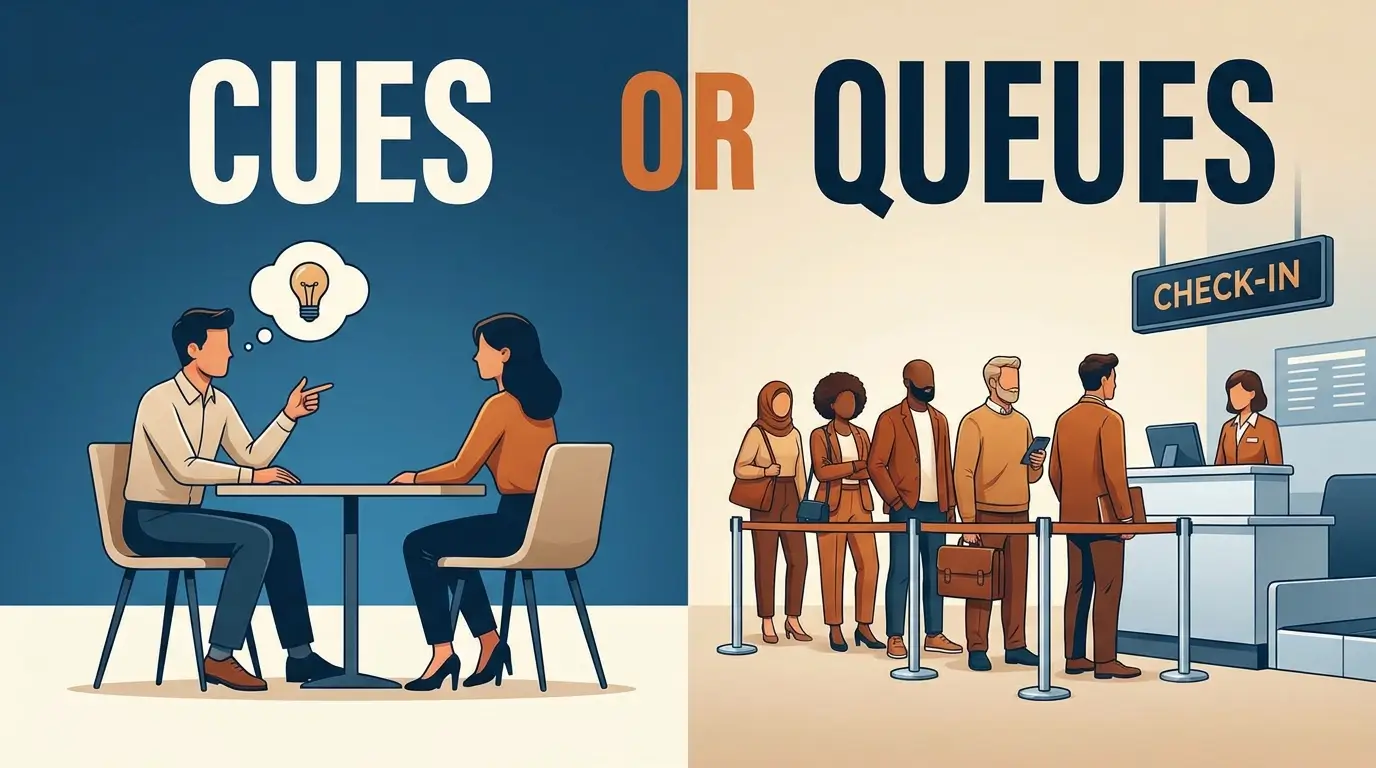
English has many words that sound exactly the same but have completely different meanings. Cues or queues is a perfect example. Both words are pronounced the same, but their meanings, spellings, and uses are very different.
People often search for cues or queues because these words are homophones. You can hear the difference only from context, not from pronunciation. If someone says, “The actor missed his cues,” you need the context to know that they mean signals, not lines of people waiting.
The confusion around cues or queues is especially common in writing. A writer may know the correct pronunciation but still be unsure whether to use cues or queues. The problem becomes even more interesting because cue has several meanings, while queue is used for waiting lines, computer tasks, and related ideas.
Learning cues or queues does not need to be difficult. The key is to connect each spelling with its meaning. Cues are signals, hints, or billiard sticks, while queues are lines or ordered groups waiting for something. Once you learn that basic difference, choosing the correct word becomes much easier.
Quick Answer
Cues is the plural of cue. A cue can be a signal, hint, prompt, or a stick used in billiards or pool. Queues is the plural of queue, meaning lines of people or things waiting or a sequence of items waiting to be processed.
The easiest distinction is:
- Cues = signals, hints, or prompts
- Queues = lines or waiting groups
For example:
The director gave the actors their cues.
The actors received signals telling them when to speak or act.
The customers formed long queues outside the store.
The customers were waiting in lines.
The two words are homophones, meaning they have the same pronunciation but different spellings and meanings.
Cues
Cues can refer to signals that tell someone what to do or when to do it.
The lights gave the performers their cues.
It can also describe hints or signs:
Her facial cues showed that she was uncomfortable.
And in billiards or pool, cues means more than one cue stick.
The club has several spare cues.
Queues
Queues means more than one line or waiting group.
There were long queues at the airport.
It can also describe a sequence of items waiting to be handled.
The computer processed several print queues.
In computing, a queue is an ordered collection of data, files, calls, or jobs waiting to be processed.
Part of Speech
Cues can be:
- a plural noun: The actor waited for his cues.
- a third-person singular verb: The director cues the actors.
Queues can be:
- a plural noun: Several queues formed outside.
- a third-person singular verb: The system queues the requests.
The spelling tells you which word you are using, but the sentence tells you how it functions grammatically.
Pronunciation
Cue and queue are pronounced the same:
/kjuː/
Cambridge gives the same pronunciation for both British and American English.
That means:
- cue → /kjuː/
- queue → /kjuː/
- cues → /kjuːz/
- queues → /kjuːz/
Because cues and queues sound alike, pronunciation cannot tell you which spelling to use. You must understand the meaning and context.
The Origin of Cues or Queues
The words cue and queue have related but distinct histories. Interestingly, one meaning of cue is historically connected to queue, while the theatrical meaning of cue has a different and uncertain origin.
The Origin of Cue
The theatrical and signaling sense of cue dates to the 16th century. Merriam-Webster gives the first known use of this sense as 1553. Its etymology is not completely certain. One established theory connects it with Q, an abbreviation used in actors’ copies of plays, possibly from Latin quando, meaning “when.”
Etymonline also describes this origin as uncertain and notes the theory that cue developed from the letter Q used as a stage direction.
The modern meaning developed from the idea of a signal telling a performer when to speak or act.
The word later expanded beyond theater. A cue can now be any signal or indication that tells someone what to do.
For example:
The sudden silence was my cue to leave.
The Origin of Queue
Queue has a different history. It came into English through French queue, meaning “tail,” from Old French forms such as cue and coe, ultimately related to Latin cauda, meaning “tail.”
The connection to a waiting line comes from the visual idea of people or things arranged one after another, like a tail.
Merriam-Webster explains that English first used queue for a long braid or tail-like arrangement of hair. Later, the word developed its modern meaning of a waiting line.
The modern “line of people” meaning became established in English in the 19th century. Etymonline dates this extended sense to 1837.
Why Do Cues and Queues Sound the Same?
Their pronunciation is similar because English spelling does not always preserve pronunciation differences between words borrowed from different historical sources.
Cue and queue eventually developed the same pronunciation, but their spellings remained different.
This is why English learners cannot rely on sound alone.
Think of it this way:
cue → signal
queue → line
That simple association can prevent most spelling errors.
British English vs American English Spelling
There is a genuine British-American usage difference with queue, but there is no major spelling difference between cue/cues and queue/queues.
Both British and American English spell the words:
- cue
- cues
- queue
- queues
However, queue is much more strongly associated with British English in everyday use for a line of people. American English commonly uses line instead. Cambridge labels queue as mainly UK and notes that US English usually uses line.
| Meaning | British English | American English |
| Signal or prompt | cue | cue |
| Plural of cue | cues | cues |
| Waiting line | queue | queue, but line is usually more common |
| Plural waiting lines | queues | queues, but lines is usually more common |
| Stand and wait | queue / queue up | stand in line / line up |
| Computer sequence | queue | queue |
For example, a British speaker might say:
We waited in a queue for tickets.
An American speaker is more likely to say:
We waited in line for tickets.
However, American English does use queue, especially in computing and technical contexts. It is not an incorrect American word.
What About Cues?
There is no comparable British-American spelling difference for cue.
Both varieties use:
The actor waited for his cue.
Both also use:
The signs provided useful cues.
The pronunciation is also essentially the same.
Which Spelling Should You Use?
The correct spelling depends on what you mean, not on whether you are writing for a British or American audience.
Use Cues for Signals or Hints
Choose cues when you mean:
- signals
- prompts
- hints
- signs
- instructions to act
- billiard or pool sticks
Examples:
The actors missed their cues.
The teacher gave the students visual cues.
The director watched for the right cues.
Use Queues for Lines or Waiting Groups
Choose queues when you mean:
- lines of people
- lines of vehicles
- waiting groups
- ordered tasks
- computer jobs waiting for processing
Examples:
Several queues formed outside the theater.
The airport had long queues.
The server processed the queues one at a time.
US Audience Tip
If you are writing for an American audience, line may sound more natural than queue when talking about people waiting.
Instead of:
We stood in a queue for coffee.
American English commonly uses:
We stood in line for coffee.
But if you are discussing software, queue remains standard:
The application placed the requests in a queue.
UK Audience Tip
For British readers, queue is a normal everyday word.
We had to queue for tickets.
There was a long queue outside the store.
Do not replace queue with cue simply because the words sound identical.
Common Mistakes
Mistake 1: Writing “Cue” for a Waiting Line
Incorrect:
We stood in a long cue.
Correct:
We stood in a long queue.
The word queue refers to the line.
Mistake 2: Writing “Queue” for a Signal
Incorrect:
The actor waited for his queue.
Correct:
The actor waited for his cue.
The actor needs a signal, not a line.
Mistake 3: Confusing “Queue Up” With “Cue Up”
Queue up means to form or join a line, especially in British English.
People queued up outside the store.
Cue up means to prepare or position something so it is ready to start, play, or happen.
She cued up the next song.
These are different phrasal verbs.
Mistake 4: Assuming “Cue” Always Means Theater
A cue can be a signal or hint in many situations.
The dark clouds were a cue to take an umbrella.
His expression was a cue that something was wrong.
The word is not limited to acting.
Mistake 5: Using “Queues” When You Mean Hints
Incorrect:
The teacher gave us several queues to help us solve the problem.
Correct:
The teacher gave us several cues to help us solve the problem.
The clues or hints are cues.
Mistake 6: Assuming Queue Only Refers to People
A queue can also refer to things waiting to be processed.
In computing, files, print jobs, calls, and data can be placed in a queue.
For example:
The printer has five jobs in its queue.
Everyday Examples
These words appear in everyday communication, workplaces, entertainment, technology, and formal writing.
In Emails
Cue:
Please watch for my cue before beginning the presentation.
Here, cue means a signal.
Queue:
Your request has been placed in the processing queue.
Here, queue refers to an ordered group waiting to be handled.
In News Writing
A news report might say:
Falling sales were a cue for the company to review its strategy.
Here, the falling sales acted as a signal.
Another report might say:
Long queues formed outside the stadium before the event.
Here, queues means lines of people.
In Social Media
A social media post might say:
That look was my cue to leave.
The expression is informal but natural.
Another might say:
The queues outside the concert were enormous.
For American readers, lines would often be more natural in this context.
In Formal Writing
In academic writing:
Participants responded to visual cues displayed on the screen.
Here, cues means signals.
In technical writing:
Incoming requests are stored in separate queues before processing.
Here, queues refers to ordered groups of tasks.
In Entertainment
Theater provides one of the clearest examples of cue.
The actor entered on cue.
This means the actor entered when the correct signal occurred.
A director might say:
Wait for your cue.
That means “wait for the signal telling you to begin.”
In Computing
Queue is an important technical term.
A computer system may place jobs into a queue so they can be handled in an organized order.
For example:
The print queue contains several documents.
The documents are waiting to be processed by the printer.
This technical meaning is used in both British and American English.
Key Differences at a Glance
| Feature | Cues | Queues |
| Singular form | cue | queue |
| Pronunciation | /kjuːz/ | /kjuːz/ |
| Main meaning | Signals, hints, prompts | Lines or ordered waiting groups |
| Part of speech | Noun or verb | Noun or verb |
| Example noun | The actor missed his cues. | The queues were long. |
| Example verb | She cues the actors. | The system queues requests. |
| Theater | Signals performers | Not normally used for signals |
| Waiting line | No | Yes |
| Computing | Not normally used for waiting tasks | Yes |
| British usage | Standard | Very common |
| American usage | Standard | Used, but “line” is often preferred for people waiting |
A Simple Memory Trick
If you struggle to remember the difference, use this trick:
CUE = CLUE
Both can involve a signal or hint.
The expression on his face was a cue.
Think:
C = Cue = Clue
For queue, imagine people standing one after another.
People are waiting in a queue.
You can also remember that queue has many letters but only one basic sound. The unusual spelling is a useful visual reminder that it is the “line” word.
Another useful pair is:
Cue up = prepare something.
Queue up = form a line.
Once these two phrases become familiar, the distinction becomes much easier.
FAQs
1. What is the difference between cues and queues?
Cues are signals, hints, or prompts. Queues are lines or ordered groups waiting to be served or processed.
2. Are cues and queues pronounced the same?
Yes. In standard English, cues and queues are homophones and are pronounced /kjuːz/. The context tells you which word is intended.
3. Is a queue British or American?
Queue is especially common in British English for a waiting line. American English usually uses line in everyday situations, although queue is common in computing and technical language.
4. Is “cue” a signal or a line?
Cue normally means a signal, hint, or prompt. It can also mean the stick used in billiards or pool. It does not mean a waiting line.
5. What does “queue up” mean?
Queue up means to form or join a line and wait. It is especially common in British English. American English commonly uses line up.
6. What does “cue up” mean?
Cue up means to prepare something so it is ready to start or play, such as a song, video, or recording. It can also mean to give someone a signal in a performance context.
7. Why do cue and queue have different spellings if they sound the same?
They have different historical origins for their main modern meanings. The theatrical cue has an uncertain origin, with one theory connecting it to a stage abbreviation, while queue came through French from a word meaning “tail.”
Conclusion
Cues and queues sound the same, but their meanings are easy to separate once you connect each spelling to its purpose: cues signal, while queues organize waiting lines or tasks.
Use cues for hints, signals, prompts, and performance instructions. Use queues for lines of people, waiting items, or computer tasks ready for processing.
The British-American difference is mainly about everyday preference: British English often says queue, while American English commonly says line for people waiting.
Keep practicing these homophones in emails, essays, and daily conversations. A little practice will make the correct spelling feel natural and automatic.

Aamer Shahzad is the founder of Diffnexx.com, a fast-growing educational platform focused on high-intent “difference between” topics. With over 8 years of experience in English language education and analytical writing, I specialize in breaking down complex “difference between” topics into clear, structured, and easy-to-understand explanations. Diffnexx.com is your go-to resource for enhancing English skills and writing with confidence.
I specializes in building search-optimized, research-driven comparison content designed for clarity, authority, and long-term digital asset value.







