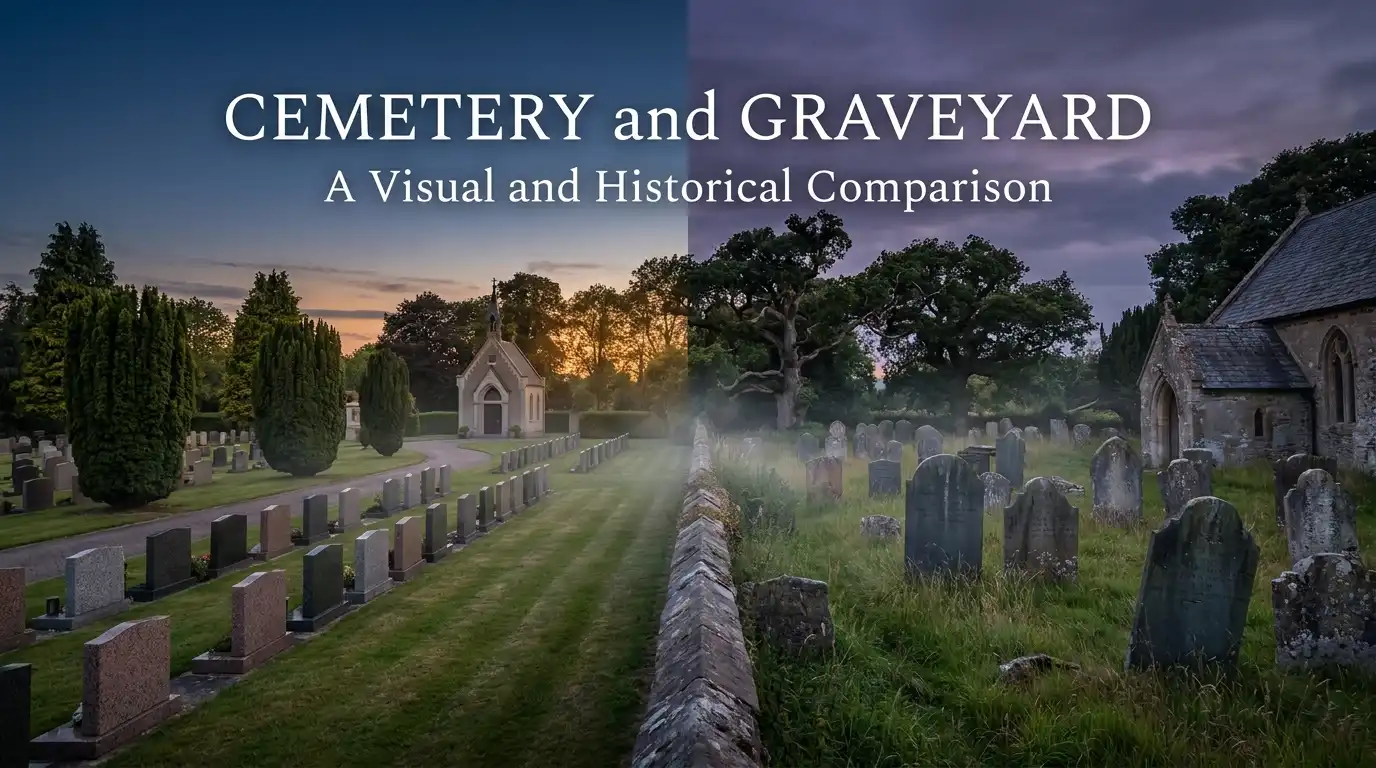
When two words describe almost the same place, choosing the right one can be surprisingly hard. The difference between cemetery and graveyard is a good example. Both words refer to places where dead people are buried, and in everyday English, they are often used interchangeably.
People often search for the difference between cemetery and graveyard because the words carry slightly different historical and cultural associations. A cemetery is usually understood as a general burial ground, while a graveyard traditionally refers to a burial place associated with a church.
The difference between cemetery and graveyard is not an absolute modern rule, however. Dictionaries recognize graveyard as a synonym for cemetery, while also noting its common association with churches.
Understanding the difference between cemetery and graveyard can help you choose a word that fits the setting, tone, and purpose of your writing. It also prevents common spelling errors such as cemetary and helps you understand why an old church burial ground may be called a graveyard while a large public burial site is called a cemetery.
Quick Answer
The simplest way to understand the difference between cemetery and graveyard is this:
- Cemetery = a place where dead people are buried, generally used as a broad and neutral term.
- Graveyard = a burial place, traditionally one associated with or located beside a church.
Oxford defines cemetery as an area used for burying dead people, especially one that is not next to a church. Cambridge similarly defines graveyard as a place where dead people are buried, often next to a church.
Consider these examples:
The city opened a new cemetery outside the town.
The old church has a small graveyard behind it.
In the first sentence, the burial ground is presented as a general facility. In the second, the word graveyard fits the traditional church setting.
However, do not treat this as a strict rule. Modern dictionaries also list cemetery as a synonym of graveyard, and real-world usage often overlaps.
The Origin of Cemetery and Graveyard
The different histories of these words help explain why they developed different associations.
Where does “cemetery” come from?
Cemetery has a long linguistic history. It entered English through Old French and Medieval Latin from the Greek koimētērion, meaning a “sleeping place” or “dormitory.” The Greek term is related to a verb meaning “to put to sleep.”
The word later became associated with a place where the dead were laid to rest. Etymological sources note that early Christian writers used the term for burial grounds.
This history gives cemetery a much older and less literal origin than graveyard. It does not simply mean “a yard containing graves.” Instead, its history reflects an older metaphor of death as sleep or rest.
By the 19th century, cemetery was commonly associated with larger public burial grounds that were not attached to churches.
Where does “graveyard” come from?
Graveyard is much easier to understand from its parts:
grave + yard
The word grave refers to a place where a dead body is buried, while yard historically referred to an enclosed or defined area of land. Etymological sources trace graveyard to this English compound.
Merriam-Webster records graveyard as a noun meaning cemetery, showing how closely the two words overlap in modern English.
The traditional association of graveyard with churches developed from the common practice of burying people in burial grounds around churches. Today, however, the word can be used more broadly.
Why are there two words?
English often keeps multiple words for similar ideas when those words enter the language through different historical paths.
Cemetery came through Greek, Latin, French, and Middle English. Graveyard was formed from native English elements.
Their histories also encouraged different associations:
- Cemetery → a designated burial ground
- Graveyard → a burial ground traditionally connected with a church
The distinction became especially useful as dedicated burial grounds developed outside church grounds. Still, modern usage has blurred the boundary.
Pronunciation and Part of Speech
Both cemetery and graveyard are nouns.
They can function as the subject or object of a sentence:
The cemetery is closed after sunset.
We visited the graveyard yesterday.
They can also follow prepositions:
She was buried in the cemetery.
The church stands beside the graveyard.
How do you pronounce “cemetery”?
Cemetery is commonly pronounced with three or four syllables depending on the variety and pronunciation style. Cambridge gives /ˈsem.ə.tri/ for UK English and /ˈsem.ə.ter.i/ for US English.
The stress falls on the first syllable.
How do you pronounce “graveyard”?
Graveyard is a compound word. Cambridge gives /ˈɡreɪv.jɑːd/ in UK English and /ˈɡreɪv.jɑːrd/ in US English.
Unlike cemetery and graveyard in meaning, their pronunciation is not especially confusing. They sound clearly different.
British English vs American English Spelling
There is no important British-versus-American spelling difference between cemetery and graveyard.
Both varieties use:
- cemetery
- graveyard
The pronunciation of cemetery can differ slightly between British and American English, but the spelling remains the same. Cambridge lists different pronunciation forms for the two varieties.
| Word | British English | American English |
|---|---|---|
| Cemetery | cemetery | cemetery |
| Graveyard | graveyard | graveyard |
| Spelling difference | None | None |
| Main variation | Pronunciation | Pronunciation |
This means you should not change the spelling based on whether your readers are from the UK or the US.
One spelling mistake deserves special attention:
❌ cemetary
✅ cemetery
The correct spelling contains -etery, not -etary.
Which Spelling Should You Use?
Because there is no UK/US spelling difference, the real choice is about word meaning and context.
For US readers
Use cemetery when referring to a modern, public, private, military, or municipal burial ground.
Example:
The veterans are buried in the national cemetery.
Use graveyard when the setting is informal, historic, literary, or associated with a church.
For UK and Commonwealth readers
The same basic advice works. Cemetery is a standard general term, while graveyard can suggest an older burial ground, especially one associated with a church.
Example:
The village church has an old graveyard.
For global English
If you are writing for an international audience, cemetery is usually the safest general term.
Choose graveyard when the setting itself matters.
For example:
The archaeological team discovered an ancient cemetery.
is neutral.
But:
The old graveyard surrounds the village church.
creates a more specific picture.
Common Mistakes with Cemetery and Graveyard
1. Thinking they can never mean the same thing
This is one of the biggest mistakes.
Modern dictionaries recognize considerable overlap between the two words. Merriam-Webster directly defines graveyard as cemetery.
So it is too strict to say that one word is always correct and the other is always wrong.
2. Assuming every graveyard must have a church
The church connection is a traditional association, not an absolute rule for every modern use.
Cambridge uses “often next to a church,” rather than saying a graveyard must always be beside one.
3. Writing “cemetary”
This is a very common spelling error.
❌ The family visited the cemetary.
✅ The family visited the cemetery.
4. Assuming cemetery means a non-religious burial place
A cemetery does not automatically mean that the people buried there were non-religious. The word describes the burial ground itself, not the beliefs of every person buried there.
5. Using “graveyard” only for spooky places
Movies and stories often connect graveyard with ghosts, darkness, or horror. That is a cultural association, not the basic dictionary meaning.
A graveyard can simply be a peaceful historic burial ground.
6. Thinking size determines the word
It is tempting to say that graveyards are always small and cemeteries are always large. That can be a useful visual stereotype, but it is not a reliable linguistic rule.
The stronger distinction is traditional setting and usage, especially the church association.
Cemetery and Graveyard in Everyday Examples
The choice between these words becomes easier when you see them in real writing situations.
In emails
Please confirm the time of the memorial service at the cemetery.
Here, cemetery sounds neutral and appropriate for practical communication.
Another example:
We plan to visit the old graveyard after the church service.
Here, graveyard fits the church setting.
In news writing
City officials announced plans to expand the local cemetery.
Cemetery works well in news writing because it is neutral and broadly understood.
On social media
We discovered a beautiful old graveyard while walking through the village.
Graveyard can sound natural and descriptive in a personal post.
In formal writing
The cemetery contains graves dating from several periods of local history.
This sentence uses the more general term and works well in an academic or historical context.
In historical writing
The church graveyard contains several old headstones.
Here, graveyard highlights the connection between the burial place and the church.
In literature
They walked quietly through the graveyard as the evening light faded.
Graveyard can create a stronger traditional or atmospheric image than cemetery. This is a matter of style, not a different basic definition.
Cemetery vs Graveyard: Comparison Table
| Feature | Cemetery | Graveyard |
|---|---|---|
| Part of speech | Noun | Noun |
| Basic meaning | Place where the dead are buried | Place where the dead are buried |
| Traditional church connection | Not required | Often associated with a church |
| Modern usage | Very broad | Broad, with traditional associations |
| Formal writing | Very common | Acceptable, but often more descriptive |
| Casual speech | Common | Common |
| Historical feeling | Neutral | Often stronger |
| British spelling | cemetery | graveyard |
| American spelling | cemetery | graveyard |
| UK/US spelling difference | None | None |
| Common spelling error | cemetary | Usually none |
The table shows the most useful practical rule: cemetery is the broader neutral choice, while graveyard often carries a church-related or historical association.
Are Cemetery and Graveyard Synonyms?
Yes. In many situations, they can be used as synonyms.
For example:
My grandfather is buried in the cemetery.
and:
My grandfather is buried in the graveyard.
Both clearly tell the reader that the grandfather was buried in a burial ground.
However, word choice can still affect the image created in the reader’s mind.
Cemetery often sounds neutral, official, or modern.
Graveyard can sound older, smaller, more local, or more closely linked to a church.
Dictionary sources support this overlap. Merriam-Webster lists cemetery as a synonym of graveyard, while Cambridge describes graveyard as a place where people are buried, often next to a church.
So, the best approach is not to memorize an absolute rule. Instead, understand the traditional distinction and then consider the context.
Search Intent and Everyday Usage
People searching for the difference between cemetery and graveyard are usually trying to solve a simple vocabulary problem: they want to know whether the words are interchangeable and, if not, when each one is more accurate.
The search itself does not prove that one term is more popular than the other. Without reliable live search data, it would be misleading to claim specific search volumes, rankings, percentages, or regional statistics.
For language learners, the practical takeaway is more useful:
- Cemetery is a safe general word.
- Graveyard is also correct for a burial ground.
- Graveyard traditionally suggests a church-associated burial place.
- Modern speakers often use the two words interchangeably.
- Neither word has a special British or American spelling.
Frequently Asked Questions
1. What is the main difference between cemetery and graveyard?
A cemetery is a general term for a burial ground. A graveyard traditionally refers to a burial place associated with a church, although modern usage often overlaps.
2. Are cemetery and graveyard synonyms?
Yes. They can be synonyms in many contexts. Graveyard is also listed as a synonym of cemetery in major dictionaries.
3. Is a graveyard always next to a church?
No. A graveyard is often associated with a church, but “often” does not mean “always.” Modern usage can be broader.
4. Is “cemetary” a correct spelling?
No. Cemetery is the correct spelling. Cemetary is a common misspelling.
5. Is cemetery British or American English?
Cemetery is used in both British and American English. The spelling does not change between the two varieties.
6. Which word is better for formal writing?
Cemetery is usually the safer general choice in formal writing. Use graveyard when the church connection, history, or descriptive setting is important.
7. Does graveyard mean a spooky place?
Not necessarily. Horror stories often use graveyard because of its atmosphere, but the normal meaning is simply a place where people are buried.
Conclusion
The difference between cemetery and graveyard is real, but it is not a strict modern rule. Both words can describe a place where people are buried.
A cemetery is the broader and more neutral term, while graveyard traditionally suggests a burial ground linked to a church.
Both words are nouns, and neither has a special British or American spelling. The main variation is in meaning, context, and pronunciation.
Once you understand this small distinction, your word choice becomes easier. Practice these terms in emails, essays, and daily conversations to make your English more natural and confident.

Anton Reyes is a contributing writer at DiffNexx.com, where he explores meaningful differences in language, culture, and everyday concepts. With a background in creative nonfiction, Anton brings clarity and balance to complex comparisons. His writing helps readers understand subtle distinctions in words and ideas, making learning both insightful and engaging.







