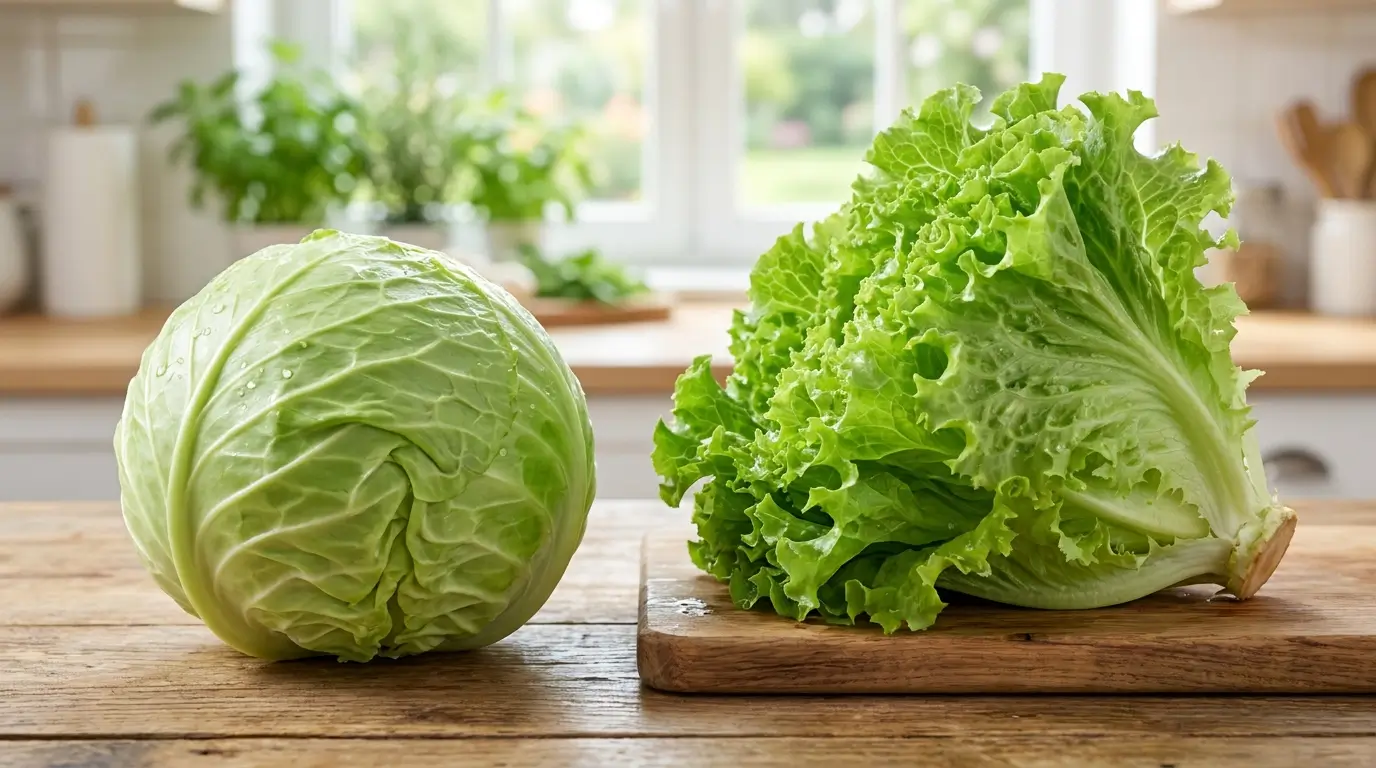
At first glance, cabbage and lettuce can look like close relatives. Both are leafy vegetables, both can appear in salads, and both may form round or compact heads. So, what is the real difference between cabbage and lettuce?
People often search for the difference between cabbage and lettuce because the two vegetables are used in similar meals. They can both be shredded, served raw, added to sandwiches, or mixed with other vegetables. Yet they come from different plant families and behave very differently in the kitchen.
The difference between cabbage and lettuce becomes clearer when you look at their leaves, texture, taste, growing habits, and botanical classification. Cabbage belongs to the Brassica group, while lettuce belongs to the Lactuca group. USDA sources classify both as vegetables, but they are botanically distinct plants.
Understanding the difference between cabbage and lettuce can help you choose the right ingredient for a salad, wrap, soup, stir-fry, or cooked dish. It also makes it easier to explain why cabbage usually feels firmer and more substantial, while lettuce is often softer, lighter, and more delicate.
Quick Answer
The simplest difference between cabbage and lettuce is that they are different vegetables from different plant groups.
Cabbage is a Brassica vegetable. Common cabbage forms a dense head of thick leaves and is closely related to vegetables such as broccoli, cauliflower, kale, and Brussels sprouts. USDA’s Brassica collection identifies common green, red, and white cabbages within Brassica oleracea.
Lettuce belongs to the species Lactuca sativa. It includes types such as iceberg, romaine, butterhead, and leaf lettuce.
Here is a quick comparison:
| Feature | Cabbage | Lettuce |
|---|---|---|
| Botanical group | Brassica | Lactuca |
| Common species | Brassica oleracea | Lactuca sativa |
| Texture | Firm and crisp | Usually softer and more delicate |
| Flavor | Mild, peppery, or slightly sweet | Mild, fresh, and watery |
| Common use | Slaws, soups, stir-fries, cooked dishes | Salads, sandwiches, wraps |
| Can be cooked? | Yes, very commonly | Yes, but usually eaten raw |
| Storage | Generally keeps well | More delicate and perishable |
For example:
I used cabbage to make coleslaw.
I added lettuce to the sandwich.
Both are leafy vegetables, but they serve different culinary roles.
The Origin of Cabbage and Lettuce
The words cabbage and lettuce have completely different histories. Their origins also reflect different ideas about the plants.
Where does “cabbage” come from?
The English word cabbage dates to Middle English forms such as caboche and entered English from Old North French caboche, meaning “head” or “noggin.” The word is ultimately related to Latin caput, meaning “head.”
This origin makes sense because cabbage develops a compact head of leaves.
The modern noun cabbage refers to several cultivated Brassica vegetables, especially headed forms of Brassica oleracea. Merriam-Webster also records other meanings of cabbage, including slang uses, but the vegetable meaning is the one relevant here.
The word has been used in English since the 15th century.
Where does “lettuce” come from?
Lettuce has a very different origin. The English word comes through Old French laitues/laitue from Latin lactuca, meaning “lettuce.” The Latin name is connected with lac, meaning “milk,” referring to the milky sap produced by the plant.
So, the two names have different histories:
- Cabbage → linked historically with the idea of a head
- Lettuce → linked historically with milk or milky sap
The words therefore do not share a linguistic origin, even though the vegetables can look somewhat alike.
Why are cabbage and lettuce sometimes confused?
Their similar appearance is the main reason.
Some cabbage varieties and head lettuces both form rounded heads made from overlapping leaves. Iceberg lettuce, for example, can look surprisingly similar to green cabbage from a distance.
But appearance alone does not determine botanical identity. USDA sources list cabbage under Brassica and lettuce under Lactuca, confirming that they are distinct crops.
Cabbage vs Lettuce: Pronunciation and Part of Speech
Both cabbage and lettuce are nouns when they refer to the vegetables.
You can use them as subjects or objects:
Cabbage grows well in cool conditions.
We bought some lettuce for the salad.
They can also appear before another noun:
cabbage soup
lettuce leaves
How do you pronounce “cabbage”?
Cabbage is commonly pronounced with two syllables. The first syllable receives the main stress.
It sounds roughly like CAB-ij.
The final -age does not sound like the “age” in page.
How do you pronounce “lettuce”?
Lettuce also has two syllables, with stress on the first syllable.
It sounds roughly like LET-iss in many varieties of English.
The words do not sound alike, so pronunciation is not a major source of confusion. The confusion usually comes from their similar appearance and overlapping culinary uses.
British English vs American English Spelling
There is no meaningful British-versus-American spelling difference between cabbage and lettuce.
Both British English and American English use:
- cabbage
- lettuce
The pronunciation can vary slightly by accent, but the written forms remain the same.
| Word | British English | American English |
|---|---|---|
| Cabbage | cabbage | cabbage |
| Lettuce | lettuce | lettuce |
| Spelling difference | None | None |
| Major regional issue | None | None |
This means you should not change either word depending on whether you are writing for readers in the United States, United Kingdom, Canada, Australia, or another English-speaking region.
Unlike words such as colour/color or centre/center, cabbage and lettuce have no standard UK/US spelling variation.
Which Spelling Should You Use?
Since there is no regional spelling difference, the important thing is to use the word that describes the correct vegetable.
For US readers
Use cabbage when you mean a Brassica vegetable with firm leaves and, in many varieties, a compact head.
Use lettuce for Lactuca sativa, including iceberg, romaine, and leaf lettuce.
For UK and Commonwealth readers
The same spellings and basic meanings apply.
For example:
We bought a cabbage for the soup.
She added lettuce to the sandwich.
There is no need to change the spelling for British English.
For global English
The same rule works well worldwide.
If you are unsure which word to use, focus on the plant rather than the country of your audience. The words themselves are internationally recognizable.
Common Mistakes with Cabbage and Lettuce
1. Assuming cabbage and lettuce are the same plant
They are not.
Cabbage belongs to the Brassica group, while lettuce belongs to Lactuca. USDA plant resources place cabbage varieties within Brassica and identify Lactuca sativa as garden lettuce.
2. Calling every leafy green “lettuce”
Not every leafy vegetable is lettuce.
Spinach, kale, cabbage, collard greens, and many other vegetables have leaves but belong to different plant groups.
3. Assuming all cabbage is green
Cabbage can be green, red, or other cultivated types. USDA’s Brassica collection specifically lists green, white, and red cabbage forms.
4. Assuming all lettuce forms a round head
Lettuce comes in several types. Some form compact heads, while leaf varieties have loose leaves.
USDA sources identify multiple lettuce types, including romaine, leaf lettuce, and head lettuce.
5. Thinking cabbage is only eaten raw
Cabbage is widely eaten both raw and cooked.
It can be:
- shredded into slaw
- added to soups
- stir-fried
- steamed
- braised
- fermented
Lettuce is more commonly served raw, although some varieties can also be cooked.
6. Treating iceberg lettuce and cabbage as interchangeable
They can sometimes provide a similar crunch, but they are not identical.
Iceberg lettuce has a lighter, more watery texture. Cabbage is generally firmer and holds its structure better during cooking.
Cabbage and Lettuce in Everyday Examples
The difference becomes easier to understand when the words appear in normal sentences.
In emails
Please add shredded cabbage to the vegetable order.
This sounds natural when discussing ingredients or food supplies.
Another example:
Please buy fresh lettuce for tomorrow’s lunch.
Here, lettuce clearly refers to a salad or sandwich ingredient.
In news writing
Farmers are preparing cabbage crops for the winter market.
The word cabbage works naturally in an agricultural context.
Another example:
Lettuce prices have affected the cost of fresh salads.
Both words can appear in food and agriculture reporting.
On social media
Made a crunchy cabbage slaw for dinner tonight!
Or:
Fresh lettuce, tomatoes, and cucumber made this salad perfect.
The context makes the difference easy to see.
In formal writing
Cabbage and lettuce are both commonly classified as vegetables, but they belong to different botanical groups.
USDA resources classify both crops within the vegetable category while distinguishing their botanical identities.
In recipes
Cabbage is often selected when a recipe needs a vegetable that can withstand heat.
For example:
Add the chopped cabbage and cook until tender.
Lettuce is often selected when the recipe needs fresh, crisp leaves.
Place the lettuce leaves on the plate and add the filling.
Cabbage vs Lettuce: Texture, Taste, and Cooking
The practical difference is especially clear in the kitchen.
Texture
Cabbage usually has firmer, thicker leaves. It can remain crisp even after being shredded.
Lettuce tends to have more delicate leaves, although texture varies by type. Iceberg lettuce is crisp and watery, while butterhead lettuce is softer.
Taste
Cabbage has a mild flavor that can become sweeter when cooked. Some varieties also have a slightly peppery or sulfur-like note.
Lettuce usually has a mild, fresh flavor. Some varieties can develop a slight bitterness, especially as the plant matures.
Cooking
Cabbage is highly useful in cooked dishes because its leaves can tolerate heat.
Lettuce is more often used fresh in:
- salads
- burgers
- sandwiches
- wraps
- tacos
USDA nutrition resources recognize both cabbage and lettuce as vegetables, while research on lettuce notes that nutritional composition can vary considerably among lettuce types and cultivars.
Cabbage vs Lettuce: Nutritional Differences
Both vegetables can contribute useful nutrients to a balanced diet, but their nutritional profiles are not identical.
USDA guidance lists vegetables as sources of nutrients such as dietary fiber, folate, potassium, vitamin A, and vitamin C.
Lettuce nutrition also varies by type. USDA-published research notes that romaine and red lettuce can differ from crisphead lettuce in their nutrient and bioactive compound content.
This means it is not accurate to say that one vegetable is always “healthier” than the other. The variety, serving size, preparation method, and overall diet all matter.
For everyday eating, both can be useful additions to meals.
Cabbage vs Lettuce: Comparison Table
| Feature | Cabbage | Lettuce |
|---|---|---|
| Botanical genus | Brassica | Lactuca |
| Common species | Brassica oleracea | Lactuca sativa |
| Plant family | Brassicaceae | Asteraceae |
| Typical texture | Firm, dense, crisp | Crisp to soft, depending on type |
| Typical flavor | Mild, slightly sweet or peppery | Mild, fresh, sometimes slightly bitter |
| Common raw use | Slaw, salads | Salads, sandwiches, wraps |
| Common cooked use | Soups, stir-fries, braises | Less common |
| Head-forming varieties | Common | Common in some types |
| Examples | Green, red, Savoy, Napa | Iceberg, romaine, butterhead, leaf |
| UK spelling | cabbage | lettuce |
| US spelling | cabbage | lettuce |
The most important distinction is botanical: cabbage and lettuce are not two names for the same vegetable.
Is Cabbage Healthier Than Lettuce?
There is no simple winner.
Both can be part of a healthy diet, but different varieties offer different nutrient profiles. Lettuce types can vary significantly in their nutrient content, while cabbage varieties also differ in composition.
USDA guidance emphasizes vegetables as important sources of nutrients and recommends including a variety of vegetables in the diet.
So instead of asking which one is always better, ask which one fits your meal.
Choose cabbage when you want:
- more cooking strength
- a firm texture
- slaw or fermented preparations
- a vegetable that holds up well in soups and stir-fries
Choose lettuce when you want:
- fresh leaves
- salad greens
- sandwich filling
- wraps
- a light, crisp texture
Frequently Asked Questions
1. What is the main difference between cabbage and lettuce?
Cabbage and lettuce are different vegetables from different botanical groups. Cabbage belongs to Brassica, while lettuce belongs to Lactuca.
2. Can cabbage and lettuce be used in the same recipes?
Sometimes. Both can provide fresh crunch in salads, wraps, and sandwiches, but cabbage is generally firmer and better suited to cooking.
3. Is cabbage a type of lettuce?
No. Cabbage is not lettuce. Cabbage belongs to the Brassica group, while lettuce belongs to Lactuca.
4. Which is crunchier, cabbage or lettuce?
It depends on the variety. Iceberg lettuce is very crisp, but cabbage usually has a firmer and denser texture that holds up well when shredded or cooked.
5. Is cabbage healthier than lettuce?
Neither is automatically healthier. Their nutrient profiles differ by variety, and both can contribute useful nutrients to a balanced diet.
6. Are cabbage and lettuce spelled differently in British and American English?
No. Both varieties of English use cabbage and lettuce with the same spelling.
7. Can you cook lettuce like cabbage?
Some lettuce can be cooked, but lettuce is more commonly eaten raw. Cabbage is generally better suited to cooking because its firmer leaves tolerate heat well.
Conclusion
The difference between cabbage and lettuce is easy to see once you look beyond their similar appearance. They are different plants with different textures, flavors, and culinary uses.
Cabbage belongs to the Brassica group and is usually firm and dense. Lettuce belongs to Lactuca and is often softer, lighter, and used fresh in salads or sandwiches.
Neither vegetable is automatically better than the other. Each has a place in a balanced diet, and the best choice depends on your recipe, texture preference, and cooking method.
Once you know the difference, these two everyday words become simple to use. Practice them in recipes, emails, essays, and daily conversations to make your English more natural.

Aamer Shahzad is the founder of Diffnexx.com, a fast-growing educational platform focused on high-intent “difference between” topics. With over 8 years of experience in English language education and analytical writing, I specialize in breaking down complex “difference between” topics into clear, structured, and easy-to-understand explanations. Diffnexx.com is your go-to resource for enhancing English skills and writing with confidence.
I specializes in building search-optimized, research-driven comparison content designed for clarity, authority, and long-term digital asset value.







