Many people use sperm and semen as if they mean the same thing. They are related, but they are not the same. This small difference can cause confusion in health articles, school lessons, medical discussions, and everyday conversations.
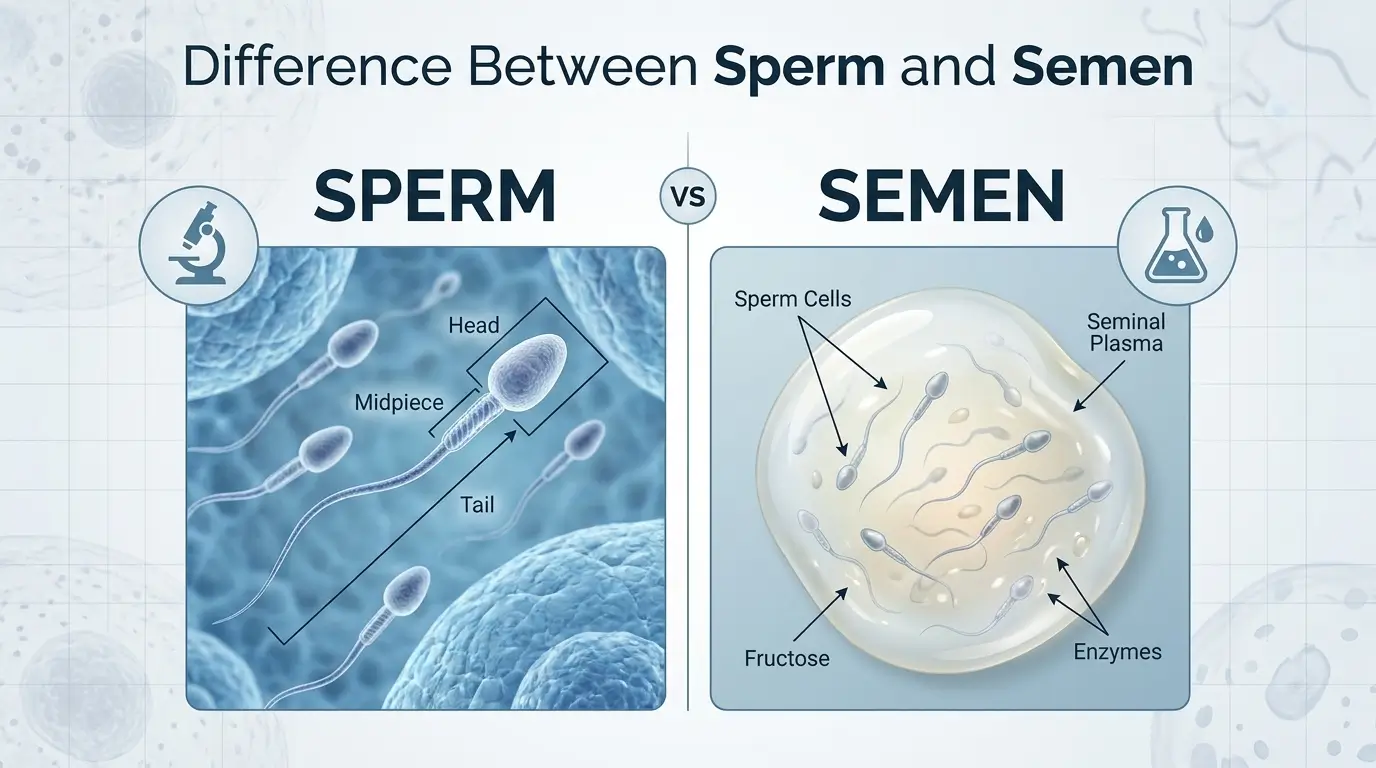
The easiest way to understand the difference between sperm and semen is to remember that sperm are reproductive cells, while semen is the fluid that carries sperm out of the male reproductive system. In other words, sperm are one part of semen.
Understanding the difference between sperm and semen also helps explain how reproduction works. Sperm cells are made in the testes, while most of the fluid in semen comes from glands such as the seminal vesicles and prostate gland. Each has a different role.
If you have ever wondered whether semen is made only of sperm, or whether sperm and semen can be used as interchangeable words, this guide will make the answer simple. By the end, the difference between sperm and semen should be easy to remember and use correctly.
Quick Answer
The main difference between sperm and semen is what each term describes.
Sperm are microscopic reproductive cells. They contain genetic material from the male and can join with an egg during sexual reproduction.
Semen is the whitish or grayish fluid released from the penis during ejaculation. It contains sperm along with fluids produced by several reproductive glands.
A simple way to remember it is:
Sperm are cells. Semen is a fluid that carries those cells.
For example:
- “Sperm can fertilize an egg.”
- “Semen is released during ejaculation.”
- “Semen contains sperm.”
- “Sperm are produced in the testes.”
So, semen is not another name for sperm. Sperm are components of semen.
| Feature | Sperm | Semen |
| What is it? | Reproductive cell | Reproductive fluid |
| Main role | Carries genetic material | Carries and supports sperm |
| Where is it made? | Mainly in the testes | Formed from fluids from reproductive glands, with sperm added |
| Visible to the naked eye? | No | Usually yes |
| Contains sperm? | It is sperm | Yes, when sperm are present |
| Part of speech | Noun | Noun |
The Origin of Sperm and Semen
The words sperm and semen have different linguistic histories.
Sperm comes from Greek sperma, meaning “seed.” The word entered scientific and medical English through Latin and later scientific usage. The idea of “seed” fits its reproductive meaning because sperm cells carry genetic material used in reproduction.
Semen comes from Latin semen, meaning “seed.” It is related to the same broad idea of reproduction but developed as a term for the reproductive fluid.
The two words therefore have connected meanings, but they did not develop into exact synonyms in modern English. Biology gives them separate meanings: sperm refers to the reproductive cells, while semen refers to the fluid in which sperm are transported.
There is no meaningful British-versus-American spelling difference for these two words. Sperm is spelled sperm in both varieties, and semen is spelled semen in both.
Pronunciation
The words do not sound alike.
Sperm is a short, one-syllable word.
Semen has two syllables in common English pronunciation.
The main pronunciation challenge is usually not hearing the difference but remembering the difference in meaning. In careful speech, make the two syllables of semen clear and avoid treating it as another pronunciation of sperm.
Parts of Speech
Both sperm and semen are primarily nouns.
Sperm names a type of reproductive cell. In biology, sperm is often treated as a mass noun when referring to sperm generally.
Examples:
- “Sperm can survive for a limited time under suitable conditions.”
- “The sperm cell carries genetic material.”
Semen is also a noun. It names the reproductive fluid.
Examples:
- “The laboratory examined the semen sample.”
- “Semen contains fluid from several reproductive glands.”
Knowing the part of speech helps because neither word normally functions as a verb in standard everyday English.
British English vs American English Spelling
There is no important British English vs American English spelling difference between sperm and semen.
Both British and American English use:
- sperm
- semen
The same spellings are also widely used in medical and scientific writing around the world.
| Word | British English | American English | Difference |
| Sperm | sperm | sperm | None |
| Semen | semen | semen | None |
This is different from words such as colour/color or centre/center, where British and American spelling can differ.
Because sperm and semen have stable scientific spellings, there is no need to change the spelling based on whether your audience is in the United Kingdom or the United States.
Which Spelling Should You Use?
Use sperm when you mean the reproductive cells.
Use semen when you mean the fluid that carries sperm.
Your choice does not depend on British or American English. It depends on what you are describing.
For a US audience, use the standard forms:
- sperm
- semen
For a UK or Commonwealth audience, use the same forms:
- sperm
- semen
while for global readers, these terms are also the best choices because they are standard biological and medical terms.
If you are writing an essay, report, health article, or educational text, be precise. Saying “semen cells” when you mean sperm cells can create confusion because semen itself is not a collection of cells. It is a fluid containing sperm and other substances.
Common Mistakes with Sperm and Semen
Several mistakes happen because the two terms are closely connected.
Mistake 1: Treating sperm and semen as synonyms
Incorrect idea:
“Sperm is the fluid released during ejaculation.”
Better:
“Semen is the fluid released during ejaculation, and it can contain sperm.”
Sperm are cells. Semen is the fluid that carries them.
Mistake 2: Saying semen is made only of sperm
Semen contains sperm, but sperm are not the only component.
Semen also contains fluids from reproductive glands. These fluids help provide an environment for sperm and assist their movement.
Mistake 3: Calling sperm a liquid
Sperm are individual reproductive cells. They are microscopic and cannot normally be seen as separate cells without magnification.
Semen, by contrast, is a visible fluid.
Mistake 4: Assuming all semen contains sperm
A semen sample does not necessarily contain sperm. For example, a person may have no sperm in their semen because of certain medical conditions, previous procedures, or other biological factors.
Therefore, “semen” describes the fluid, not a guarantee that sperm are present.
Mistake 5: Using “sperm” when discussing the whole ejaculate
In casual conversation, people may use sperm to mean the fluid released during ejaculation. In precise medical or scientific writing, however, semen is the better term for the fluid.
Everyday Examples
These words appear in different kinds of writing. Using the correct term makes your meaning clearer.
In an email
A medical or laboratory email might say:
“The semen sample has been received for analysis.”
Here, semen is correct because the laboratory is referring to the fluid sample.
Another example:
“The test measures several characteristics of sperm.”
Here, sperm is correct because the focus is on the reproductive cells.
In news writing
A health article might say:
“Researchers studied sperm movement under laboratory conditions.”
The subject is the movement of sperm cells.
Another report might say:
“The researchers collected semen samples from participants.”
The subject is the collected reproductive fluid.
In social media
Informal posts may use sperm and semen loosely. However, if you want to share accurate health information, keep the distinction clear.
For example:
“Semen contains sperm, but the two terms do not mean the same thing.”
That short sentence gives the correct idea.
In formal writing
Scientific and academic writing should be especially precise.
Good:
“Sperm cells carry paternal genetic material.”
Good:
“Semen contains secretions from several reproductive glands.”
Less precise:
“Sperm is the fluid that carries sperm.”
The last sentence uses sperm for both the cells and the fluid, which can confuse readers.
What Is Sperm?
Sperm are male reproductive cells. A mature sperm cell is highly specialized for reproduction.
A typical sperm cell has three main regions:
- Head – contains the nucleus and genetic material.
- Midpiece – contains many mitochondria that provide energy.
- Tail – helps the sperm move.
Sperm are produced through a process called spermatogenesis, which occurs in the testes.
Their main reproductive function is to deliver genetic material to an egg. If a sperm successfully fertilizes an egg, the genetic material from the sperm and egg combines.
Sperm are extremely small. A single sperm cell cannot normally be seen without magnification.
What Is Semen?
Semen is a reproductive fluid. It is made from secretions produced by several structures in the male reproductive system, together with sperm that have entered the fluid.
Important contributors include the seminal vesicles and prostate gland, along with smaller contributions from other reproductive structures.
Semen helps transport sperm through the reproductive tract and out of the body during ejaculation.
Its composition can vary between individuals and between different ejaculations. Therefore, semen should not be thought of as one fixed substance with exactly the same composition every time.
This also explains why semen and sperm should not be treated as identical terms.
How Sperm and Semen Work Together
The easiest way to understand their relationship is to think of cells inside a transport fluid.
Sperm are the reproductive cells that carry genetic information.
Semen is the fluid that carries those cells.
During ejaculation, sperm from the reproductive tract mix with secretions from reproductive glands. The resulting fluid is semen.
This means the relationship can be written simply:
Sperm + reproductive gland fluids = semen
That is a simplified explanation rather than a complete chemical formula, but it is useful for remembering the basic distinction.
Sperm vs Semen: Key Differences
| Category | Sperm | Semen |
| Definition | Male reproductive cell | Fluid containing reproductive secretions and, normally, sperm |
| Biological type | Cell | Fluid |
| Genetic material | Contains genetic material | Contains sperm that carry genetic material |
| Production | Sperm are formed in the testes | Semen forms from glandular fluids mixed with sperm |
| Appearance | Microscopic | Usually visible as a fluid |
| Main function | Fertilization | Transport and support of sperm |
| During ejaculation | Released as part of semen | Released as the ejaculatory fluid |
| Can exist without sperm? | Not applicable | Yes, semen can lack sperm |
| Correct general term | Sperm cell | Semen |
Why the Difference Matters
This distinction is more than a vocabulary lesson.
In medical writing, the terms can describe different things being tested or discussed. A semen analysis, for example, examines a semen sample and can assess sperm-related characteristics such as concentration, movement, and shape.
In biology, the distinction is also important because sperm and semen have different structures and functions.
Understanding the terms can therefore help you read health information without misunderstanding what a doctor, teacher, researcher, or article is describing.
It is also useful when talking about fertility. Fertility problems can involve sperm production or sperm function, while semen refers to the fluid in which sperm are carried. These are related but separate concepts.
Frequently Asked Questions
1. Is sperm the same as semen?
No. Sperm are reproductive cells, while semen is the fluid that carries sperm and contains secretions from reproductive glands.
2. Does semen always contain sperm?
No. Semen can be released without detectable sperm. Several biological or medical factors can lead to an absence of sperm in a semen sample.
3. Are sperm cells visible?
Individual sperm cells are microscopic. They cannot normally be seen separately with the naked eye.
4. Where are sperm produced?
Sperm are produced in the testes through a process called spermatogenesis.
5. Where does semen come from?
Semen is formed from sperm mixed with fluids produced mainly by the seminal vesicles and prostate gland, along with smaller contributions from other reproductive structures.
6. Is semen a type of sperm?
No. Semen is not a type of sperm. Sperm are cells that can be present within semen.
7. Do British and American English spell sperm and semen differently?
No. Both British and American English use sperm and semen with the same spellings. The difference is biological, not regional spelling.
Conclusion
Sperm and semen are closely connected, but they are not the same. Sperm are reproductive cells, while semen is the fluid that carries them.
Once this simple distinction is clear, many biology and health terms become easier to understand. The two words describe different parts of the same reproductive process.
There is also no British or American spelling issue here. Both varieties use sperm and semen, so focus on choosing the word that matches your meaning.
Keep practicing these terms in emails, essays, and daily conversations. A little precision can make your English clearer, more confident, and easier to understand.

Eliza Marlowe is a passionate content strategist and comparison writer at diffnexx.com. She specializes in breaking down complex “difference between” topics into clear, reader-friendly guides. With a background in linguistics and digital research, Eliza focuses on accuracy, clarity, and content that helps readers make informed decisions with confidence.







