People often use feelings and emotions as if they mean the same thing. In daily speech, that is usually fine. But in psychology, education, health writing, and self-help, the two words can carry different meanings.
Understanding the difference between feelings and emotions can help you explain your inner world with greater care. It can also make it easier to understand why you react to events, why your mood changes, and how your thoughts shape your experience.
Many people search for the difference between feelings and emotions because they want to know whether emotions happen first or whether feelings are simply another name for emotions. Others need the answer for schoolwork, counseling, professional writing, or personal growth.
The difference between feelings and emotions is not always fixed across every field. Some experts use the words in similar ways, while others make a clear distinction. This article explains the most useful distinction in simple language, shows where the words overlap, and gives practical examples for everyday use.
Quick Answer
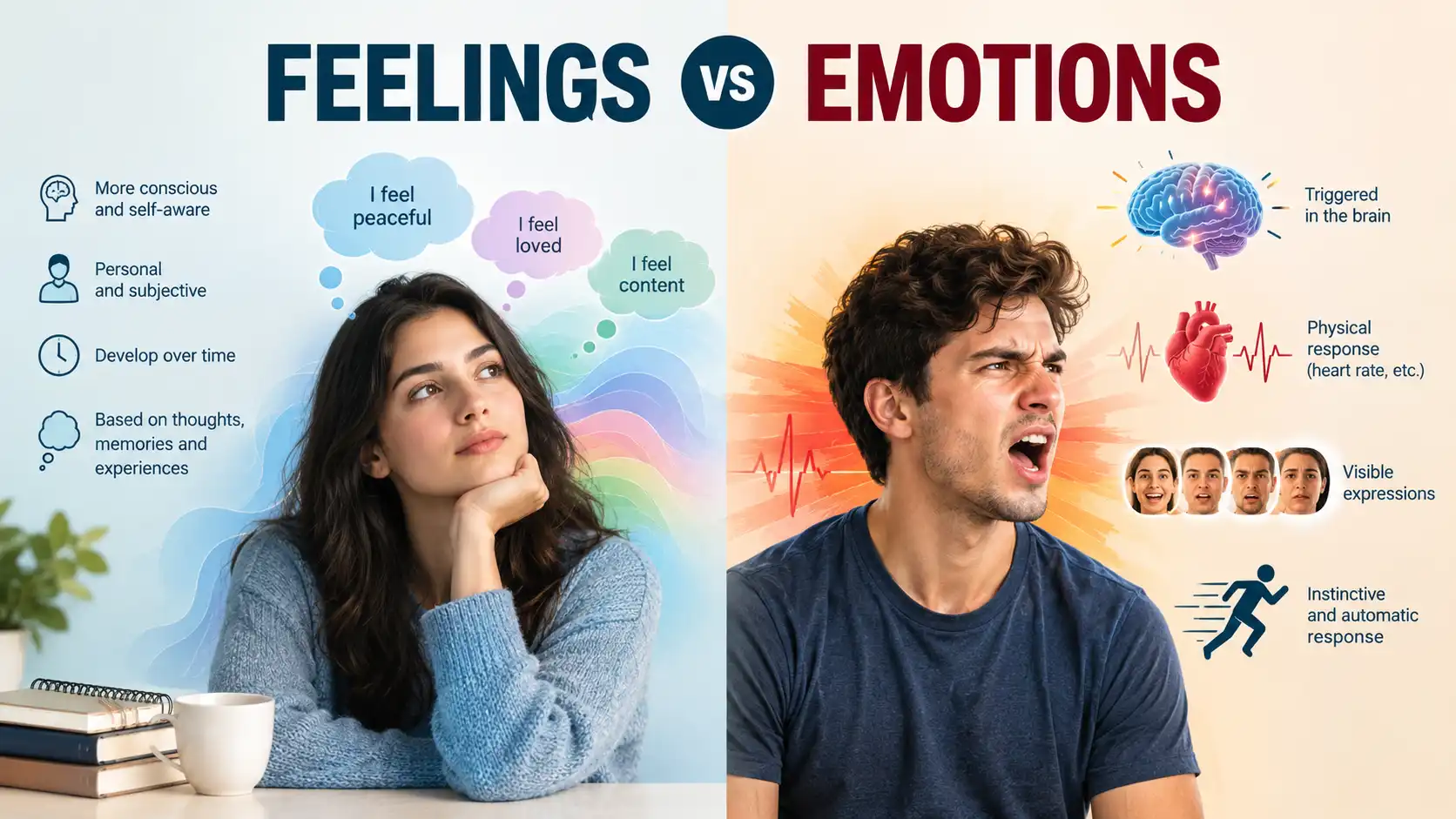
An emotion is usually a fast, automatic response to something happening inside or outside the body. A feeling is the conscious experience or personal awareness of that response.
For example:
- You see a car moving toward you quickly. Your body may react with fear. That fear is an emotion.
- You notice the fear and think, “I feel unsafe.” That conscious experience is a feeling.
- Your heart beats faster, your muscles tighten, and you prepare to move. These are physical parts of the emotional response.
In simple terms:
Emotions are often automatic reactions. Feelings are how we consciously experience and describe those reactions.
However, this is a helpful general model, not a rule accepted by every researcher. In ordinary conversation, “emotion” and “feeling” often overlap.
The Origin of Feelings and Emotions
The words feeling and emotion have different histories.
The origin of “feeling”
The word feeling comes from the Old English verb fēlan, meaning “to touch,” “to perceive,” or “to experience.” It was first linked to physical sense, such as touching something with the hand.
Over time, its meaning expanded. People began using feeling for inner experiences, opinions, and emotional states. Today, we can feel heat, pain, sadness, hope, doubt, or affection.
This history explains why feeling has both physical and emotional meanings:
- I felt the cold air.
- She felt pain in her arm.
- He felt proud of his work.
- I have mixed feelings about the plan.
The origin of “emotion”
The word emotion comes through French from Latin emovere, meaning “to move out” or “to stir up.” The word is linked to the idea of being moved or stirred by an experience.
In English, emotion became associated with strong inner responses such as joy, fear, anger, sadness, and love. Modern psychology uses the word for complex responses involving the brain, body, thoughts, and behavior.
Why the meanings overlap
Both words developed around the idea of human experience. A person may be moved by an event and then become aware of that experience as a feeling. Because of this close connection, the words often overlap in normal speech.
There is no major British English versus American English spelling difference in these words. Both varieties use:
- feeling
- feelings
- emotion
- emotions
The difference is mainly about meaning and context, not spelling.
Pronunciation and Part of Speech
Pronunciation
The words are not pronounced alike, but both are common and easy to confuse in fast speech.
- Feeling: /ˈfiː.lɪŋ/
- Feelings: /ˈfiː.lɪŋz/
- Emotion: /ɪˈməʊ.ʃən/ in British English and /ɪˈmoʊ.ʃən/ in American English
- Emotions: /ɪˈməʊ.ʃənz/ in British English and /ɪˈmoʊ.ʃənz/ in American English
The main stress in feeling is on the first syllable. The main stress in emotion is on the second syllable.
Part of speech
Both target words are mainly used as nouns.
Feeling as a noun
“Feeling” can refer to:
- An emotional state
- I have a feeling of sadness.
- A physical sense
- I lost feeling in my fingers.
- An opinion or belief
- My feeling is that we should wait.
- A general attitude
- There is a strong feeling of trust between them.
The plural form, feelings, often refers to several emotional experiences or personal reactions.
Emotion as a noun
“Emotion” refers to a strong or noticeable mental and physical response.
- Anger is a powerful emotion.
- Her emotions changed after the news.
- He found it hard to control his emotions.
The word emotion is often used in psychology, science, medicine, education, and formal writing. Feeling is more common in personal speech.
British English vs American English Spelling
There is no meaningful spelling difference between British English and American English for feelings and emotions.
| Word | British English | American English |
| Feeling | feeling | feeling |
| Feelings | feelings | feelings |
| Emotion | emotion | emotion |
| Emotions | emotions | emotions |
The words are spelled the same in both varieties. Their pronunciation may differ slightly, especially in the vowel sound of emotion:
- British English: often sounds like “ee-MOH-shun”
- American English: often sounds like “ee-MOH-shun,” with a slightly different vowel quality
These are pronunciation differences, not spelling differences.
Other related words may show regional spelling changes. For example, favour and favor differ between British and American English. But feeling and emotion do not follow that pattern.
Which Spelling Should You Use?
Because the spelling is the same in both major forms of English, you do not need to choose between British and American versions.
If you write for a US audience
Use:
- feeling
- feelings
- emotion
- emotions
These forms are standard in American English.
If you write for a UK or Commonwealth audience
Use the same spellings:
- feeling
- feelings
- emotion
- emotions
You may use British vocabulary or punctuation rules in the rest of your writing, but these words do not change.
If you write for a global audience
The same spellings are safe and widely understood. Focus more on clear meaning than on regional spelling.
For formal writing, use emotion when discussing a general psychological concept. Use feeling when describing a person’s personal experience or response.
Common Mistakes with Feelings and Emotions
Mistake 1: Treating the words as completely different
Some writers claim that emotions are always automatic and feelings are always conscious. This distinction can be useful, but it is not accepted in exactly the same way by every field.
Better approach: Explain that emotions are often automatic responses, while feelings are the conscious experience or interpretation of those responses.
Mistake 2: Using “feelings” only for sadness
Feelings can be positive, negative, or mixed. They include:
- happiness
- anger
- fear
- love
- shame
- excitement
- calm
- confusion
- hope
Incorrect idea:
- Feelings are only painful emotions.
Better sentence:
- We should respect people’s feelings, whether they are positive or difficult.
Mistake 3: Confusing feelings with opinions
The word feeling can mean an opinion, but not every opinion is an emotion.
Compare:
- I feel nervous about the exam.
This describes an emotional state. - I feel that the exam should be shorter.
This expresses an opinion.
The meaning depends on the sentence.
Mistake 4: Saying “I am emotion”
The word emotion is a noun, so it cannot normally follow “I am” in that form.
Incorrect:
- I am emotion.
Correct:
- I am emotional.
- I am feeling angry.
- I am experiencing a strong emotion.
Mistake 5: Using “emotional” and “emotion” in the same way
Emotion is a noun. Emotional is an adjective.
- Fear is an emotion.
- He became emotional during the speech.
Mistake 6: Assuming every body reaction is a feeling
A fast heartbeat, sweating, and tense muscles may be physical parts of an emotional response. They are not always the feeling itself.
For example:
- My heart is beating fast.
This describes a physical reaction. - I feel afraid.
This describes the conscious experience.
Mistake 7: Believing feelings are always logical
Feelings are real experiences, but they do not always provide complete or accurate information. A person may feel rejected even when nobody intended to reject them.
A useful sentence is:
- Feelings are important, but they may need to be checked against facts.
Difference Between Feelings and Emotions in Everyday Examples
The best way to understand the distinction is to see how the words work in real situations.
In an email
Feeling is common when discussing a personal response:
I wanted to share how I am feeling about the changes to our project.
Emotion sounds more formal or analytical:
The decision caused strong emotions among the staff.
Both are correct, but the tone is different.
In a news report
News writing often uses emotion when describing public reactions:
The announcement created strong emotions across the community.
It may use feelings when reporting personal views:
Residents shared their feelings about the new policy.
In social media
People often use feelings in a personal and direct way:
- I have so many feelings about this ending.
- My feelings are hurt.
- I cannot explain how I feel right now.
The word emotion may sound more formal:
- This song brings out a lot of emotion.
- The film was full of emotion.
In formal writing
Academic and professional writing often uses emotion to discuss a broad concept:
Emotion can influence attention, memory, and decision-making.
It may use feeling to describe conscious experience:
A person’s feelings may change after receiving new information.
In a conversation
A friend may say:
- How are you feeling?
- Tell me about your feelings.
- I understand why you feel upset.
A teacher, counselor, or researcher may say:
- What emotion did you notice first?
- Which emotions were present?
- How did the emotional response affect your behavior?
In a personal journal
Both words can work:
I felt anxious before the meeting. The emotion stayed with me for several hours, but writing about it helped me understand my feelings.
This example shows how the words can describe connected parts of one experience.
A Clear Comparison of Feelings and Emotions
| Feature | Feelings | Emotions |
| Basic meaning | Conscious personal experience | Automatic or complex response |
| Main focus | Awareness and interpretation | Brain, body, and behavior |
| Common use | Personal and everyday speech | Psychology, science, and formal writing |
| Example | I feel worried. | Fear is an emotion. |
| Can be physical? | Yes, as in feeling pain or heat | Usually includes physical changes |
| Can be positive? | Yes | Yes |
| Can be mixed? | Yes | Yes |
| Always conscious? | Usually refers to conscious experience | Not always |
| Always automatic? | Not necessarily | Often begins automatically |
| Spelling variation | Same in British and American English | Same in British and American English |
The most useful working distinction is:
An emotion is the response, while a feeling is the conscious experience of that response.
Still, the two terms are not strict opposites. A feeling may also include thoughts, memories, body sensations, and personal meaning. Likewise, an emotion may involve conscious awareness.
How Feelings and Emotions Work Together
Feelings and emotions often form part of the same process.
Imagine that your manager says, “We need to talk.”
- Your brain notices the message.
- Your body may become tense.
- You may experience fear or concern.
- You become aware of that reaction and think, “I feel worried.”
- You may choose to ask questions or prepare for the meeting.
In this example, the emotional response may begin before you fully understand why you are reacting. The feeling helps you name and interpret the experience.
This process is not always simple. Your past experiences, beliefs, health, stress level, and current environment can affect both emotions and feelings.
For example, two people may receive the same news but feel very different. One person may feel excited, while another may feel nervous. The event is the same, but their memories and expectations are different.
Why Understanding the Difference Matters
Knowing the difference between feelings and emotions can improve communication.
Instead of saying:
- I feel bad.
You can say:
- I feel disappointed because the plan changed.
- I feel nervous about the meeting.
- I feel angry because I was not heard.
- I feel hopeful about the next step.
This gives others clearer information.
It can also help with emotional control. When you name a feeling, you create space between the experience and your action. You may still feel angry, but you can choose not to speak harshly. You may feel afraid, but you can decide what to do next.
This does not mean that every feeling should be ignored or controlled. Feelings can signal needs, values, stress, danger, connection, or loss. They deserve attention, but they should be understood with care.
Frequently Asked Questions
1. Are feelings and emotions the same thing?
They can mean the same thing in everyday speech. In many psychological explanations, emotions are automatic responses, while feelings are the conscious experience of those responses.
2. Which comes first, feelings or emotions?
In the common psychological model, an emotion often comes first and a feeling follows as conscious awareness. However, researchers do not all describe the process in exactly the same way.
3. Is happiness a feeling or an emotion?
Happiness can be described as both. It may be an emotion that responds to a positive event, and it may also be a conscious feeling of joy or satisfaction.
4. Is anger a feeling or an emotion?
Anger is often called an emotion. When you notice and describe your experience, you may say, “I feel angry.” The two descriptions refer to connected parts of the same experience.
5. Can feelings be wrong?
Feelings are real experiences, but they do not always prove that your interpretation is correct. You may feel unwanted even when others care about you. It helps to respect feelings while checking the facts.
6. What is the difference between emotional and feeling?
Emotional is an adjective that describes a person, reaction, or situation. Feeling is usually a noun that names an experience.
- She became emotional.
- I have a strong feeling about this.
7. Should I use “feelings” or “emotions” in formal writing?
Use emotion when discussing psychological or scientific ideas. Use feelings when focusing on personal experience, opinions, or reactions. Both can be correct when used clearly.
Conclusion
Feelings and emotions are closely linked, but they are not always used in the same way. Emotions often begin as automatic responses, while feelings describe our conscious experience.
The difference between feelings and emotions becomes clearer when you notice both the body’s reaction and your personal awareness. Each part helps explain human behavior.
Neither word is limited to sadness or anger. Feelings and emotions can include joy, fear, hope, love, calm, shame, and many mixed states.
Practice these words in emails, essays, and daily conversations. Naming what you feel can make your thoughts clearer and your connections with others stronger.

Anton Reyes is a contributing writer at DiffNexx.com, where he explores meaningful differences in language, culture, and everyday concepts. With a background in creative nonfiction, Anton brings clarity and balance to complex comparisons. His writing helps readers understand subtle distinctions in words and ideas, making learning both insightful and engaging.







