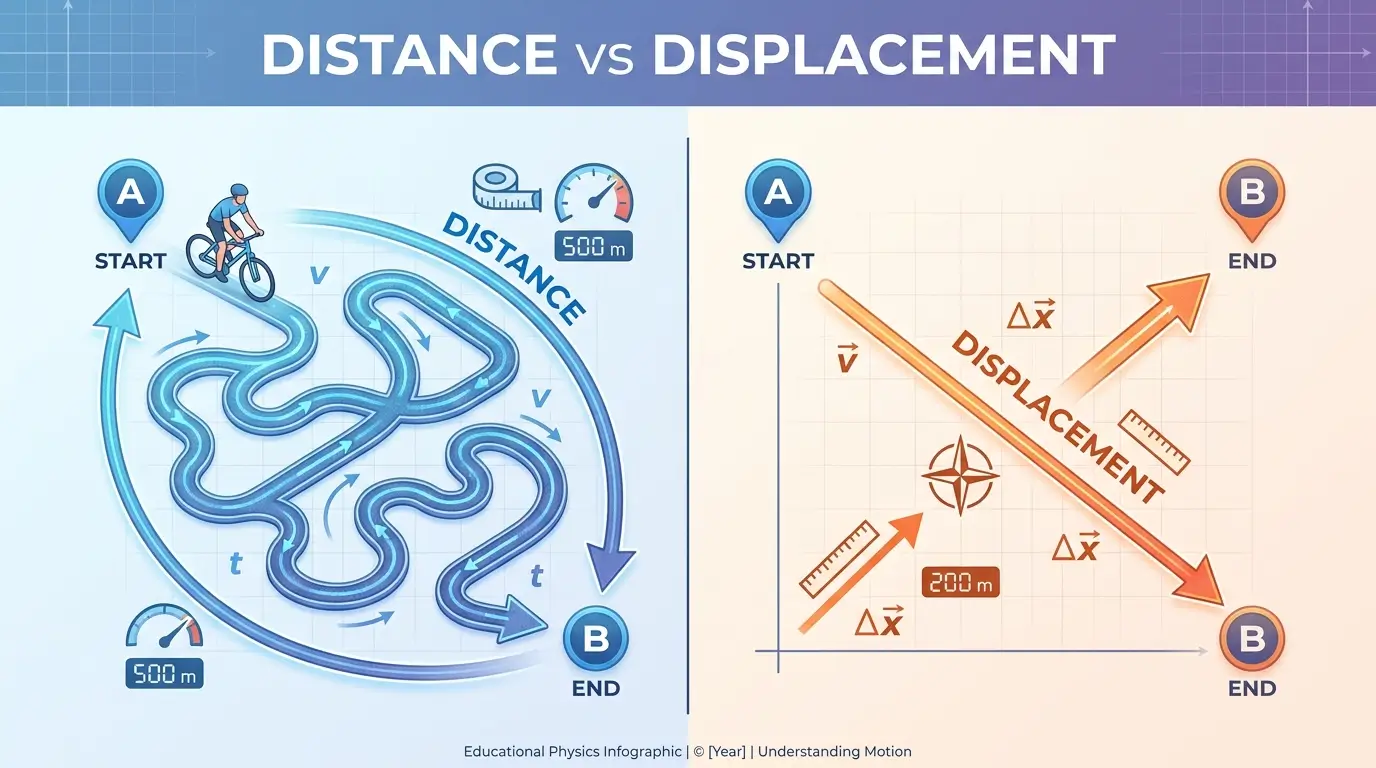
Motion sounds simple: an object moves from one place to another. But physics gives us two different ways to describe that motion. This is where the difference between distance and displacement becomes important.
A person may walk around a park, drive through several streets, or run from one point to another. The total path they travel is not always the same as the direct change between their starting and ending points. Distance measures the whole path. Displacement measures the change in position from start to finish.
Students often search for the difference between distance and displacement because the two terms seem similar in everyday English. In physics, however, they have precise meanings. Knowing the difference between distance and displacement helps you solve motion problems, choose the right formula, and understand why an object can travel a large distance while having zero displacement.
This guide explains the difference between distance and displacement with simple definitions, formulas, examples, tables, and common mistakes. By the end, you should be able to tell them apart quickly.
Quick Answer
The simplest way to remember the difference between distance and displacement is:
Distance is the total length of the path an object travels.
Displacement is the change in the object’s position from its starting point to its ending point, including direction.
For example, imagine you walk 5 meters east and then 3 meters west.
Your total distance is:
5 m + 3 m = 8 m
Your final position is 2 meters east of where you started. Therefore, your displacement is:
2 m east
So:
- Distance = 8 m
- Displacement = 2 m east
Distance does not need a direction. Displacement does.
A very easy example
Suppose you run one complete lap around a 400-meter track and finish exactly where you started.
Your:
- Distance = 400 meters
- Displacement = 0 meters
You traveled 400 meters, but your starting and ending positions are the same.
This is one of the clearest examples of the difference between distance and displacement.
The Origin of Distance and Displacement
The words distance and displacement have different histories, but their modern scientific meanings developed from the broader language of measurement and movement.
Origin of “distance”
Distance comes through Old French distance from Latin distantia, meaning separation or a standing apart. It is related to the Latin verb distare, meaning “to stand apart” or “to be distant.”
The basic idea has remained connected to separation between points.
In everyday English, distance can describe how far apart two places are:
The distance between the two towns is 20 miles.
Physics uses a more specific meaning. Distance describes the total length of the path traveled.
Origin of “displacement”
Displacement comes from the verb displace, which means to move something from its usual or original position.
Displace was formed from Latin-based elements that carry the idea of moving something away from its place. In modern physics, displacement became a technical term for a change in position.
This gives the word a useful clue:
Displacement = a change from an original position.
The historical meanings of these words help explain why physicists use them differently, but the modern physics definitions are more important when solving problems.
Part of speech
Both distance and displacement are nouns.
Examples:
The distance traveled was 10 km.
The displacement was 4 km north.
The related verbs and adjectives can appear in other contexts, but in basic physics questions, these two words usually function as nouns describing physical quantities.
Distance: What Does It Mean in Physics?
In physics, distance is the total length of the path traveled by an object.
It does not matter which direction the object moves. Every part of the path adds to the total distance.
For example, a cyclist travels:
- 4 km north
- 2 km south
- 3 km north
The total distance is:
4 + 2 + 3 = 9 km
The cyclist traveled 9 km in total.
Distance is a scalar quantity. This means it has magnitude but no direction.
Important features of distance
Distance:
- measures the entire path traveled
- has no direction
- is a scalar quantity
- cannot be negative
- is usually greater than or equal to the magnitude of displacement
The SI unit of distance is the meter (m).
Other units include:
- kilometer (km)
- centimeter (cm)
- mile (mi)
- foot (ft)
Displacement: What Does It Mean in Physics?
Displacement describes how much an object’s position changes from its starting point to its final point.
Unlike distance, displacement includes direction.
Suppose a person walks 10 meters east and then stops.
Their displacement is:
10 meters east
Now suppose they walk 10 meters east and then 10 meters west.
Their total distance is:
20 meters
But they finish where they started.
Their displacement is:
0 meters
This shows why displacement depends only on the initial and final positions, not the complete path between them.
Displacement is a vector quantity because it has both:
- magnitude
- direction
Its SI unit is also the meter (m).
Distance vs Displacement: The Main Differences
| Feature | Distance | Displacement |
|---|---|---|
| Meaning | Total path traveled | Change in position |
| Type | Scalar | Vector |
| Direction needed? | No | Yes |
| Depends on path? | Yes | No, only start and end positions |
| Can be zero? | Yes, if no movement occurs | Yes, even after movement |
| Can be negative? | No | A component can be negative depending on the chosen direction |
| SI unit | Meter (m) | Meter (m) |
| Usually written as | A positive value | Magnitude with direction |
| Can be greater than displacement? | Yes | Its magnitude cannot exceed distance |
One important detail is worth remembering: when comparing them, it is more precise to say that distance is greater than or equal to the magnitude of displacement.
The Formula for Distance and Displacement
Distance formula
For simple motion at a constant speed:
Distance = Speed × Time
Or:
d = vt
where:
- d = distance
- v = speed
- t = time
For more complicated motion, total distance is found by adding the lengths of all parts of the path.
Displacement formula
For motion along a straight line:
Displacement = Final position − Initial position
Or:
Δx = x₂ − x₁
where:
- Δx = displacement
- x₂ = final position
- x₁ = initial position
The result may be positive, negative, or zero depending on the direction chosen as positive.
Example
A car moves from position 10 m to position 40 m along a straight road.
Displacement:
40 m − 10 m = 30 m
If the car traveled directly between those positions, the distance is also 30 m.
But if the car took a longer route, the distance would be greater while the displacement would remain 30 m in the chosen direction.
Can Distance and Displacement Be Equal?
Yes.
Distance and the magnitude of displacement are equal when an object moves in a straight line without changing direction.
For example, a person walks 15 meters east without turning around.
- Distance = 15 m
- Displacement = 15 m east
- Magnitude of displacement = 15 m
So they have the same numerical value.
However, they are still different physical concepts.
Distance tells you the total path traveled. Displacement tells you the change in position.
Can Displacement Be Greater Than Distance?
No.
The magnitude of displacement can never be greater than the distance traveled.
Think of displacement as the shortest straight-line connection between the starting and ending positions, while distance follows the actual route.
For example, if you walk around several streets and end 2 km from your starting point, your distance might be 7 km.
So:
Distance = 7 km
Magnitude of displacement = 2 km
The route cannot be shorter than the direct separation between its endpoints.
Can Displacement Be Zero While Distance Is Not Zero?
Yes. This is one of the most important ideas in the topic.
Imagine running around a circular track and returning to the starting point.
You may travel:
500 meters
But your final position is exactly the same as your initial position.
Therefore:
Distance = 500 m
Displacement = 0 m
The same thing happens when you walk away from your house and later return home.
You traveled a real distance, but your overall displacement is zero.
British English vs American English Spelling
There is no meaningful British-versus-American spelling difference for distance or displacement.
Both British English and American English use:
- distance
- displacement
- meter
- motion
- position
- direction
However, a related unit word can show a regional spelling difference:
- British English: metre
- American English: meter
In scientific writing, meter is also the standard SI unit name internationally, even though everyday British English commonly uses metre for the unit.
Comparison table
| Term | British English | American English |
|---|---|---|
| Distance | distance | distance |
| Displacement | displacement | displacement |
| Unit in everyday British writing | metre | meter |
| Scientific SI symbol | m | m |
| Meaning of distance | Same | Same |
| Meaning of displacement | Same | Same |
There is therefore no need to choose between distance and displacement based on British or American English. The physics definitions are the same.
Which Term Should You Use?
Choose the term based on what you are measuring, not your location.
Use “distance” when:
You want the total path traveled.
The runner covered a distance of 8 km.
Use “displacement” when:
You want the change from the starting position to the ending position.
The runner’s displacement was 3 km north.
For US students
Use the standard physics terms distance and displacement. American textbooks and science courses use the same core definitions.
For UK and Commonwealth students
The definitions are also the same. Follow your school’s preferred notation and unit conventions.
For global readers
The safest approach is to define both terms clearly when they first appear:
Distance is the total path traveled, while displacement is the change in position.
This removes confusion even for readers who are new to physics.
Common Mistakes
1. Saying they are always the same
This is incorrect.
They can have the same numerical value in straight-line motion, but they measure different things.
A person walks 10 m east and 10 m west.
Distance = 20 m.
Displacement = 0 m.
2. Forgetting direction
A displacement answer that only says:
5 meters
may be incomplete when direction matters.
A better answer is:
5 meters east.
Distance does not require a direction.
3. Adding all movements to find displacement
This is a common student mistake.
Suppose an object moves:
- 6 m east
- 2 m west
Distance:
6 + 2 = 8 m
Displacement:
6 − 2 = 4 m east
For displacement, opposite directions must be treated differently.
4. Thinking displacement is always positive
Displacement can be positive, negative, or zero depending on the coordinate system.
For example, if east is positive and an object moves 5 m west, its displacement can be written as:
−5 m
The negative sign indicates direction. It does not mean the object traveled a “negative distance.”
5. Confusing speed with displacement
Speed tells you how fast something moves.
Displacement tells you how its position changes.
They answer different questions.
6. Using the shortest route for distance
Distance is based on the actual path traveled, not necessarily the shortest path.
Displacement, however, is based only on the starting and ending positions.
Difference Between Distance and Displacement in Everyday Examples
Walking
You walk 200 m from your home to a store and then return home.
Distance:
200 + 200 = 400 m
Displacement:
0 m
You ended at your starting point.
Driving
A driver travels 30 km east and then 10 km west.
Distance:
30 + 10 = 40 km
Displacement:
20 km east
The total route is 40 km, but the final position is only 20 km east of the start.
Running
A runner completes one full 400 m lap.
Distance:
400 m
Displacement:
0 m
The runner moved, but the starting and ending positions are identical.
In an email
A teacher might write:
Please calculate the total distance traveled and the final displacement.
This is a clear physics instruction because the two quantities require different calculations.
In a science report
A formal report might say:
The object traveled a total distance of 12 m, while its displacement from the starting point was 4 m east.
This gives both quantities and the direction of displacement.
On social media
A simple educational post might say:
Fun physics fact: you can travel 10 km and still have zero displacement if you finish where you started.
This is a good everyday example because it makes the difference easy to visualize.
A Simple Comparison
| Example | Distance | Displacement |
|---|---|---|
| Walk 5 m east | 5 m | 5 m east |
| Walk 5 m east, then 3 m west | 8 m | 2 m east |
| Walk 10 m and return 10 m | 20 m | 0 m |
| Complete one 400 m lap | 400 m | 0 m |
| Move directly 15 m north | 15 m | 15 m north |
| Travel 20 km north, then 5 km south | 25 km | 15 km north |
This table captures the main rule: distance counts the path, while displacement compares the beginning and the end.
FAQs
1. What is the main difference between distance and displacement?
Distance is the total length of the path traveled. Displacement is the change in position from the starting point to the ending point and includes direction.
2. Is distance a scalar or vector?
Distance is a scalar quantity. It has magnitude but no direction.
3. Is displacement a scalar or vector?
Displacement is a vector quantity. It has both magnitude and direction.
4. Can displacement be zero?
Yes. Displacement is zero when an object finishes at the same position where it started, even if it traveled a considerable distance.
5. Can distance be zero while displacement is not zero?
No. If an object has traveled no distance, its position has not changed, so its displacement must also be zero.
6. Can distance equal displacement?
Yes. When an object moves in a straight line without changing direction, the distance equals the magnitude of its displacement.
7. Which is always greater, distance or displacement?
Distance is always greater than or equal to the magnitude of displacement. It cannot be smaller because the actual path cannot be shorter than the direct separation between the starting and ending points.
Conclusion
The difference between distance and displacement is simple once you focus on the path and the final position. Distance counts the journey; displacement compares where you started and ended.
Distance is a scalar, so it has no direction. Displacement is a vector, so direction matters. This small detail changes many physics calculations.
Remember the key idea: an object can travel a large distance but have zero displacement if it returns to its starting point. That example makes the rule stick.
Practice these ideas with simple walks, drives, and motion problems. Use them in your notes and physics exercises, and the difference will soon feel natural.

Aamer Shahzad is the founder of Diffnexx.com, a fast-growing educational platform focused on high-intent “difference between” topics. With over 8 years of experience in English language education and analytical writing, I specialize in breaking down complex “difference between” topics into clear, structured, and easy-to-understand explanations. Diffnexx.com is your go-to resource for enhancing English skills and writing with confidence.
I specializes in building search-optimized, research-driven comparison content designed for clarity, authority, and long-term digital asset value.







