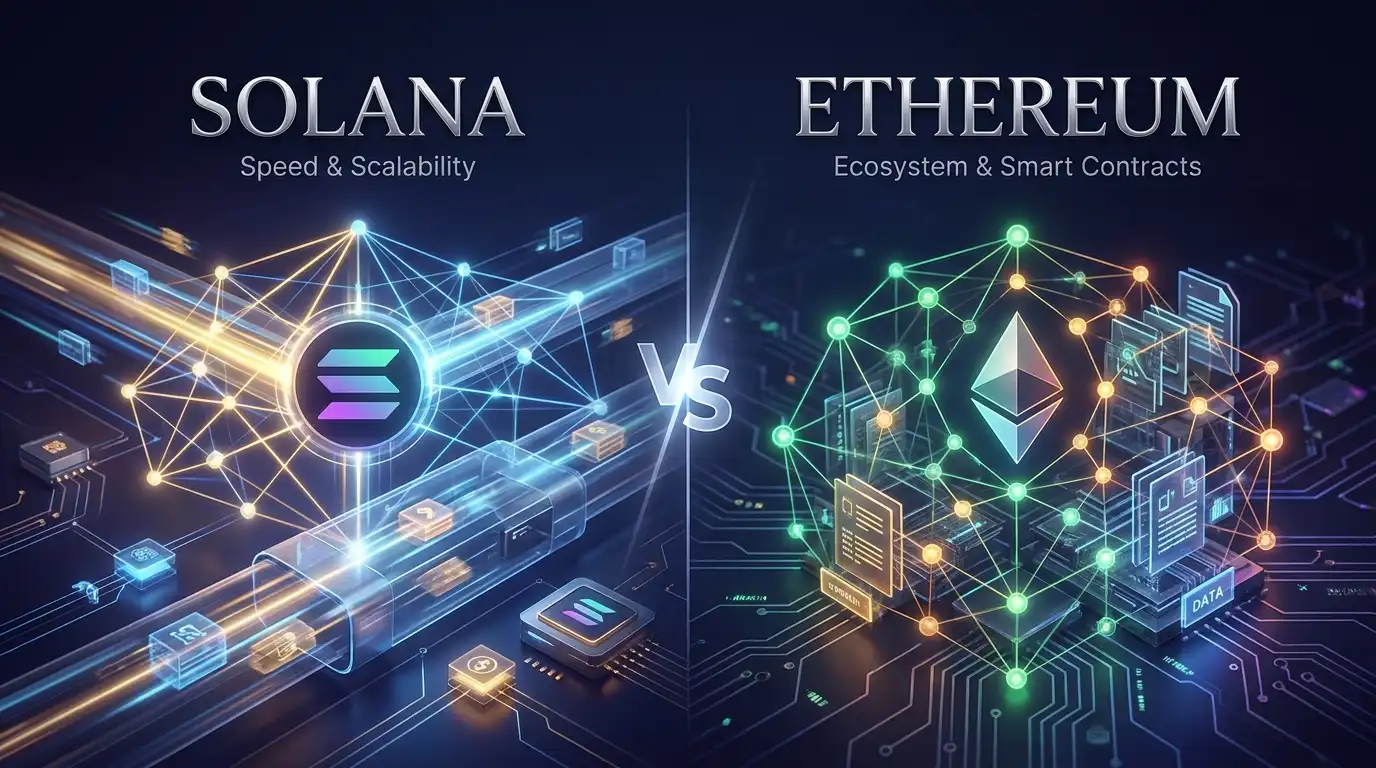
If you are comparing Solana or Ethereum, you are looking at two of the best-known smart-contract blockchain networks, but they take different approaches to speed, fees, applications, and network design. Choosing between them depends on what you want to do.
People search for Solana or Ethereum because both networks support decentralized applications, tokens, decentralized finance (DeFi), NFTs, and other blockchain-based projects. Yet the user experience can feel very different.
The Solana or Ethereum question is also confusing because people often compare the networks with their native cryptocurrencies. Solana uses SOL, while Ethereum’s native asset is ether (ETH). The networks themselves are not the same thing as their tokens.
Understanding Solana or Ethereum also requires looking beyond price. Transaction costs, scalability, decentralization, developer ecosystems, smart contracts, security models, and long-term goals all matter. This guide breaks down those differences in simple language so you can understand what each network is designed to do.
Important: This is an educational comparison, not personalized financial advice. Crypto assets can be highly volatile, and network strengths do not guarantee future investment performance.
Quick Answer
Solana and Ethereum are both Layer 1 blockchain networks that support smart contracts and decentralized applications, but they are designed with different technical priorities.
The term Solana focuses heavily on high-speed transaction processing and low transaction costs. Its architecture combines Proof of Stake with Proof of History (PoH), a mechanism designed to provide a verifiable ordering of events and a shared sense of time. Solana’s documentation describes it as a high-performance Layer 1 network designed for fast and low-cost applications.
Ethereum is a broader smart-contract platform with a large ecosystem of applications, developers, tokens, and Layer 2 networks. Ethereum uses Proof of Stake, and its execution environment supports programmable smart contracts and decentralized applications.
| Feature | Solana | Ethereum |
|---|---|---|
| Native cryptocurrency | SOL | ETH |
| Network type | Layer 1 blockchain | Layer 1 blockchain |
| Consensus | Proof of Stake with Proof of History | Proof of Stake |
| Main strength | Speed and low-cost execution | Smart-contract ecosystem and decentralization |
| Smart contracts | Yes | Yes |
| Transaction fees | SOL-based fees | ETH-based gas fees |
| Scaling approach | High-performance base layer | Ethereum + Layer 2 ecosystem |
| Mainnet launch | 2020 Mainnet Beta | July 30, 2015 |
| Best known for | Fast, inexpensive on-chain activity | DeFi, smart contracts, L2s, broad ecosystem |
Neither network is simply “better.” The right choice depends on the use case.
The Origin of Solana or Ethereum
The names Solana and Ethereum refer to blockchain projects, not alternative spellings of the same concept.
Where did the name Solana come from?
Solana was founded in 2017 by Anatoly Yakovenko, according to Solana’s official materials. The network’s Mainnet Beta was launched in March 2020.
The name Solana is associated with Solana Beach, California, where Yakovenko and his former Qualcomm colleagues spent time. The project developed around the idea of building a high-performance blockchain capable of processing large amounts of activity.
One of Solana’s defining ideas was Proof of History. The original Solana whitepaper describes PoH as a way to verify the order and passage of time between events. Importantly, PoH is not itself the complete consensus mechanism. It works alongside Proof of Stake and other components of Solana’s architecture.
Solana’s Mainnet Beta began in March 2020, marking an important point in the network’s development.
Where did the name Ethereum come from?
Ethereum has a different history. Vitalik Buterin proposed Ethereum in 2013, and the network officially launched on July 30, 2015, when its genesis block was created.
Ethereum was created with a broader goal than simply transferring digital money. Its core idea was to provide a programmable blockchain where developers could create smart contracts and decentralized applications.
The name Ethereum was chosen for the project during its early development. It comes from “ether,” an old scientific term referring to a hypothetical substance once thought to fill space. The project name was intended to evoke an underlying medium or infrastructure.
Today, the network is commonly called Ethereum, while its native cryptocurrency is called ether, with the ticker ETH.
Why the names matter
A common mistake is to say:
“Ethereum is ETH.”
A more accurate statement is:
“Ethereum is the blockchain network, and ETH is its native cryptocurrency.”
Likewise:
“Solana is the blockchain network, and SOL is its native cryptocurrency.”
This distinction becomes important when discussing network fees, staking, wallets, and investments.
Pronunciation and Part of Speech
Solana and Ethereum are both proper nouns because they identify specific blockchain networks.
SOL and ETH are abbreviations or ticker symbols for their respective native crypto assets.
They are not homophones, so pronunciation is not usually a major source of confusion.
For English learners, the most important distinction is grammatical:
- Solana = proper noun
- Ethereum = proper noun
- SOL = cryptocurrency ticker
- ETH = cryptocurrency ticker
Examples:
- “Solana processed the transaction.”
- “Ethereum supports smart contracts.”
- “I paid the network fee in SOL.”
- “The transaction required ETH for gas.”
Avoid writing solana or ethereum as ordinary lowercase nouns when you mean the named networks. Standard writing uses Solana and Ethereum.
British English vs American English Spelling
There is no meaningful British English versus American English spelling difference for Solana or Ethereum.
Both varieties use:
- Solana
- Ethereum
- SOL
- ETH
These are proper names and standardized cryptocurrency tickers, not words with competing British and American spellings.
| Term | British English | American English |
|---|---|---|
| Blockchain | Solana | Solana |
| Blockchain | Ethereum | Ethereum |
| Native asset | SOL | SOL |
| Native asset | ETH | ETH |
| Spelling variation | None | None |
| Capitalization | Solana, Ethereum | Solana, Ethereum |
The main writing issue is therefore capitalization and terminology, not regional spelling.
A useful distinction
Do not change Ethereum to a supposed American or British alternative. There is no standard regional variant.
Similarly, Solana has one standard spelling in English.
Solana vs Ethereum: How the Technology Differs
The biggest technical difference is how the two networks approach execution and scaling.
Solana’s approach
Solana combines Proof of Stake with Proof of History. PoH provides a verifiable way to establish ordering and passage of time, reducing some of the communication work that validators would otherwise need to perform.
Solana also uses technologies such as Sealevel for parallel transaction processing. Its architecture is designed to handle many operations efficiently when those transactions do not conflict with one another.
This design helps explain why Solana is often associated with fast and inexpensive transactions.
Ethereum’s approach
Ethereum uses Proof of Stake for consensus. Validators stake ETH and participate in proposing and validating blocks. The network moved from Proof of Work to Proof of Stake during The Merge on September 15, 2022.
Ethereum also uses the Ethereum Virtual Machine, or EVM, to execute smart-contract code.
Rather than relying only on changes to the main blockchain for scaling, Ethereum has developed a large Layer 2 ecosystem. Layer 2 networks can process activity away from the main Ethereum chain and use Ethereum as an underlying security and settlement layer.
This creates a different scaling philosophy:
Solana: push more performance into the Layer 1 itself.
Ethereum: combine a strong Layer 1 with multiple scaling layers.
Neither approach is automatically superior.
Fees: Solana or Ethereum?
Fees are one of the biggest reasons people compare Solana and Ethereum.
Solana transactions require fees paid in SOL. Its current fee structure includes a base fee and, when used, a prioritization fee. Solana’s documentation lists a base fee of 5,000 lamports per signature under the current fee structure.
Ethereum uses gas to measure the computational work required by a transaction. Gas fees are paid in ETH and vary according to network demand and transaction complexity.
A simple ETH transfer has a lower gas requirement than a complex smart-contract transaction. Contract interactions can require substantially more computational work and therefore more gas.
This means you should not simply ask:
“Which network has cheaper fees?”
Instead, ask:
“What transaction am I performing, and what does it cost at the time I use the network?”
Network demand can change fees.
Solana or Ethereum for Developers?
Both networks support smart contracts and decentralized applications, but their development environments differ.
Ethereum has one of the largest and most established smart-contract ecosystems. Its development environment is centered around the EVM, and Solidity is a major programming language for Ethereum smart contracts.
Solana has a different architecture and has historically emphasized Rust-based development. Solana’s current developer ecosystem also supports multiple tools and languages, including Rust, Python, and Solidity through different parts of its stack.
For developers, the decision may depend on:
- Programming language preference
- Existing application architecture
- Available libraries
- Wallet support
- User base
- Smart-contract requirements
- Transaction volume
- Scaling needs
A developer should choose based on the application’s technical needs rather than cryptocurrency price alone.
Solana or Ethereum for DeFi and Apps?
Both networks support DeFi, tokens, NFTs, games, payments, and other applications.
Ethereum has a long-established ecosystem and supports thousands of applications and digital assets. Its official documentation highlights DeFi, NFTs, gaming, stablecoins, and decentralized social applications among its major use cases.
Solana also supports DeFi, payments, digital assets, gaming, and other applications. Its architecture is designed around high throughput and low-cost execution.
For users who make many transactions, lower transaction costs can be especially attractive.
For users who value Ethereum’s established ecosystem and Layer 2 infrastructure, Ethereum may be more appealing.
Solana or Ethereum: Which Is Better for You?
There is no universal winner.
Solana may appeal to you if:
- You want fast on-chain activity.
- Low transaction costs are important.
- You use applications designed around Solana.
- You prefer Solana’s high-performance architecture.
- You frequently interact with tokens or applications on Solana.
Ethereum may appeal to you if:
- You want access to Ethereum’s broad application ecosystem.
- You use EVM-based applications.
- You want to interact with Ethereum Layer 2 networks.
- You value Ethereum’s long development history.
- Your preferred application is built primarily around Ethereum.
These are network-use considerations, not predictions about which cryptocurrency will increase in value.
Which Spelling Should You Use?
Since Solana and Ethereum are proper names, there is no spelling choice based on audience.
Use:
Solana when referring to the Solana blockchain.
Ethereum when referring to the Ethereum blockchain.
Use:
SOL for Solana’s native cryptocurrency.
ETH for Ethereum’s native cryptocurrency.
For global English, business writing, educational articles, and technical content, these forms are standard.
One important style point is to avoid treating SOL and ETH as interchangeable names for the networks. They are the native assets used by those networks.
Common Mistakes with Solana or Ethereum
Mistake 1: Treating SOL as the network
Incorrect:
“SOL is a blockchain.”
Better:
“Solana is a blockchain, and SOL is its native cryptocurrency.”
Mistake 2: Calling ETH the Ethereum network
Incorrect:
“ETH supports smart contracts.”
Better:
“Ethereum supports smart contracts, and ETH is its native asset.”
Mistake 3: Saying Ethereum still uses mining
Ethereum no longer uses Proof of Work on its mainnet. The Merge completed its transition to Proof of Stake in 2022.
Mistake 4: Assuming Proof of Stake automatically means cheaper transactions
Ethereum’s own documentation states that consensus type does not directly determine gas costs. Ethereum fees are influenced by the network’s dynamic fee market and demand.
Mistake 5: Comparing only token prices
A coin’s unit price does not tell you which blockchain is technically better.
Compare the network, token economics, usage, fees, security model, ecosystem, and your actual purpose.
Mistake 6: Treating Solana’s Proof of History as its entire consensus system
PoH is a core Solana innovation, but it is not simply a replacement name for Proof of Stake. Solana’s architecture combines PoH with its Proof of Stake consensus approach and other technologies.
Solana or Ethereum in Everyday Examples
In an email
“Please confirm whether the payment should be sent using Ethereum or Solana before we proceed.”
This is appropriate when the sender is discussing the blockchain network.
In a business message
“Our application currently supports payments on Solana, while the Ethereum version is being tested.”
Here, the network names are used as proper nouns.
On social media
“I tried a Solana application today, and the transaction was completed quickly.”
This is natural informal usage.
In a news article
“Developers continue to build decentralized applications across the Solana and Ethereum ecosystems.”
This sentence correctly treats both names as blockchain ecosystems.
In formal writing
“Solana and Ethereum use different architectural approaches to blockchain scalability.”
This is suitable for reports, essays, and technical articles.
In a technical document
“ETH is required to pay Ethereum gas fees, while SOL is used to pay Solana transaction fees.”
This clearly distinguishes the networks from their native assets.
Solana vs Ethereum Comparison Table
| Category | Solana | Ethereum |
|---|---|---|
| Network | Solana | Ethereum |
| Native asset | SOL | ETH |
| Launch | Mainnet Beta in 2020 | Mainnet launched in 2015 |
| Consensus | Proof of Stake + PoH | Proof of Stake |
| Smart contracts | Yes | Yes |
| Scaling model | High-performance Layer 1 | Layer 1 + Layer 2 ecosystem |
| Fee unit | SOL | ETH/gas |
| Main technical focus | High throughput and efficiency | General-purpose smart contracts and layered scaling |
| Developer ecosystem | Large and growing | Very large and mature |
| Parallel execution | Strong focus | Different execution model |
| Common uses | DeFi, payments, tokens, apps, gaming | DeFi, stablecoins, NFTs, apps, L2s |
| Regional spelling | No difference | No difference |
Solana’s official materials describe its network as a high-performance Layer 1 using Proof of History alongside Proof of Stake, while Ethereum’s documentation describes Ethereum as a Proof-of-Stake smart-contract platform with Layer 2 scaling as a major part of its roadmap.
Frequently Asked Questions
1. Is Solana better than Ethereum?
Not in every situation. Solana emphasizes high performance and low-cost transactions, while Ethereum offers a broad smart-contract ecosystem and extensive Layer 2 infrastructure. The better option depends on your use case.
2. Is Ethereum faster than Solana?
The two networks use different architectures and scaling strategies, so a simple “faster” label can be misleading. Solana is designed for high-throughput Layer 1 execution, while Ethereum increasingly relies on Layer 2 networks for scaling.
3. Is SOL the same as Ethereum?
No. SOL is Solana’s native cryptocurrency. ETH is Ethereum’s native cryptocurrency. Solana and Ethereum are the respective blockchain networks.
4. Why are Ethereum fees sometimes high?
Ethereum uses a dynamic gas market. When demand is high, users may face higher fees. More complex transactions can also require more gas.
5. Does Solana use Proof of Stake?
Yes. Solana uses Proof of Stake together with Proof of History and other components of its architecture. PoH provides a verifiable ordering and timing mechanism; it is not simply another name for Proof of Stake.
6. Does Ethereum still use Proof of Work?
No. Ethereum switched from Proof of Work to Proof of Stake during The Merge on September 15, 2022.
7. Which one should I invest in, Solana or Ethereum?
That depends on your financial goals, risk tolerance, time horizon, and research. Network technology alone cannot tell you which asset will perform better. Crypto markets are highly volatile, so investment decisions should be based on broader research rather than a simple Solana-versus-Ethereum comparison.
Conclusion
Solana and Ethereum are both powerful blockchain networks, but they solve scaling and application needs in different ways. Understanding that difference makes the choice much clearer.
Solana focuses on high-performance Layer 1 activity, while Ethereum combines a mature base network with a large smart-contract and Layer 2 ecosystem. Neither approach fits every user.
Remember the simple distinction: Solana uses SOL, while Ethereum uses ETH. The network and its native cryptocurrency are related, but they are not the same thing.
The best way to learn these terms is to use them correctly in emails, essays, reports, and daily conversations. Keep practicing, and blockchain vocabulary will soon feel natural.

Aamer Shahzad is the founder of Diffnexx.com, a fast-growing educational platform focused on high-intent “difference between” topics. With over 8 years of experience in English language education and analytical writing, I specialize in breaking down complex “difference between” topics into clear, structured, and easy-to-understand explanations. Diffnexx.com is your go-to resource for enhancing English skills and writing with confidence.
I specializes in building search-optimized, research-driven comparison content designed for clarity, authority, and long-term digital asset value.







