The difference between transunion and equifax becomes important when you check your credit score for the first time. Imagine applying for a loan and seeing different scores from different reports. It feels confusing, right?
Both TransUnion and Equifax are major credit bureaus. They collect and store your financial data. Lenders use this data to decide if they should trust you with credit.
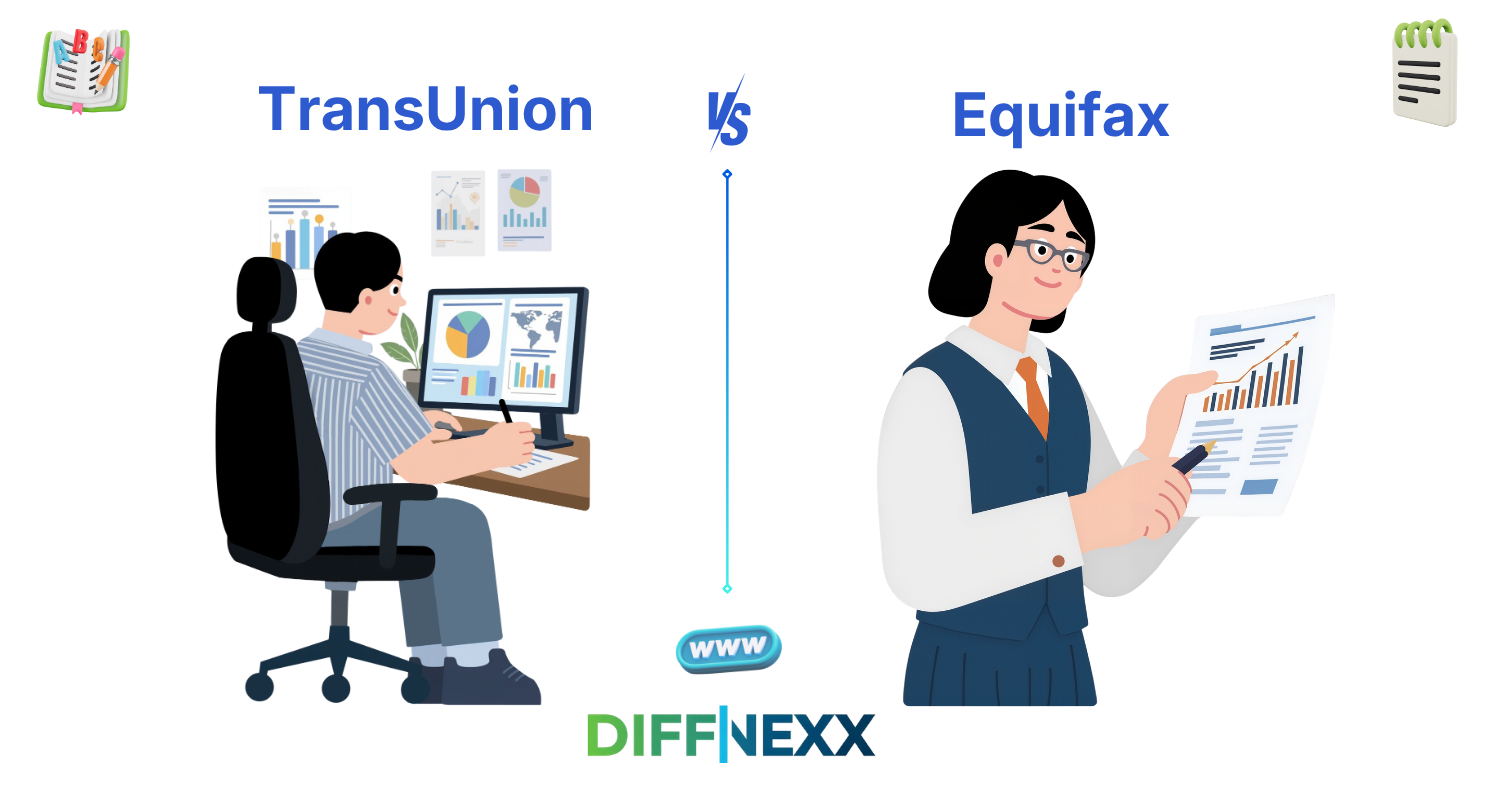
The difference between transunion and equifax is not about purpose. Both do similar jobs. The difference lies in how they collect, update, and present your credit data.
Understanding the difference between transunion and equifax helps you manage your financial health better. Let’s break it down step by step.
📌 Key Difference Between the Both
The key difference is simple:
- TransUnion focuses more on real-time updates and detailed credit monitoring tools.
- Equifax is known for strong data analytics and widely used credit scoring models.
Both provide credit reports, but their data and scoring can differ slightly.
🌍 Importance
Knowing the difference helps you understand your credit profile better.
For learners, it builds financial awareness. You can read credit reports with confidence.
For professionals, especially in finance, it helps in decision-making and risk analysis.
In society, credit affects loans, jobs, and housing. Understanding these bureaus helps you avoid costly mistakes.
🔊 Pronunciation Section
TransUnion
- US: /trænzˈjuːniən/
- UK: /trænzˈjuːniən/
Equifax
- US: /ˈɛkwɪfæks/
- UK: /ˈekwɪfæks/
Now that you can say them correctly, let’s understand what they actually do.
📚 Core Definitions
TransUnion
TransUnion is a credit reporting agency that collects financial data about consumers. It tracks credit usage, payment history, and account activity. It often updates data more frequently.
Example:
- A lender checks your TransUnion report before approving a credit card.
Equifax
Equifax is another major credit bureau that gathers and analyzes credit data. It is known for its deep data insights and long history in credit reporting.
Example:
- A bank reviews your Equifax report before giving a loan.
📚 10 Clear Differences Between TransUnion and Equifax
1. Data Collection Sources
Both collect data from lenders, but sources may vary. This leads to small differences.
Example for TransUnion:
- Your credit card appears earlier.
Example for Equifax:
- Your loan update appears later.
2. Update Frequency
TransUnion often updates data more frequently. Equifax may update on a different schedule.
Example for TransUnion:
- Payment reflects quickly.
Example for Equifax:
- Payment shows after a few days.
3. Credit Score Variation
Scores may differ slightly due to data differences.
Example for TransUnion:
- Score shows 720.
Example for Equifax:
- Score shows 710.
4. Reporting Style
TransUnion reports are often simpler. Equifax reports can be more detailed.
Example for TransUnion:
- Easy-to-read summary.
Example for Equifax:
- More technical details.
5. Fraud Protection
Both offer fraud alerts, but tools may differ.
Example for TransUnion:
- Real-time alerts.
Example for Equifax:
- Strong identity monitoring.
6. Global Presence
TransUnion operates in several countries. Equifax has a wider global reach.
Example for TransUnion:
- Available in select regions.
Example for Equifax:
- Operates worldwide.
7. Data Analytics
Equifax is known for advanced analytics. TransUnion focuses on usability.
Example for TransUnion:
- User-friendly insights.
Example for Equifax:
- Deep risk analysis.
8. Consumer Tools
TransUnion offers simple tools. Equifax offers detailed reports and services.
Example for TransUnion:
- Basic credit tracking.
Example for Equifax:
- Advanced credit monitoring.
9. Industry Usage
Some lenders prefer one bureau over another.
Example for TransUnion:
- Used by certain credit card companies.
Example for Equifax:
- Preferred by some banks.
10. Data History Depth
Equifax may have longer historical data in some cases.
Example for TransUnion:
- Recent data focus.
Example for Equifax:
- Extended credit history.
🎯 Why Knowing the Difference Matters
Students benefit by learning how credit systems work. It builds financial literacy early.
Professionals need accurate credit data. It helps in lending and financial planning.
In daily life, your credit score affects loans, rent, and even jobs. Understanding both bureaus helps you stay prepared.
🔍 Real-world consequences of confusion
If you rely on one report only, you may miss errors in another. This can lead to loan rejection or higher interest rates.
🧠 Why People Get Confused
Similar roles
Both companies do the same job. This creates confusion.
Overlapping data
They often use similar information sources.
Context usage
People use their names interchangeably in conversation.
Informal understanding
Many users don’t study credit systems deeply.
🎭 Connotation & Emotional Tone
(Connotation = the emotional meaning associated with a word.)
TransUnion
- Positive: reliable and fast updates
- Negative: may lack deep detail
- Neutral: standard credit reporting
Example:
- I checked my TransUnion report today.
Equifax
- Positive: detailed and analytical
- Negative: complex reports
- Neutral: widely trusted bureau
Example:
- My Equifax score improved this month.
🗣 Usage in Metaphors, Similes & Idioms
These terms are technical, so idioms are rare. But you can still use them creatively:
- “My credit report is as clean as a TransUnion file.”
- “That data is as detailed as an Equifax report.”
📊 Comparison Table
| Feature | TransUnion | Equifax |
|---|---|---|
| Meaning | Credit bureau | Credit bureau |
| Tone | User-friendly | Analytical |
| Usage | Credit tracking | Risk analysis |
| Context | Consumer-focused | Data-focused |
| Formality | Neutral | Neutral |
⚖️ Which Is Better in What Situation?
When to use TransUnion
Use TransUnion when you want quick updates and simple reports. It is helpful for everyday tracking.
When to use Equifax
Use Equifax when you need detailed analysis. It is useful for deeper financial insights.
Situational clarity
Both are useful. Check both reports for a full picture of your credit.
Contextual correctness
Choose based on your need. For simplicity, use TransUnion. For detail, use Equifax.
📖 Literary or Cultural References
- Book:The Total Money Makeover (Finance, Dave Ramsey, 2003)
- Discusses credit reports and financial habits
- Movie:The Big Short (USA, 2015)
- Shows how credit systems affect the economy
❓ FAQs
1. Are TransUnion and Equifax the same?
No, they are different companies. Both collect credit data but may show different scores.
2. Why are my scores different?
Scores differ because each bureau may have slightly different data. Update timing also matters.
3. Which one do lenders use?
Lenders can use either or both. It depends on their policy.
4. Should I check both reports?
Yes, checking both helps you find errors and get a full credit picture.
5. Is one more accurate than the other?
Both are reliable. Differences come from data sources, not accuracy.
🏁 Conclusion
The difference between transunion and equifax lies mainly in how they collect, update, and present credit data. Both serve the same purpose but may show slightly different results.
Understanding this difference helps you manage your financial profile better. It allows you to check errors and improve your credit score.
When you review both reports, you gain a complete picture of your financial health. This helps you make smarter decisions.
Keep learning about credit systems and check your reports regularly. Small steps today can lead to strong financial stability in the future.

Aamer Shahzad is the founder of Diffnexx.com, a fast-growing educational platform focused on high-intent “difference between” topics. With over 8 years of experience in English language education and analytical writing, I specialize in breaking down complex “difference between” topics into clear, structured, and easy-to-understand explanations. Diffnexx.com is your go-to resource for enhancing English skills and writing with confidence.
I specializes in building search-optimized, research-driven comparison content designed for clarity, authority, and long-term digital asset value.