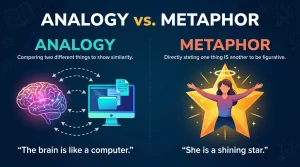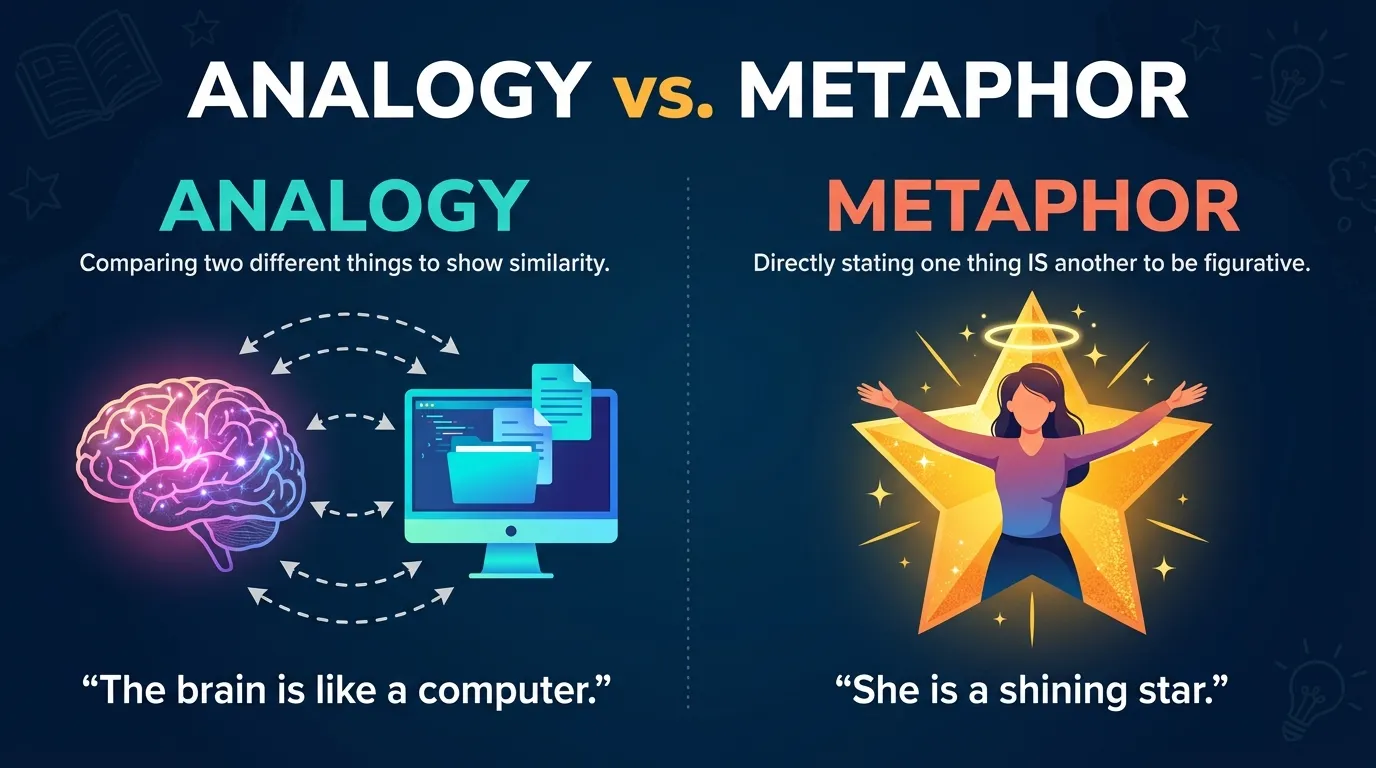
The main difference between analogy and metaphor is that an analogy explains an idea by comparing relationships or similarities between two things, while a metaphor describes one thing as another to express a figurative meaning. Both techniques make communication more effective, but they serve slightly different purposes.
Understanding the difference between analogy and metaphor helps you choose the right technique for writing, teaching, storytelling, and everyday conversations. An analogy usually provides an explanation that connects an unfamiliar concept to something familiar, while a metaphor often creates a vivid image or expresses an idea in a memorable way.
For example, saying “Learning is like building a house because both require a strong foundation” is an analogy. Saying “Learning is a journey” is a metaphor that presents learning as an experience involving progress, challenges, and discovery.
Although analogy and metaphor are closely related, they are not exactly the same. In this guide, you will learn their definitions, key differences, common types, practical examples, and when to use each technique.
Analogy vs. Metaphor: Quick Comparison
| Feature | Analogy | Metaphor |
|---|---|---|
| Definition | Compares similarities or relationships to explain an idea | Describes one thing as another figuratively |
| Main purpose | Explain or clarify | Create imagery or express meaning |
| Structure | Often a developed comparison | Usually a word, phrase, or statement |
| Length | Can be short or extended | Often concise, but can be extended |
| Language | Can be literal or figurative | Figurative |
| Common uses | Teaching, reasoning, explanations | Literature, speeches, creative writing |
| Example | Learning is like exercising because both improve with practice | Learning is a journey |
| Main benefit | Makes complex concepts easier to understand | Makes ideas vivid and memorable |
| Potential limitation | May oversimplify a concept | May be ambiguous or overused |
| Relationship | Can include metaphors | Can form part of an analogy |
The most important distinction is their purpose. An analogy generally develops a comparison to explain something, while a metaphor uses figurative language to communicate an idea or create an image.
What Is an Analogy?
An analogy is a comparison between two different things that share a relevant similarity or relationship. It helps explain an unfamiliar concept by connecting it to something the audience already understands.
Analogies are commonly used in education, science, business, writing, and everyday communication. They can make complicated ideas easier to understand without requiring readers to have specialized knowledge.
For example:
“Learning a new language is like building a house. You need a strong foundation before adding more complex structures.”
In this analogy, the foundation represents basic vocabulary and grammar, while the house’s additional structures represent advanced language skills.
How Does an Analogy Work?
An analogy identifies a familiar situation and explains how its characteristics relate to a different subject.
It typically involves three elements:
- The subject: The concept you want to explain.
- The comparison: A familiar object, situation, or process.
- The shared relationship: The similarity that helps explain the subject.
For example, comparing the human brain to a computer can help explain information processing and memory. However, the comparison has limits because human brains and computers do not function in exactly the same way.
Common Types of Analogies
1. Explanatory analogy
An explanatory analogy makes an unfamiliar or complicated concept easier to understand.
Example: “An electrical circuit is like a water pipe system because both involve flow through a connected pathway.”
2. Functional analogy
A functional analogy compares things that perform similar roles.
Example: “A project manager is like an orchestra conductor because both coordinate different people toward a shared goal.”
3. Relational analogy
A relational analogy focuses on the relationship between two pairs of things.
Example: “A teacher is to a student as a coach is to an athlete.”
4. Extended analogy
An extended analogy develops a comparison across several sentences or paragraphs to explain a broader concept.
Example: A writer might compare learning to planting a garden, explaining how preparation, consistent care, patience, and time contribute to growth.
These categories can overlap. They describe common ways analogies are used rather than a universally fixed classification.
Benefits of Analogies
Analogies offer several advantages:
- Simplify complex ideas: They connect unfamiliar concepts to familiar experiences.
- Improve learning: They help students understand abstract subjects.
- Clarify relationships: They show how different concepts share similar characteristics.
- Support explanations: They make technical information easier to communicate.
- Improve retention: A familiar comparison can make information easier to remember.
Limitations of Analogies
Analogies can also cause problems when used carelessly.
- They may oversimplify complex subjects.
- Readers may assume that two things are identical rather than merely similar.
- An unfamiliar comparison can create confusion.
- A weak analogy can make an argument less convincing.
The best analogies highlight relevant similarities while acknowledging important differences.
What Is a Metaphor?
A metaphor is a figure of speech that describes one thing as another to suggest a shared quality, characteristic, or meaning. It does not intend to make a literal statement.
For example, “Time is money” is a metaphor. Time is not literally currency, but the expression suggests that time is valuable and should be used carefully.
Metaphors are widely used in literature, poetry, advertising, speeches, and everyday conversations. They help writers communicate feelings, describe abstract ideas, and create memorable images.
How Does a Metaphor Work?
A metaphor transfers qualities associated with one thing to another.
Consider this example:
“Her voice was music to my ears.”
The voice is not literally music. The metaphor suggests that hearing it was pleasant, comforting, or enjoyable.
Readers interpret metaphors using context and their understanding of the qualities being associated with the subject.
Common Types of Metaphors
1. Direct metaphor
A direct metaphor explicitly describes one thing as another.
Example: “The classroom was a zoo.”
This suggests that the classroom was noisy, chaotic, or difficult to manage.
2. Implied metaphor
An implied metaphor suggests a comparison without directly identifying both things.
Example: “He barked orders at his team.”
The word “barked” suggests that his commands were sharp, forceful, or aggressive.
3. Extended metaphor
An extended metaphor develops the same figurative comparison across several sentences, paragraphs, or an entire literary work.
Example: A writer describes life as a journey and continues with references to crossroads, obstacles, destinations, and unexpected turns.
4. Mixed metaphor
A mixed metaphor combines images that do not fit together naturally.
Example: “Let’s get the ball rolling and cross that bridge when we come to it.”
This combines two expressions with different images. Mixed metaphors can be intentional for humor, but accidental combinations may make writing confusing.
Benefits of Metaphors
Metaphors can improve communication in several ways:
- Make writing more vivid and expressive.
- Communicate emotions and abstract ideas efficiently.
- Help readers visualize unfamiliar experiences.
- Add personality to speeches and stories.
- Make phrases more memorable.
Limitations of Metaphors
Metaphors also have limitations:
- Their meaning may be unclear without context.
- Overused metaphors can sound predictable or clichéd.
- Readers may interpret the same metaphor differently.
- Figurative language may sacrifice precision for emotional impact.
A good metaphor uses an appropriate image that supports the writer’s intended meaning.
Difference Between Analogy and Metaphor With Examples
Examples make the distinction easier to understand because both techniques can communicate similar ideas in different ways.
Example 1: Learning
Analogy: Learning a skill is like training for a marathon because both require consistent effort, practice, and patience.
Metaphor: Learning is a marathon.
The analogy explains several shared characteristics, while the metaphor communicates the same general idea more briefly.
Example 2: Time
Analogy: Managing time is like managing money because both involve limited resources and decisions about how to use them.
Metaphor: Time is money.
The analogy develops the relationship between time and money. The metaphor expresses the idea that time is valuable.
Example 3: Emotions
Analogy: Anger can be like a fire because it may grow when fueled and cause harm when left uncontrolled.
Metaphor: Anger is a fire.
The analogy explains how anger may behave in certain situations, while the metaphor creates a vivid image of anger.
Example 4: Education
Analogy: A teacher is like a guide who helps students navigate unfamiliar territory.
Metaphor: A teacher is a compass.
The analogy explains a teacher’s guiding role, while the metaphor presents that role through the image of a compass.
Example 5: Business
Analogy: Running a business is like sailing a ship because both require planning, teamwork, and adjustments when conditions change.
Metaphor: The business is a ship navigating rough waters.
The analogy explains similarities between business management and sailing. The metaphor creates an image of business challenges and uncertainty.
When Should You Use an Analogy or a Metaphor?
The best choice depends on what you want your reader to understand or feel.
Use an Analogy to Explain an Idea
Choose an analogy when your primary goal is to clarify a complicated concept.
Analogies are particularly useful for:
- Teaching scientific or technical concepts.
- Explaining unfamiliar processes.
- Comparing relationships between ideas.
- Helping beginners understand abstract subjects.
- Supporting arguments by highlighting relevant similarities.
For example, a teacher might explain internet data packets by comparing them to packages traveling through a delivery network. This makes the basic process easier to visualize without requiring advanced technical knowledge.
However, the teacher should also explain where the comparison stops being accurate.
Use a Metaphor to Create an Impression
Choose a metaphor when you want to communicate an idea vividly, express emotion, or make your writing more engaging.
Metaphors work particularly well in:
- Poetry and fiction.
- Speeches and presentations.
- Advertising and slogans.
- Descriptions of emotions and personal experiences.
- Memorable headlines and creative writing.
For example, “Hope is a light in the darkness” creates an image of hope providing comfort or direction during difficult times.
Can You Use Both Together?
Yes. Combining analogy and metaphor can make writing both clear and memorable.
For example:
“Knowledge is a key that opens doors. Learning works like collecting the right keys for different locks because each new skill helps you access opportunities that were previously unavailable.”
The first sentence uses a metaphor. The second develops an analogy by explaining the relationship between skills and opportunities.
Analogy vs. Metaphor in Literature and Everyday Writing
Both techniques are valuable, but writers often choose them for different reasons.
| Situation | Useful technique | Example |
|---|---|---|
| Explaining a difficult concept | Analogy | A computer network is like a road system |
| Writing a poem | Metaphor | The city was a sleeping giant |
| Teaching children | Analogy | The heart works like a pump |
| Expressing emotion | Metaphor | My heart is broken |
| Explaining a process | Analogy | Saving money is like filling a reservoir |
| Writing a memorable slogan | Metaphor | Your future is a blank canvas |
These are practical preferences rather than strict rules. Metaphors can explain concepts, and analogies can appear in creative writing.
Common Mistakes to Avoid
1. Assuming Analogy and Metaphor Mean Exactly the Same Thing
Both involve comparison, but their purposes often differ. An analogy generally explains a similarity or relationship, while a metaphor uses figurative identification to create meaning.
How to avoid it: Ask whether your main goal is to explain a relationship or create a vivid image.
2. Thinking Every Analogy Uses “Like” or “As”
These words often appear in comparisons, but analogies do not require them. An analogy can develop a relationship through several sentences.
How to avoid it: Focus on the relationship being explained rather than specific words.
3. Confusing Metaphors With Similes
A simile explicitly compares things using words such as “like” or “as.” A metaphor makes a figurative identification.
- Simile: “Her smile was like sunshine.”
- Metaphor: “Her smile was sunshine.”
How to avoid it: Check whether the comparison uses “like” or “as” explicitly or presents one thing figuratively as another.
4. Using Weak or Misleading Analogies
An analogy can sound convincing even when its similarities are irrelevant or inaccurate.
How to avoid it: Ensure that the shared characteristics genuinely support your explanation, and acknowledge important differences.
5. Making Metaphors Too Complicated
Combining too many unrelated images can make figurative writing difficult to understand.
How to avoid it: Use clear, relevant imagery that supports the intended message.
Frequently Asked Questions
What is the main difference between analogy and metaphor?
An analogy compares two things to explain a similarity or relationship, while a metaphor describes one thing as another to express a figurative meaning. Analogies often provide more explanation, whereas metaphors are frequently shorter and more expressive.
Is a metaphor a type of analogy?
A metaphor can function as an analogy because it compares things through shared characteristics. However, not every analogy is a metaphor. Analogies can also use literal comparisons and detailed explanations.
What is an example of an analogy and a metaphor?
An analogy is, “Learning a language is like building a house because both require a strong foundation.” A metaphor is, “Learning is a journey.” The analogy explains a relationship, while the metaphor creates a figurative image.
Can an analogy contain a metaphor?
Yes. A writer can introduce a metaphor and then develop it into a longer analogy. For example, describing knowledge as a key and explaining how different skills unlock different opportunities combines figurative language with an explanatory comparison.
Which is better for writing, analogy or metaphor?
Neither is always better. An analogy is useful when readers need to understand a complex idea, while a metaphor is useful when you want to create vivid imagery or communicate emotion. Choose according to your purpose and audience.
What is the difference between a metaphor and a simile?
A metaphor describes one thing as another, such as “The classroom was a zoo.” A simile explicitly compares two things using “like” or “as,” such as “The classroom was like a zoo.”
Why are analogies important in education?
Analogies help students connect unfamiliar concepts to familiar experiences. They can make abstract ideas easier to understand, although teachers should explain the limits of a comparison to prevent misconceptions.
Can analogies and metaphors be used in the same sentence?
Yes. For example, “Time is a river, and managing your schedule is like navigating its current.” The first clause uses a metaphor, while the second uses an analogy to explain a practical relationship.
Conclusion
The difference between analogy and metaphor lies primarily in their purpose and how they communicate comparisons. An analogy explains an idea by highlighting similarities or relationships between two things, while a metaphor describes one thing as another to create figurative meaning.
Use an analogy when you want to make an unfamiliar concept easier to understand. Choose a metaphor when you want your writing to be more vivid, expressive, or memorable. You can also combine both techniques to explain an idea clearly while making it engaging.
Understanding these differences can help you become a more effective writer, teacher, student, and communicator.
External Sources
- Texas A&M University Writing Center — Rhetorical Terms
- University of Colorado Colorado Springs — Literary Devices
- Utah Valley University Writing Center — Select Literary Devices
- University of Maryland Global Campus — Writing to Describe
- Memorial University of Newfoundland Writing Centre — Figurative Devices

Anton Reyes is a contributing writer at DiffNexx.com, where he explores meaningful differences in language, culture, and everyday concepts. With a background in creative nonfiction, Anton brings clarity and balance to complex comparisons. His writing helps readers understand subtle distinctions in words and ideas, making learning both insightful and engaging.