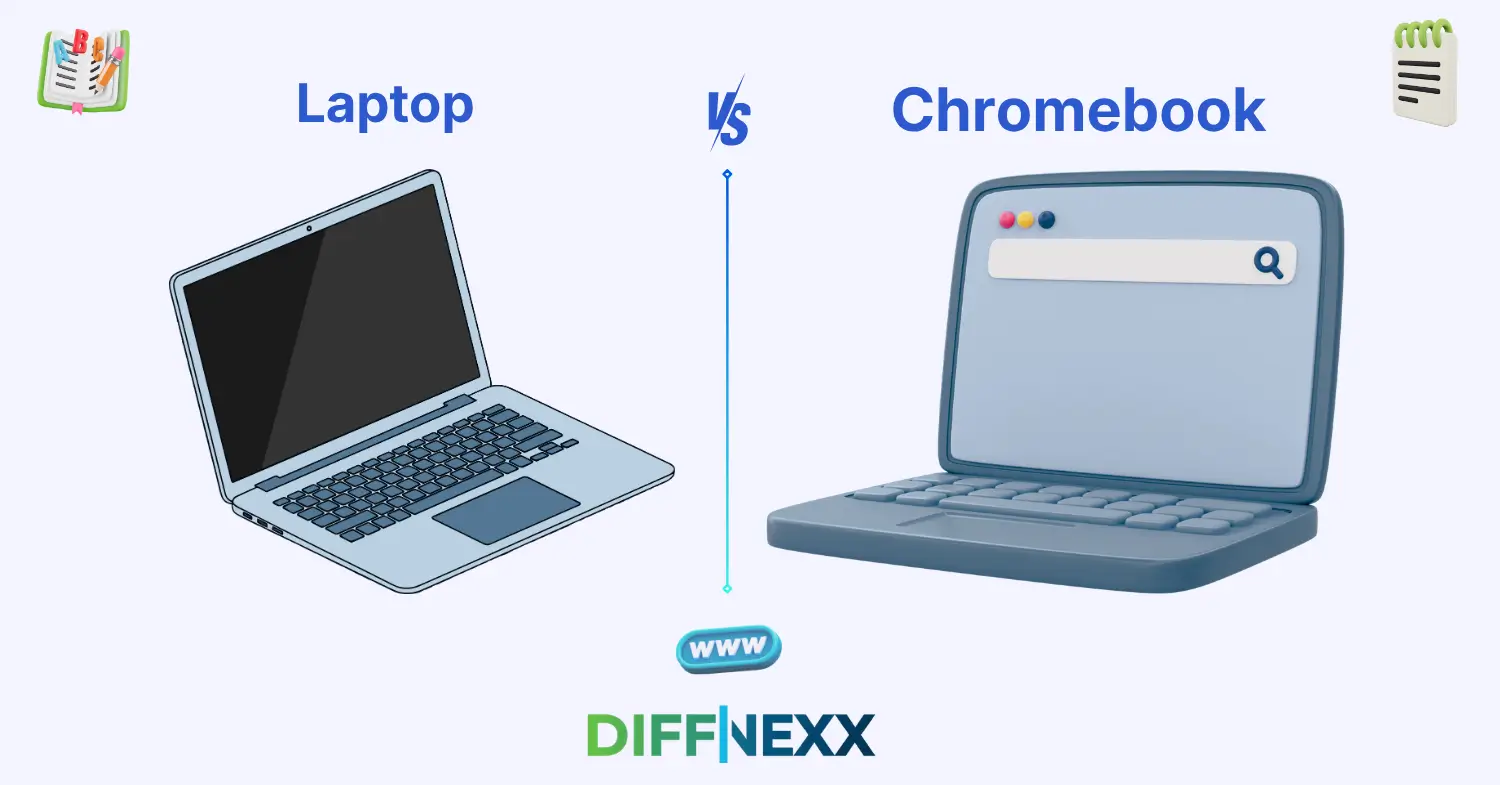
Difference between laptop and Chromebook is something many people wonder about when buying a new computer. Imagine you walk into a store and see two similar-looking devices one is a laptop, and the other is a Chromebook. Which one should you pick?
The difference between laptop and Chromebook mainly lies in their operating systems, performance, and usage style. While both are portable computers, they are designed for different types of users.
Many buyers feel confused because they look alike. But understanding the difference between laptop and Chromebook helps you choose the right device for your needs, whether it’s study, work, or entertainment.
Let’s break it down in a simple and clear way.
Key Difference Between the Both
The main difference is:
- A laptop runs full operating systems like Windows or macOS and supports many applications.
- A Chromebook runs Chrome OS and mainly works with web-based apps.
So, laptops offer full power and flexibility, while Chromebooks focus on simplicity and online use.
Importance – Why Knowing the Difference Matters
Understanding this difference is important for students, professionals, and everyday users.
For students, it helps choose the right device for schoolwork. Some tasks need full software, while others work fine online.
For professionals, the choice affects productivity. Designers or developers may need powerful laptops, while basic users may prefer Chromebooks.
In society, this knowledge helps people spend wisely. It prevents buying a device that does not meet their needs.
🔊 Pronunciation Section
Laptop
US: /ˈlæp.tɑːp/
UK: /ˈlæp.tɒp/
Chromebook
US: /ˈkroʊm.bʊk/
UK: /ˈkrəʊm.bʊk/
Now that you can say them correctly, let’s understand what they really mean.
📚 Core Definitions
Laptop
A laptop is a portable computer that runs full operating systems and supports a wide range of software. It can handle tasks like gaming, coding, and video editing.
Example: A student uses a laptop to run Microsoft Word and Photoshop.
Chromebook
A Chromebook is a lightweight computer designed for internet-based tasks. It relies on cloud apps and online storage.
Example: A user writes documents using Google Docs on a Chromebook.
📚 10 Clear Differences Between Laptop and Chromebook
1. Operating System
Laptops use full systems like Windows or macOS. Chromebooks use Chrome OS.
- Example (Laptop): Install many programs.
- Example (Chromebook): Use browser-based apps.
2. Performance Power
Laptops are more powerful. Chromebooks are lighter.
- Example (Laptop): Run heavy software.
- Example (Chromebook): Handle basic tasks.
3. Software Support
Laptops support almost all apps. Chromebooks support limited apps.
- Example (Laptop): Use Adobe software.
- Example (Chromebook): Use web apps.
4. Internet Dependency
Chromebooks rely more on internet. Laptops work offline easily.
- Example (Laptop): Edit files offline.
- Example (Chromebook): Needs internet for full use.
5. Price Range
Chromebooks are usually cheaper. Laptops vary in price.
- Example (Laptop): High-end models are expensive.
- Example (Chromebook): Budget-friendly.
6. Storage Type
Laptops use local storage. Chromebooks use cloud storage.
- Example (Laptop): Save files on hard drive.
- Example (Chromebook): Save files online.
7. Battery Life
Chromebooks often last longer. Laptops vary.
- Example (Laptop): Battery depends on usage.
- Example (Chromebook): Optimized for long life.
8. Security
Chromebooks are more secure by design. Laptops need extra protection.
- Example (Laptop): Requires antivirus.
- Example (Chromebook): Built-in security features.
9. Target Users
Laptops suit professionals and gamers. Chromebooks suit students and casual users.
- Example (Laptop): Used for coding.
- Example (Chromebook): Used for browsing.
10. Flexibility
Laptops offer more flexibility. Chromebooks are simpler.
- Example (Laptop): Customize software.
- Example (Chromebook): Limited customization.
🎯 Why Knowing the Difference Matters
Students need this knowledge to pick the right study tool. A wrong choice can limit their work.
Professionals must choose devices based on job needs. For example, designers need powerful laptops.
For society, it helps avoid waste. People can buy devices that match their real needs.
Real-world consequences of confusion
Buying a Chromebook for heavy tasks can lead to frustration. Choosing a laptop for simple tasks may waste money.
🧠 Why People Get Confused
Similar Appearance
Both devices look almost the same.
Semantic Overlap
Both are portable computers, so people assume they are identical.
Context-Based Usage
Stores often display them together, adding confusion.
Informal Speech
People call all portable computers “laptops.”
🎭 Connotation & Emotional Tone
Connotation = the emotional meaning associated with a word.
Laptop
- Neutral to powerful
- Seen as professional and capable
- Example: “I need a laptop for serious work.”
Chromebook
- Neutral to simple
- Seen as easy and beginner-friendly
- Example: “A Chromebook is great for basic tasks.”
🗣 Usage in Metaphors, Similes & Idioms
These words appear in comparisons:
- “This system works like a laptop powerful and flexible.”
- “This tool is like a Chromebook simple and efficient.”
These show complexity vs simplicity.
📊 Comparison Table
| Feature | Laptop | Chromebook |
|---|---|---|
| Meaning | Full computer system | Web-based computer |
| Tone | Powerful | Simple |
| Usage | Advanced tasks | Basic tasks |
| Context | Professional work | Everyday use |
| Formality | Formal | Semi-formal |
⚖️ Which Is Better in What Situation?
When to use Laptop
Use a laptop for heavy tasks like video editing, coding, or gaming. It works best for professionals and advanced users.
When to use Chromebook
Use a Chromebook for browsing, online classes, and simple work. It is ideal for students and casual users.
Situational clarity
Choose based on your needs. If you need power, pick a laptop. If you need simplicity, pick a Chromebook.
Contextual correctness
Always match the device to your tasks. For example, a Chromebook is great for Google Docs, but not for high-end software.
📖 Literary or Cultural References
- Book: The Innovators (Technology, Walter Isaacson, 2014)
- Movie: The Social Network (USA, 2010) – shows the role of computers in modern innovation.
❓ FAQs
1. Is a Chromebook the same as a laptop?
No, a Chromebook is a type of laptop but with a different operating system and limited capabilities.
2. Can Chromebooks work offline?
Yes, but with limited features. Most functions work best with an internet connection.
3. Which is better for students?
Chromebooks are better for basic school tasks. Laptops are better for advanced studies.
4. Can I install software on a Chromebook?
You can install some apps, but not all traditional software like on laptops.
5. Are Chromebooks cheaper than laptops?
Yes, most Chromebooks are more affordable than traditional laptops.
🏁 Conclusion
The difference between laptop and Chromebook comes down to power, flexibility, and purpose. Laptops offer full performance and support for many programs, while Chromebooks focus on simplicity and online tasks.
Understanding this difference helps you choose wisely. It saves money and ensures your device matches your needs.
Whether you need a powerful machine or a simple tool, knowing the right option makes all the difference. Keep learning and make smart tech choices for your future.

Anton Reyes is a contributing writer at DiffNexx.com, where he explores meaningful differences in language, culture, and everyday concepts. With a background in creative nonfiction, Anton brings clarity and balance to complex comparisons. His writing helps readers understand subtle distinctions in words and ideas, making learning both insightful and engaging.