Difference between violin and viola becomes clear when you watch an orchestra for the first time. A music student once asked why two players held instruments that looked almost the same but produced different sounds. The teacher smiled and explained that one was a violin and the other was a viola.
The difference between violin and viola is not only about size. These two instruments belong to the same string family, but they produce different tones, play different roles, and require slightly different techniques.
Many beginners feel confused about the difference between violin and viola because they look very similar. However, musicians know that each instrument has its own sound, purpose, and style.
In this guide, we will explain their meanings, differences, importance, and real-life use step by step.
Key difference between the both
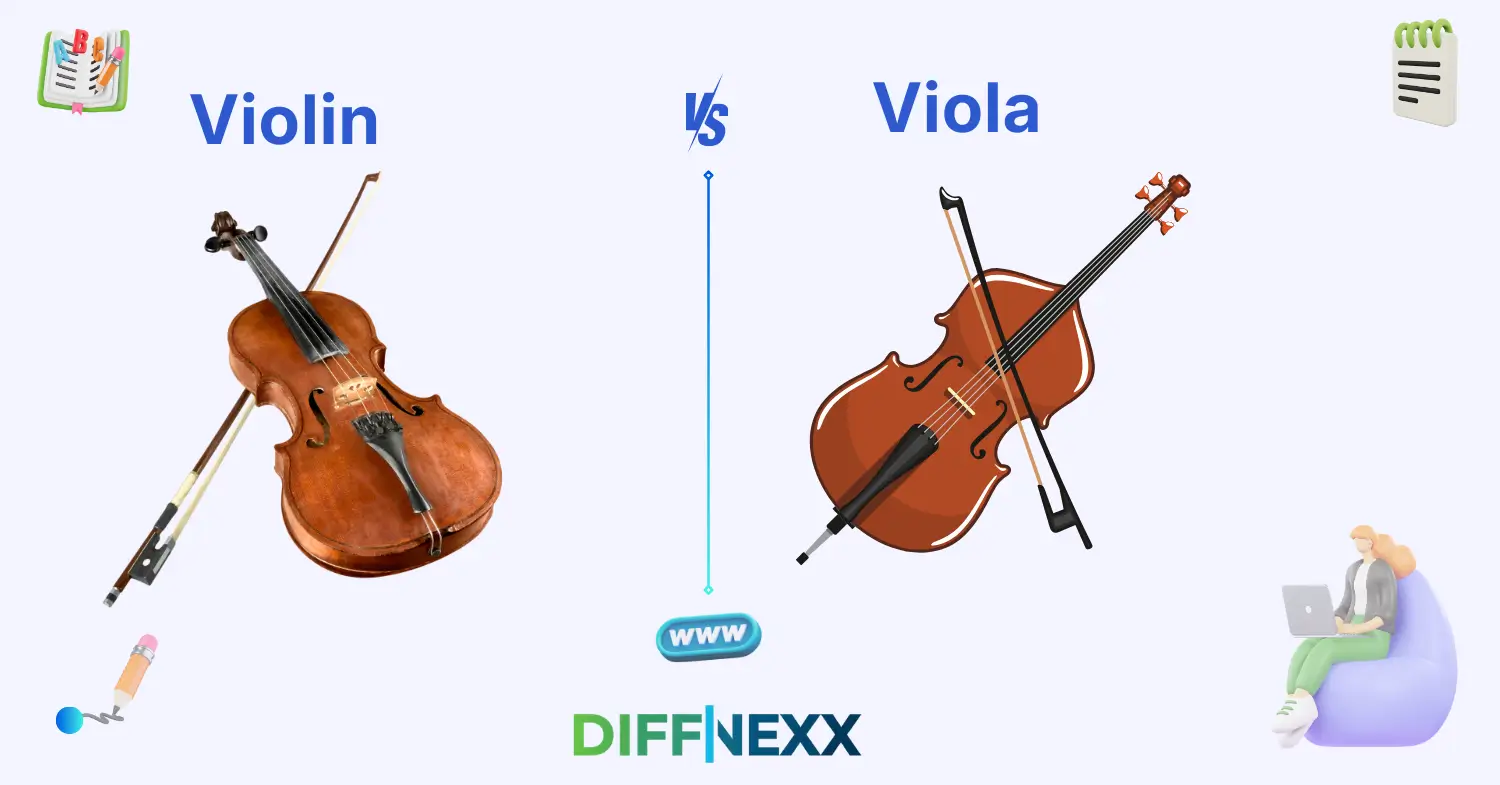
The main difference between violin and viola is that the violin is smaller and produces a higher sound, while the viola is larger and produces a deeper sound.
Violin → higher pitch, smaller size
Viola → lower pitch, bigger size
The violin usually plays melody, while the viola often plays harmony.
Why is their difference necessary to know
Understanding the difference between violin and viola is important for music students, teachers, and performers.
In society, orchestras, bands, and music schools use both instruments. Each has a special role, and mixing them can change the sound of the music.
Professionals must know the difference to choose the right instrument for the right music.
Learners must know the difference to learn correct technique.
Knowing this difference helps people understand classical music, concerts, and musical culture better.
🔊 Pronunciation Section
Violin
US (US): /ˌvaɪəˈlɪn/
UK (UK): /ˌvaɪəˈlɪn/
Viola
US (US): /viˈoʊlə/
UK (UK): /viˈəʊlə/
Now that we know how to say the words, let us understand what each instrument means before comparing them.
Core Definitions
Violin
The violin is a small string instrument played with a bow.
It produces a high and bright sound.
It is the most common instrument in orchestras.
Example:
A violin often plays the main melody in classical music.
Tone: bright, sharp, clear.
Viola
The viola is a larger string instrument similar to the violin.
It produces a deeper and warmer sound.
It usually plays harmony in music.
Example:
The viola supports the melody in an orchestra.
Tone: warm, soft, rich.
10 Clear Differences Between Violin and Viola
1. Size
The violin is smaller.
The viola is bigger.
Example for Violin:
Easy to hold for children
Example for Viola:
Larger body, longer neck
2. Sound pitch
Violin has high pitch.
Viola has low pitch.
Example for Violin:
Sharp, bright sound
Example for Viola:
Deep, warm sound
3. Role in music
Violin plays melody.
Viola plays harmony.
Example for Violin:
Lead part in orchestra
Example for Viola:
Background support
4. String tuning
Violin tuning: G D A E
Viola tuning: C G D A
Example for Violin:
Higher top string
Example for Viola:
Lower bottom string
5. Weight
Violin is lighter.
Viola is heavier.
Example for Violin:
Comfortable for beginners
Example for Viola:
Needs stronger arm
6. Tone quality
Violin sound is bright.
Viola sound is warm.
Example for Violin:
Clear solo sound
Example for Viola:
Soft background sound
7. Music reading
Violin uses treble clef.
Viola uses alto clef.
Example for Violin:
Common in beginner books
Example for Viola:
Used in orchestra music
8. Popularity
Violin is more popular.
Viola is less common.
Example for Violin:
Many solo players
Example for Viola:
Fewer solo concerts
9. Learning difficulty
Violin easier for beginners.
Viola needs more strength.
Example for Violin:
Small hands fit well
Example for Viola:
Needs longer reach
10. Emotional effect
Violin sounds excited.
Viola sounds calm.
Example for Violin:
Fast happy music
Example for Viola:
Slow emotional music
Why Knowing the Difference Matters
Students must know the difference between violin and viola to choose the right instrument. Learning the wrong one can make practice harder.
Professionals must know the difference because orchestras need correct balance of sound. Each instrument has its own job.
In society, music teachers, composers, and performers must understand the difference to create beautiful music.
Real-world consequences of confusion
Wrong instrument → wrong sound
Wrong sound → bad performance
Bad performance → poor music quality
Why People Get Confused
Similar look
Both instruments look almost the same.
Similar names
Violin and viola sound alike.
Same family
Both belong to string instruments.
Informal speech
People call both simply “violin”.
Connotation & Emotional Tone
Connotation = emotional meaning attached to a word.
Violin
Positive: beauty, melody
Example: violin solo
Neutral: music instrument
Negative: rare, but can mean sad sound
Viola
Positive: warm, rich sound
Example: viola harmony
Neutral: orchestra instrument
Negative: sometimes seen as background role
Usage in Metaphors, Similes & Idioms
Not many idioms, but used in comparisons.
Example with violin:
Her voice was like a violin.
Example with viola:
His tone was deep like a viola.
Comparison Table
| Feature | Violin | Viola |
|---|---|---|
| Meaning | Small string instrument | Larger string instrument |
| Tone | Bright | Warm |
| Usage | Melody | Harmony |
| Context | Orchestra, solo | Orchestra |
| Formality | Formal term | Formal term |
Which Is Better in What Situation?
When to use Violin
Use violin when high sound or melody is needed.
Example: solo music.
When to use Viola
Use viola when deep and warm sound is needed.
Example: orchestra harmony.
Situational clarity
Violin for lead sound.
Viola for support sound.
Contextual correctness
Choosing the right instrument makes music balanced.
Literary or Cultural References
Book:
The Violin Maker
Novel / John Marchese / 2007
Movie:
The Red Violin
Canada / 1998
Both show the importance of violin in music culture.
FAQs
1. Is viola bigger than violin?
Yes, the viola is larger and heavier.
2. Which sounds higher?
The violin sounds higher.
3. Which is easier to learn?
Violin is usually easier for beginners.
4. Do orchestras use both?
Yes, both are important in orchestra.
5. Can violin players play viola?
Yes, but they need practice because size and tuning are different.
Conclusion
The difference between violin and viola is mainly in size, sound, and role in music. The violin is smaller and produces a bright, high sound, while the viola is larger and creates a deeper, warmer tone. Both instruments are important in orchestras and music education.
Understanding this difference helps students choose the right instrument and helps listeners enjoy music more. Musicians use both instruments to create balance and harmony in songs.
Learning small differences like this makes music easier to understand. Keep exploring instruments, sounds, and styles, and your knowledge will grow step by step.

Aamer Shahzad is the founder of Distinly.com, a fast-growing educational platform focused on high-intent “difference between” topics. With over 8 years of experience in English language education and analytical writing, I specialize in breaking down complex “difference between” topics into clear, structured, and easy-to-understand explanations. Distinly.com is your go-to resource for enhancing English skills and writing with confidence.
I specializes in building search-optimized, research-driven comparison content designed for clarity, authority, and long-term digital asset value.