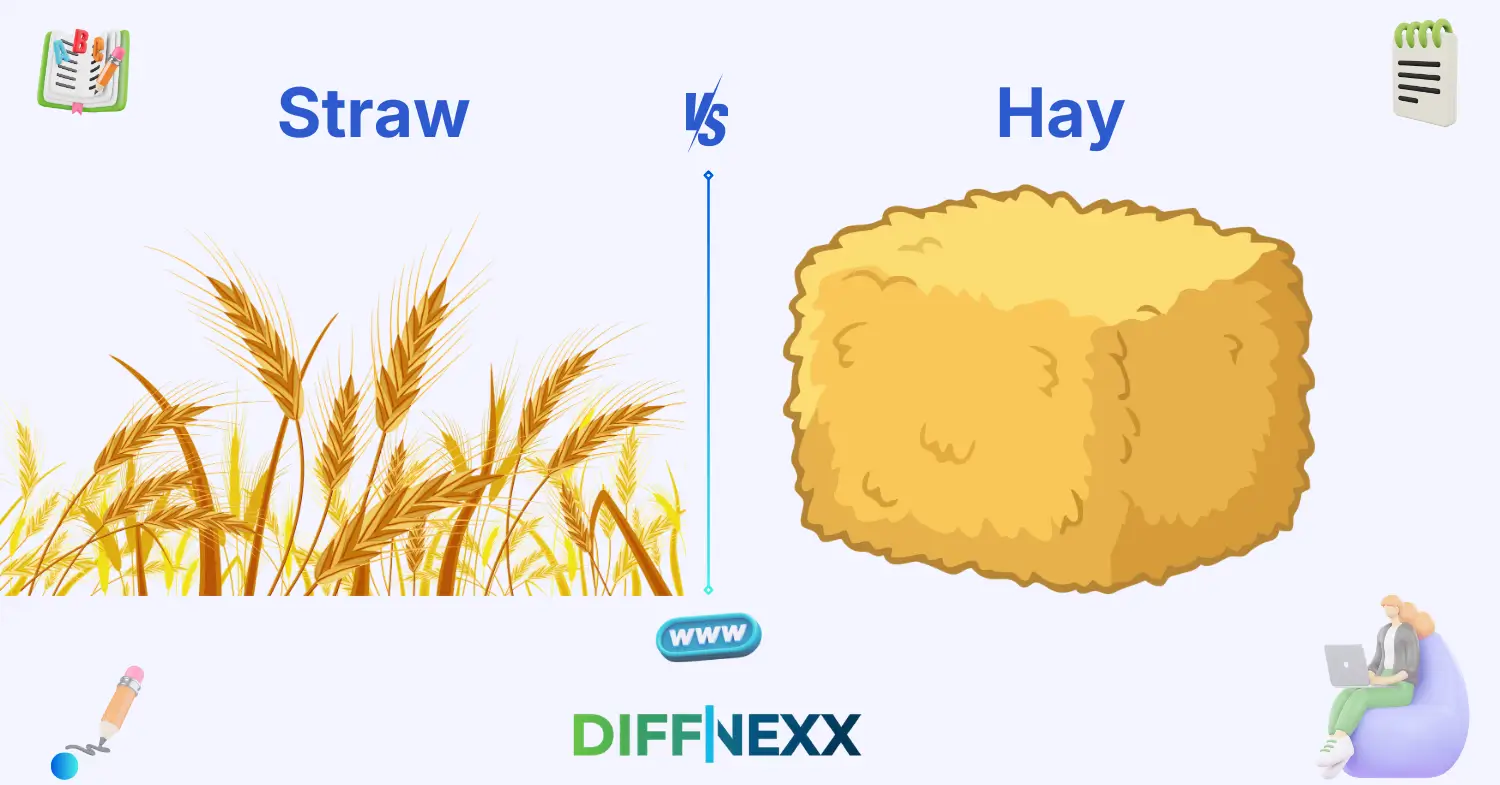
Difference between straw and hay often becomes confusing when people visit a farm for the first time. A child once saw yellow dry grass in a barn and asked the farmer, “Is this hay for the animals?” The farmer laughed and said, “No, that is straw. Hay is for eating, straw is for bedding.”
The difference between straw and hay is simple, but many people mix them up because they look similar. Both come from plants, both are dry, and both are used on farms. However, they are made in different ways and used for different purposes.
Understanding the difference between straw and hay is important not only for farmers but also for students, pet owners, gardeners, and anyone learning English vocabulary related to agriculture.
In this guide, we will explain their meanings, uses, and differences step by step so the idea becomes clear.
Key difference between the both
The main difference between straw and hay is that hay is used as animal food, while straw is used for bedding, covering, or building.
Hay comes from dried grass or plants that animals can eat.
Straw comes from the dry stems left after grains are harvested.
Hay = food
Straw = leftover plant stems
Why is the difference necessary to know for the learners and experts in society
Understanding the difference between straw and hay is important for farmers, animal owners, and agriculture students.
Animals need hay for nutrition, but straw does not give enough food. If someone gives straw instead of hay, animals may become weak.
In society, these materials are also used for gardening, building, decoration, and farming. Knowing the difference helps people use the right material for the right purpose.
Experts in farming, veterinary work, and environmental science must know this difference to avoid mistakes.
🔊 Pronunciation Section
Straw
US (US): /strɔː/
UK (UK): /strɔː/
Hay
US (US): /heɪ/
UK (UK): /heɪ/
Now that we know how to pronounce the words correctly, let us understand what each one means before comparing them.
Core Definitions
Straw
Straw is the dry stem left after wheat, rice, or other grains are harvested.
It has little nutrition and is mostly used for bedding or covering.
Example:
Farmers use straw on the floor for animals to sleep.
Tone: neutral, used in farming.
Hay
Hay is dried grass or plants cut and stored as food for animals.
It is full of nutrients and used to feed cows, horses, and goats.
Example:
Horses eat hay every day.
Tone: neutral, related to food for animals.
10 Clear Differences Between Straw and Hay
1. Purpose
Straw is used for bedding.
Hay is used for food.
Example for Straw:
Used on barn floor
Example for Hay:
Fed to horses
2. Source
Straw comes from grain stems.
Hay comes from grass or plants.
Example for Straw:
Wheat straw
Example for Hay:
Grass hay
3. Nutrition
Straw has little nutrition.
Hay has high nutrition.
Example for Straw:
Not good for feeding
Example for Hay:
Healthy for animals
4. Color
Straw is light yellow.
Hay is green or green-brown.
Example for Straw:
Dry yellow stems
Example for Hay:
Green dried grass
5. Texture
Straw is rough.
Hay is soft.
Example for Straw:
Hard stems
Example for Hay:
Soft grass
6. Smell
Straw has little smell.
Hay smells fresh.
Example for Straw:
Dry smell
Example for Hay:
Sweet smell
7. Use in farming
Straw for bedding and cover.
Hay for feeding.
Example for Straw:
Animal bedding
Example for Hay:
Animal food
8. Cost
Straw is usually cheaper.
Hay is more expensive.
Example for Straw:
Used in building
Example for Hay:
Sold as feed
9. Storage use
Straw used for insulation.
Hay stored for feeding.
Example for Straw:
Roof covering
Example for Hay:
Winter food
10. Role in agriculture
Straw is leftover.
Hay is prepared crop.
Example for Straw:
After harvest
Example for Hay:
Cut for animals
Why Knowing the Difference Matters
Students must know the difference between straw and hay to understand farming, biology, and environmental science correctly.
Professionals like farmers and veterinarians must know the difference because animals need proper food.
In society, wrong use can cause waste of money, harm to animals, or farming problems.
Real-world consequences of confusion
Giving straw instead of hay → animal becomes weak
Buying hay instead of straw → extra cost
Wrong use → farming loss
Why People Get Confused
Similar look
Both look like dry grass.
Same place
Both are found in farms.
Same color
Both are yellow or brown.
Informal speech
People say “hay” for all dry grass.
Connotation & Emotional Tone
Connotation = emotional meaning attached to a word.
Straw
Neutral meaning.
Used in farming.
Positive: natural material
Example: straw house
Negative: weak
Example: straw man
Hay
Neutral meaning.
Used as animal food.
Positive: healthy food
Example: fresh hay
Negative: none common
Usage in Metaphors, Similes & Idioms
Some idioms use these words.
Example with straw:
Last straw = final problem
Using hay as an example:
Make hay while the sun shines = use opportunity
Example sentence:
He said the mistake was the last straw.
We must make hay while the sun shines.
Comparison Table
| Feature | Straw | Hay |
|---|---|---|
| Meaning | Dry stems | Dried grass |
| Tone | Neutral | Neutral |
| Usage | Bedding, cover | Animal food |
| Context | Farming, building | Farming, feeding |
| Formality | Common word | Common word |
Which Is Better in What Situation?
When to use Straw
Use straw for bedding, covering soil, or building.
Example: animal floor.
When to use Hay
Use hay for feeding animals.
Example: cow food.
Situational clarity
Straw = support
Hay = food
Contextual correctness
Correct use keeps animals healthy and saves money.
Literary or Cultural References
Book:
Charlotte’s Web
Children’s novel / E. B. White / 1952
Shows farm life with hay and straw.
Movie:
Babe
USA / 1995
Farm animals shown with hay and straw.
FAQs
1. Is straw the same as hay?
No, straw is dry stems, and hay is animal food.
2. Can animals eat straw?
Some animals can eat small amounts, but hay is better.
3. Why is hay green?
Because it is dried grass, not stems.
4. Why is straw yellow?
Because it is the dry part after harvest.
5. Which is cheaper?
Straw is usually cheaper than hay.
Conclusion
The difference between straw and hay is easy to understand once you know their purpose. Hay is dried grass used as food for animals, while straw is the dry stem left after grain harvest and is used for bedding, covering, or building.
This difference is important for students, farmers, and anyone learning about agriculture. Using the wrong material can cause problems for animals and waste money.
By remembering one simple rule hay is food, straw is bedding you can easily tell them apart. Keep learning small differences like this, and your knowledge of English and real life will grow stronger.

Aamer Shahzad is the founder of Distinly.com, a fast-growing educational platform focused on high-intent “difference between” topics. With over 8 years of experience in English language education and analytical writing, I specialize in breaking down complex “difference between” topics into clear, structured, and easy-to-understand explanations. Distinly.com is your go-to resource for enhancing English skills and writing with confidence.
I specializes in building search-optimized, research-driven comparison content designed for clarity, authority, and long-term digital asset value.