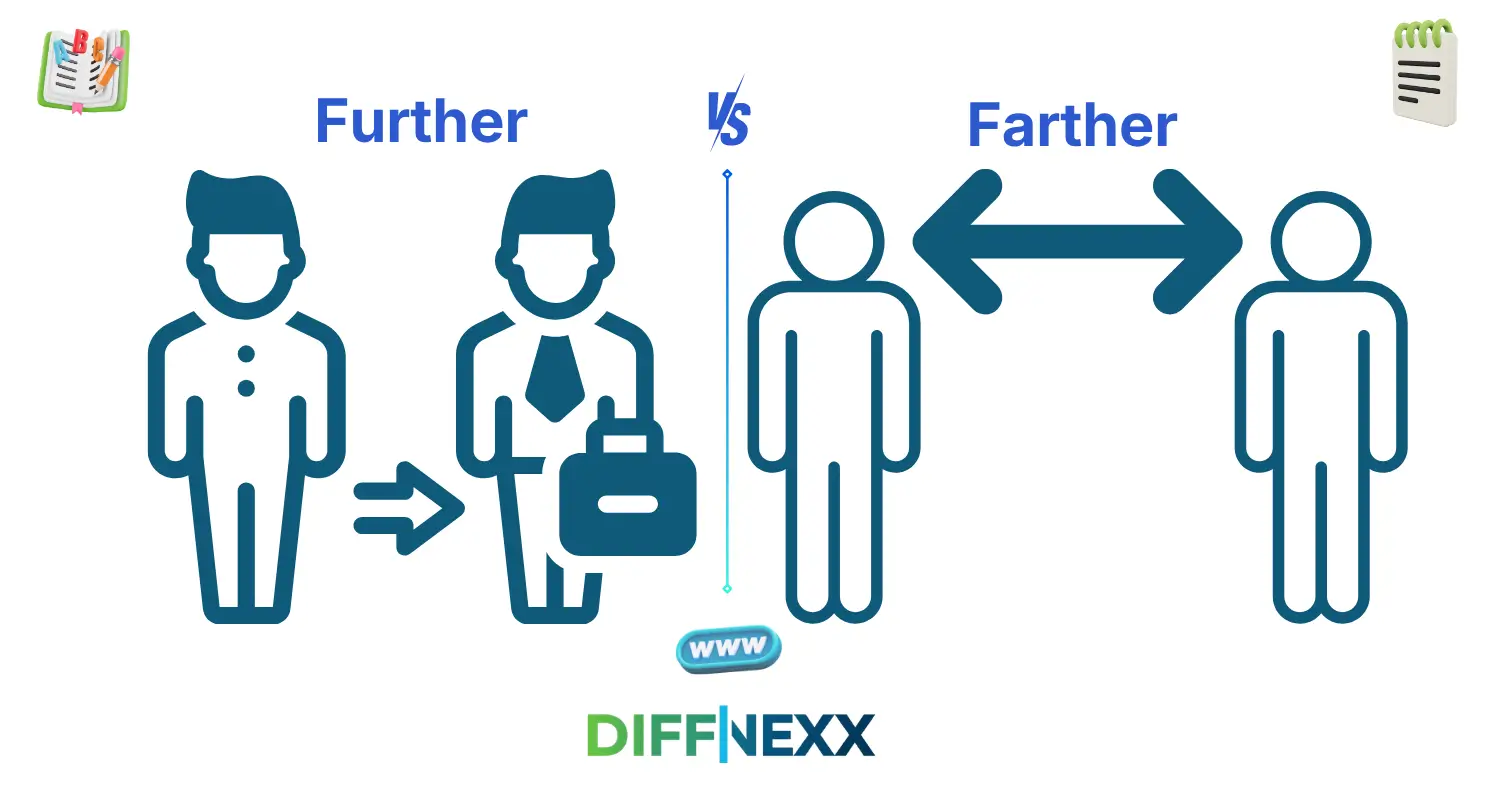
Difference between further and farther often confuses learners when they try to describe distance or progress. Imagine asking someone, “Can you go further?” or “Can you go farther?” Both sound right, but are they the same?
The difference between further and farther lies in how we use them in context. Both words relate to distance, but one is more physical, and the other can be abstract.
Many people mix them because they look and sound similar. However, once you understand the difference between further and farther, you can use them correctly with confidence.
Let’s break it down in a simple way.
Key Difference Between the Both ⚖️
The main difference between further and farther is type of distance:
- Farther refers to physical distance (measurable).
- Further refers to figurative or abstract distance (ideas, progress, time).
This simple rule helps you choose the correct word.
Importance – Why Knowing the Difference Matters 🎯
Understanding the difference between further and farther improves both writing and speaking skills.
For students, it helps avoid grammar mistakes in exams and essays. It also improves clarity in communication.
For professionals, correct usage shows strong language skills. It is especially important in formal writing.
In everyday life, using the right word helps you sound more natural and confident.
Pronunciation Section 🔊
Further
US: /ˈfɝː.ðɚ/
UK: /ˈfɜː.ðə/
Farther
US: /ˈfɑːr.ðɚ/
UK: /ˈfɑː.ðə/
Now that you know how to say them, let’s define them clearly.
Core Definitions 📚
Further
Further means “more” or “to a greater degree.” It is used for abstract ideas, progress, or time. It can also mean additional information.
Example: We need to discuss this further.
Farther
Farther means “at a greater physical distance.” It is used when you can measure distance.
Example: He walked farther than his friend.
10 Clear Differences Between Further and Farther ✍️
1. Type of Distance
Further is abstract. Farther is physical.
- Example for Further: Let’s go further in the discussion.
- Example for Farther: She ran farther than before.
2. Measurement
Farther can be measured. Further cannot always be measured.
- Example for Further: We need further explanation.
- Example for Farther: The shop is farther down the road.
3. Usage Context
Further is used in ideas. Farther is used in real-world distance.
- Example for Further: He wants to study further.
- Example for Farther: The park is farther away.
4. Meaning Extension
Further can mean “additional.” Farther cannot.
- Example for Further: Further details are required.
- Example for Farther: Incorrect usage here.
5. Formality
Further is more common in formal writing. Farther is less formal.
- Example for Further: Used in academic writing.
- Example for Farther: Used in casual speech.
6. Flexibility
Further has multiple meanings. Farther has a specific meaning.
- Example for Further: Can mean “more” or “extra.”
- Example for Farther: Only relates to distance.
7. Emotional Tone
Further feels thoughtful and analytical. Farther feels practical.
- Example for Further: Let’s think further about this.
- Example for Farther: Walk farther to reach the goal.
8. Frequency of Use
Further is used more often. Farther is used less frequently.
- Example for Further: Common in writing.
- Example for Farther: Less common overall.
9. Grammatical Role
Further can act as adjective, adverb, or verb. Farther is mainly an adverb or adjective.
- Example for Further: Further research is needed.
- Example for Farther: He went farther.
10. Expression Style
Further fits abstract expression. Farther fits physical description.
- Example for Further: We need further improvement.
- Example for Farther: The house is farther away.
Why Knowing the Difference Matters 🎯
Students need this knowledge to write clearly and correctly. It improves grammar and exam performance.
Professionals use it to maintain accuracy in formal communication. It shows attention to detail.
In social settings, correct usage helps avoid confusion and improves understanding.
Real-world Consequences of Confusion
Using the wrong word can confuse meaning, especially in instructions or directions.
Why People Get Confused 🤔
Similar Spelling
Both words look very similar.
Similar Pronunciation
They sound almost the same in fast speech.
Semantic Overlap
Both relate to distance in some way.
Informal Usage
People often use them interchangeably in casual speech.
Connotation & Emotional Tone 🎭
Connotation = the emotional meaning associated with a word.
Further
- Positive: Progress, growth
- Neutral: Additional information
- Example: Further suggests improvement.
Farther
- Positive: Movement, achievement
- Neutral: Physical distance
- Example: Farther suggests measurable effort.
Usage in Metaphors, Similes & Idioms 🗣
- “Go further in life” → progress
- “Go the extra mile (farther)” → effort
Examples:
- She wants to go further in her career.
- He walked farther than expected.
Comparison Table 📊
| Feature | Further | Farther |
|---|---|---|
| Meaning | Abstract distance | Physical distance |
| Tone | Analytical | Practical |
| Usage | Ideas, progress | Real-world distance |
| Context | Formal and informal | Mostly physical context |
| Formality | More formal | Less formal |
Which Is Better in What Situation? ⚖️
When to Use Further
Use further when talking about ideas, time, or progress. For example, “We need further discussion” is correct.
When to Use Farther
Use farther when talking about measurable distance. For example, “The store is farther away.”
Situational Clarity
Choose based on whether the distance is physical or abstract.
Contextual Correctness
Using the right word ensures clarity in both writing and speech.
Literary or Cultural References 📖
- Book: The Elements of Style by Strunk & White (Writing, 1918)
- Movie: Dead Poets Society (USA, 1989)
These highlight the importance of language and expression.
FAQs ❓
1. Can further and farther be used interchangeably?
Sometimes in informal speech, yes. However, in formal writing, it is better to follow the rule: farther for physical distance, further for abstract ideas.
2. Which one is more common?
Further is more commonly used because it has broader meanings. Farther is limited to physical distance.
3. Is it wrong to use further for distance?
In modern English, “further” is often used for both meanings. However, traditional grammar prefers “farther” for physical distance.
4. How can I remember the difference easily?
Think: “Farther” has “far” in it, so it relates to physical distance.
5. Which is better in formal writing?
Use “further” for abstract ideas and “farther” for physical distance to maintain clarity.
Conclusion 🏁
The difference between further and farther is simple but important. Farther refers to physical distance, while further relates to abstract ideas or progress. This small distinction can make your writing clearer and more precise.
By understanding and using these words correctly, you improve your communication skills and confidence. It also helps you sound more natural in both spoken and written English.
Keep practicing, and soon this difference will feel easy and natural to use.

Anton Reyes is a contributing writer at DiffNexx.com, where he explores meaningful differences in language, culture, and everyday concepts. With a background in creative nonfiction, Anton brings clarity and balance to complex comparisons. His writing helps readers understand subtle distinctions in words and ideas, making learning both insightful and engaging.