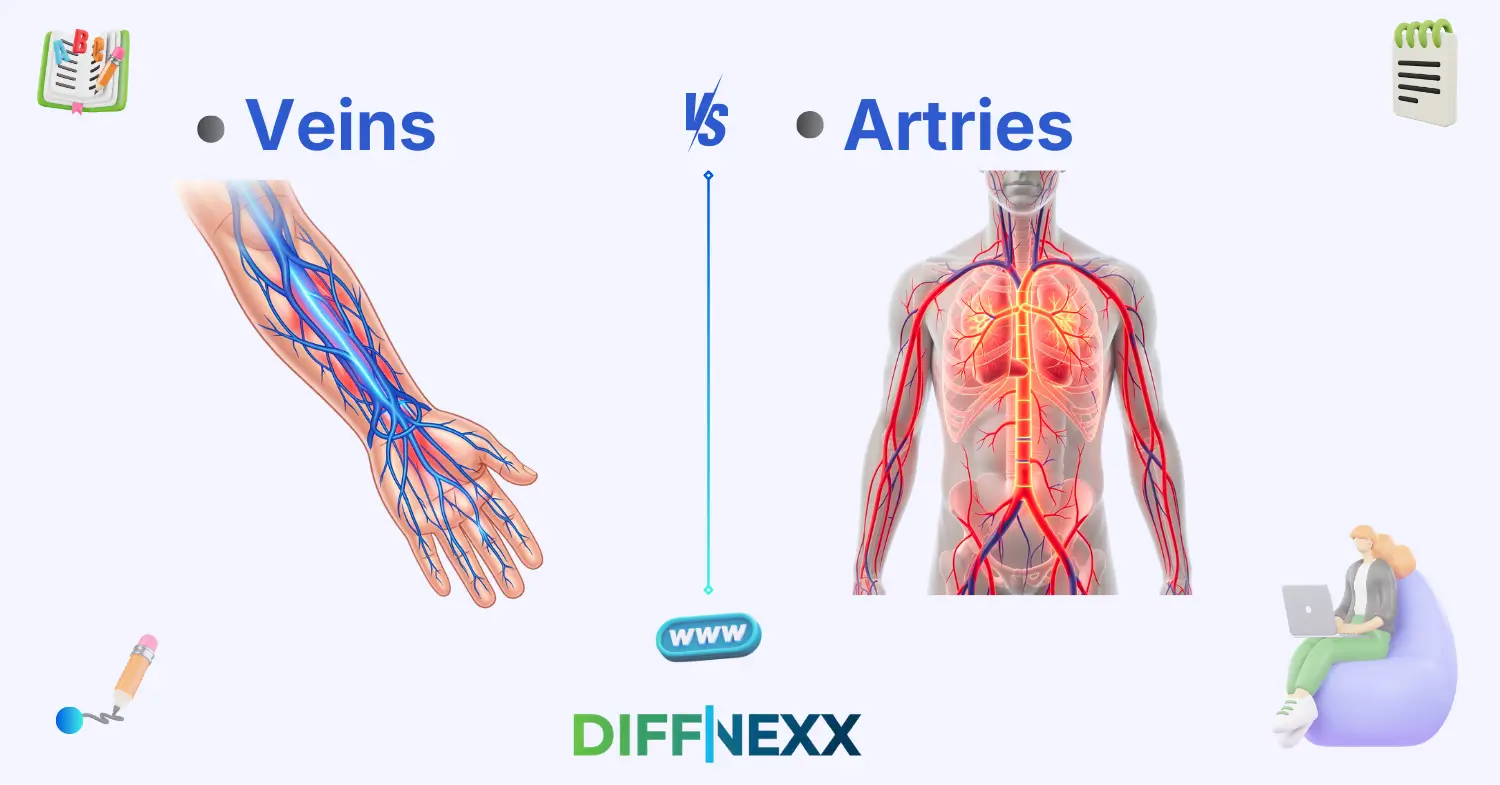
Difference between veins and arteries becomes clear the moment you feel your pulse. Place two fingers on your wrist. That steady beat you feel is blood moving through arteries. But where does the blood go after that?
The difference between veins and arteries lies in direction, structure, and function. Arteries carry blood away from the heart. Veins carry blood back to the heart. Both are blood vessels, but they play opposite roles.
Many students confuse them because both belong to the circulatory system. However, understanding the difference between veins and arteries helps you grasp how your body survives every second.
Let’s break it down in a simple, clear way.
Key Difference Between the Two
The main difference is blood flow direction.
Arteries carry blood away from the heart.
Veins carry blood toward the heart.
That single contrast shapes their structure and function.
Why Is Their Difference Necessary to Know
Students must understand this difference to learn human biology correctly. It forms the foundation of cardiovascular knowledge.
Medical professionals rely on this distinction daily. Nurses draw blood from veins, not arteries. Surgeons treat arterial blockages carefully because they carry oxygen-rich blood.
In society, health awareness saves lives. When people know how circulation works, they better understand heart disease and blood pressure.
Now, let’s clarify pronunciation before going deeper.
🔊 Pronunciation
Veins
US: /veɪnz/
UK: /veɪnz/
Arteries
US: /ˈɑːrtəriz/
UK: /ˈɑːtəriz/
Now that you know how to say them correctly, let’s define each clearly.
📚 Core Definitions
Veins
Veins are blood vessels that carry blood back to the heart. Most veins transport oxygen-poor blood. They have thinner walls and contain valves.
The tone is neutral and scientific.
Example:
Blood Return – “The veins carried blood back to the heart.”
Arteries
Arteries are blood vessels that carry blood away from the heart. Most arteries carry oxygen-rich blood. They have thick, muscular walls to handle high pressure.
The tone is also neutral and scientific.
Example:
Pulse Beat – “The arteries pushed oxygenated blood through the body.”
📚 10 Clear Differences Between Veins and Arteries
1. Direction of Blood Flow
Arteries move blood away from the heart. Veins return blood to the heart.
Example for Veins: “Veins carried blood back after circulation.”
Example for Arteries: “Arteries delivered blood from the heart.”
2. Oxygen Content
Most arteries carry oxygen-rich blood. Most veins carry oxygen-poor blood.
Example for Veins: “Veins transported deoxygenated blood.”
Example for Arteries: “Arteries supplied oxygen to muscles.”
3. Wall Thickness
Arteries have thick, elastic walls. Veins have thinner walls.
Example for Veins: “The vein collapsed easily under pressure.”
Example for Arteries: “The artery stayed firm due to thick walls.”
4. Blood Pressure Level
Arteries handle high pressure. Veins operate under lower pressure.
Example for Veins: “Veins rely on muscle movement.”
Example for Arteries: “Arteries pulse with each heartbeat.”
5. Valves
Veins contain valves to prevent backflow. Arteries usually do not need valves.
Example for Veins: “The vein valve stopped reverse flow.”
Example for Arteries: “The artery relied on pressure alone.”
6. Location in Body
Veins often appear close to the skin. Arteries usually lie deeper.
Example for Veins: “You can see blue veins on your hand.”
Example for Arteries: “Major arteries run deep in the chest.”
7. Pulse Presence
You feel a pulse in arteries. You do not feel it in veins.
Example for Veins: “The vein showed no pulse.”
Example for Arteries: “The artery beat steadily.”
8. Medical Procedures
Doctors draw blood from veins. Arterial blood sampling is more complex.
Example for Veins: “The nurse inserted a needle into a vein.”
Example for Arteries: “The doctor carefully accessed the artery.”
9. Structural Shape
Arteries keep a round shape. Veins can flatten when empty.
Example for Veins: “The vein looked flattened.”
Example for Arteries: “The artery remained circular.”
10. Health Risks
Blocked arteries can cause heart attacks. Weak veins can cause varicose veins.
Example for Veins: “Varicose veins caused discomfort.”
Example for Arteries: “Blocked arteries reduced blood flow.”
🎯 Why Knowing the Difference Matters
Students build their medical knowledge on this concept. Without clarity, advanced topics become confusing.
Healthcare workers must identify vessels correctly to avoid serious errors. Mistakes in vessel identification can cause complications.
Public awareness improves heart health understanding. When people know how arteries function, they better understand high blood pressure risks.
Real-World Consequences of Confusion
Confusing arteries with veins during treatment could lead to improper medical action. Accurate knowledge protects patient safety.
🧠 Why People Get Confused
Similar Context
Both belong to the circulatory system.
Shared Function
Both transport blood.
Academic Overlap
Biology textbooks present them together.
Informal Speech
People rarely distinguish them in daily conversation.
🎭 Connotation & Emotional Tone
Connotation = emotional meaning attached to a word.
Connotation (bold) = the emotional meaning associated with a word.
Veins
Positive: Associated with life flow.
Example: “Music runs in his veins.”
Negative: Linked to weakness in varicose conditions.
Example: “She worried about visible veins.”
Neutral: Medical description.
Example: “The veins carry blood.”
Arteries
Positive: Symbol of strength and vitality.
Example: “Energy pumped through his arteries.”
Negative: Associated with heart disease.
Example: “Clogged arteries can be dangerous.”
Neutral: Biological term.
Example: “Arteries move blood from the heart.”
🗣 Usage in Metaphors, Similes & Idioms
People often use both words metaphorically.
- “Ice in his veins” means calm under pressure.
- “The city’s arteries” refers to major roads.
Example Sentence:
“Highways act as the arteries of a city, while small streets are its veins.”
📊 Comparison Table
| Feature | Veins | Arteries |
|---|---|---|
| Meaning | Carry blood to heart | Carry blood away from heart |
| Tone | Neutral | Neutral |
| Usage | Blood return | Blood delivery |
| Context | Low pressure system | High pressure system |
| Formality | Scientific term | Scientific term |
⚖️ Which Is Better in What Situation?
When to Use Veins
Use “veins” when discussing blood returning to the heart or medical procedures like blood tests.
When to Use Arteries
Use “arteries” when discussing pulse, oxygen delivery, or heart-related conditions.
Situational Clarity
Focus on blood direction.
Contextual Correctness
In exams and healthcare settings, precision matters.
📖 Literary or Cultural References
- “Gray’s Anatomy” (Medical Textbook, Henry Gray, 1858) explains arteries and veins in detail.
- Film: “Something the Lord Made” (USA, 2004) highlights heart surgery and arterial procedures.
These works emphasize circulatory system importance.
❓ FAQs
1. Do all arteries carry oxygen-rich blood?
Most do, but pulmonary arteries carry oxygen-poor blood to the lungs. Function matters more than oxygen level.
2. Why do veins look blue?
Veins appear blue due to light reflection through the skin. The blood inside is dark red.
3. Which is more dangerous if damaged?
Arteries are more dangerous when damaged because they carry blood under high pressure.
4. Why do veins have valves?
Veins use valves to prevent blood from flowing backward, especially in the legs.
5. Can arteries become veins?
No. They have different structures and functions from birth.
🏁 Conclusion
The difference between veins and arteries centers on direction, structure, and pressure. Arteries carry blood away from the heart under high pressure. Veins return blood under lower pressure and rely on valves. Though both belong to the circulatory system, their roles differ clearly.
Understanding this distinction builds strong biology knowledge and supports health awareness. It also helps students, professionals, and everyday learners speak accurately about the body.
Keep asking simple questions about how your body works. Small insights lead to big understanding. ❤️

Aamer Shahzad is the founder of Distinly.com, a fast-growing educational platform focused on high-intent “difference between” topics. With over 8 years of experience in English language education and analytical writing, I specialize in breaking down complex “difference between” topics into clear, structured, and easy-to-understand explanations. Distinly.com is your go-to resource for enhancing English skills and writing with confidence.
I specializes in building search-optimized, research-driven comparison content designed for clarity, authority, and long-term digital asset value.