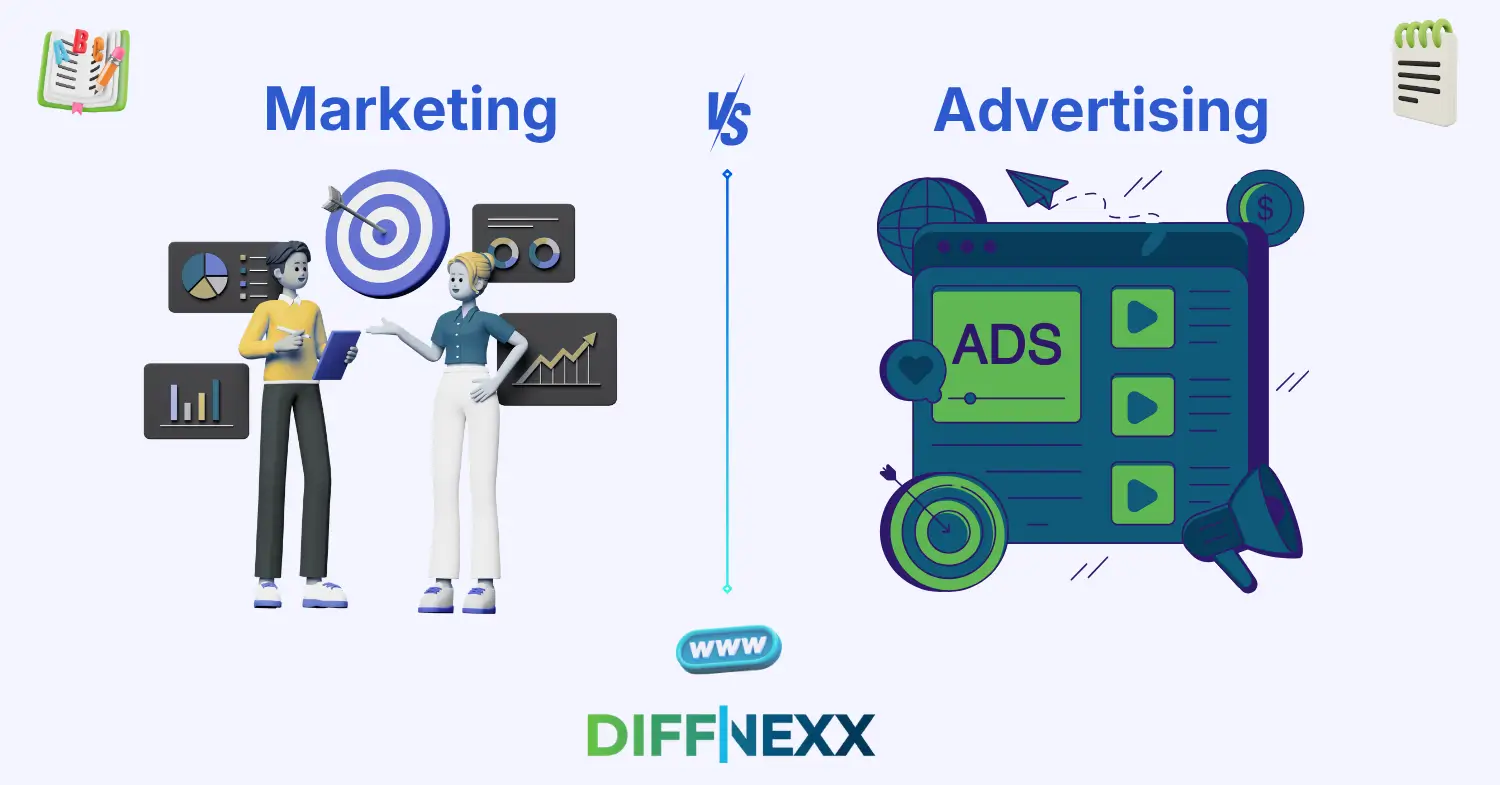
Difference between marketing and advertising often comes up when businesses try to grow or sell products. Imagine a small shop owner who creates a product, promotes it online, and builds customer relationships. Is all of that advertising or something bigger?
The difference between marketing and advertising lies in scope and purpose. Marketing is a broad process, while advertising is just one part of it.
Many people mix these terms, but the difference between marketing and advertising is important for students, professionals, and business owners. It helps you understand how products reach customers.
Let’s break it down step by step so you can use these terms correctly.
Key Difference Between the Both
The main difference is:
- Marketing is a complete strategy that includes research, branding, pricing, and promotion.
- Advertising is a specific activity focused on promoting products through paid messages.
In simple words, advertising is a part of marketing.
Importance – Why Knowing the Difference Matters
Understanding this difference is very useful.
For students, it builds strong business knowledge. It helps them understand how companies operate.
For professionals, especially in business and media, it improves decision-making. It helps in planning strategies effectively.
In society, it improves awareness. People can better understand how brands influence their choices.
🔊 Pronunciation Section
Marketing
US: /ˈmɑːr.kə.t̬ɪŋ/
UK: /ˈmɑː.kɪ.tɪŋ/
Advertising
US: /ˈæd.vɚ.taɪ.zɪŋ/
UK: /ˈæd.və.taɪ.zɪŋ/
Now that you know how to say them, let’s define them clearly.
📚 Core Definitions
Marketing
Marketing is the process of understanding customer needs and creating strategies to meet them. It includes research, branding, pricing, and promotion.
Example: A company studying customer preferences before launching a product.
Advertising
Advertising is the act of promoting a product or service through paid channels. It aims to attract attention and increase sales.
Example: A TV commercial promoting a new smartphone.
📚 10 Clear Differences Between Marketing and Advertising
1. Scope
Marketing is broad. Advertising is narrow.
- Example (Marketing): Includes product design and pricing.
- Example (Advertising): Focuses only on promotion.
2. Purpose
Marketing builds relationships. Advertising drives attention.
- Example (Marketing): Building customer trust.
- Example (Advertising): Showing product benefits.
3. Focus
Marketing focuses on customers. Advertising focuses on products.
- Example (Marketing): Understanding needs.
- Example (Advertising): Promoting features.
4. Duration
Marketing is long-term. Advertising is short-term.
- Example (Marketing): Brand growth over years.
- Example (Advertising): Limited-time campaign.
5. Strategy vs Action
Marketing is strategy. Advertising is execution.
- Example (Marketing): Planning campaigns.
- Example (Advertising): Running ads.
6. Cost Structure
Marketing includes many costs. Advertising focuses on ad spending.
- Example (Marketing): Research and branding costs.
- Example (Advertising): Paid ads budget.
7. Channels Used
Marketing uses multiple channels. Advertising uses paid media.
- Example (Marketing): Social media, email, content.
- Example (Advertising): TV, online ads.
8. Audience Engagement
Marketing builds engagement. Advertising grabs attention.
- Example (Marketing): Customer feedback.
- Example (Advertising): Eye-catching ads.
9. Tone
Marketing is informative and relational. Advertising is persuasive.
- Example (Marketing): Helpful content.
- Example (Advertising): Strong selling message.
10. Measurement
Marketing measures overall growth. Advertising measures campaign results.
- Example (Marketing): Brand awareness.
- Example (Advertising): Clicks and sales.
🎯 Why Knowing the Difference Matters
Students gain clarity in business studies. It helps them understand real-world strategies.
Professionals use this knowledge to plan better campaigns. It ensures efficient use of resources.
In daily life, it helps people recognize how companies influence decisions.
Real-world consequences of confusion
Confusing marketing with advertising can lead to poor business decisions. A company may focus only on ads and ignore customer needs.
🧠 Why People Get Confused
Similar Context
Both deal with promoting products.
Semantic Overlap
Advertising is part of marketing, so they seem similar.
Context-Based Usage
People often use “marketing” to mean advertising.
Informal Speech
In daily talk, both terms are used interchangeably.
🎭 Connotation & Emotional Tone
Connotation = the emotional meaning associated with a word.
Marketing
- Neutral and strategic
- Suggests planning and growth
- Example: “Good marketing builds trust.”
Advertising
- Persuasive and direct
- Suggests selling and promotion
- Example: “The advertising caught my attention.”
🗣 Usage in Metaphors, Similes & Idioms
- “Marketing is the engine, advertising is the fuel.”
- “Advertising speaks, marketing listens.”
Examples:
- “Their marketing strategy built loyalty.”
- “The advertising campaign went viral.”
📊 Comparison Table
| Feature | Marketing | Advertising |
|---|---|---|
| Meaning | Full strategy | Promotion activity |
| Tone | Strategic | Persuasive |
| Usage | Planning & execution | Paid promotion |
| Context | Business growth | Product promotion |
| Formality | Formal | Formal |
⚖️ Which Is Better in What Situation?
When to use Marketing
Use marketing when discussing overall strategy, customer research, or brand building. It covers the full business approach.
When to use Advertising
Use advertising when focusing on promotion, campaigns, or paid media efforts.
Situational clarity
Choose marketing for big-picture discussions. Choose advertising for specific campaigns.
Contextual correctness
In business planning, use “marketing.” In promotion discussions, use “advertising.”
📖 Literary or Cultural References
- Book: This Is Marketing (Business, Seth Godin, 2018)
- Movie: The Social Network (USA, 2010) – shows marketing and advertising in tech growth.
❓ FAQs
1. Is advertising part of marketing?
Yes, advertising is one component of marketing.
2. Which is more important?
Both are important. Marketing guides strategy, while advertising executes promotion.
3. Can a business succeed without advertising?
Yes, but it may grow slower. Marketing can include other methods like word-of-mouth.
4. Is digital marketing the same as advertising?
No, digital marketing includes advertising plus other strategies like content and SEO.
5. Why do people mix these terms?
Because advertising is a visible part of marketing, people often assume they are the same.
🏁 Conclusion
The difference between marketing and advertising is simple but important. Marketing is the complete strategy that includes research, planning, and customer relationships. Advertising is just one part of that strategy focused on promotion.
Understanding this difference helps you think clearly about business and communication. It allows you to plan better, whether you are a student, professional, or business owner.
Both marketing and advertising work together. When used correctly, they create strong brands and successful businesses. Keep learning these concepts to improve your understanding of how the modern world works.

Anton Reyes is a contributing writer at DiffNexx.com, where he explores meaningful differences in language, culture, and everyday concepts. With a background in creative nonfiction, Anton brings clarity and balance to complex comparisons. His writing helps readers understand subtle distinctions in words and ideas, making learning both insightful and engaging.