Difference between IPv4 and IPv6 becomes clear when your internet slows down or struggles to connect new devices. Imagine adding a new smartphone to your home Wi-Fi, but the network seems “full.” That’s where these two internet protocols come in.
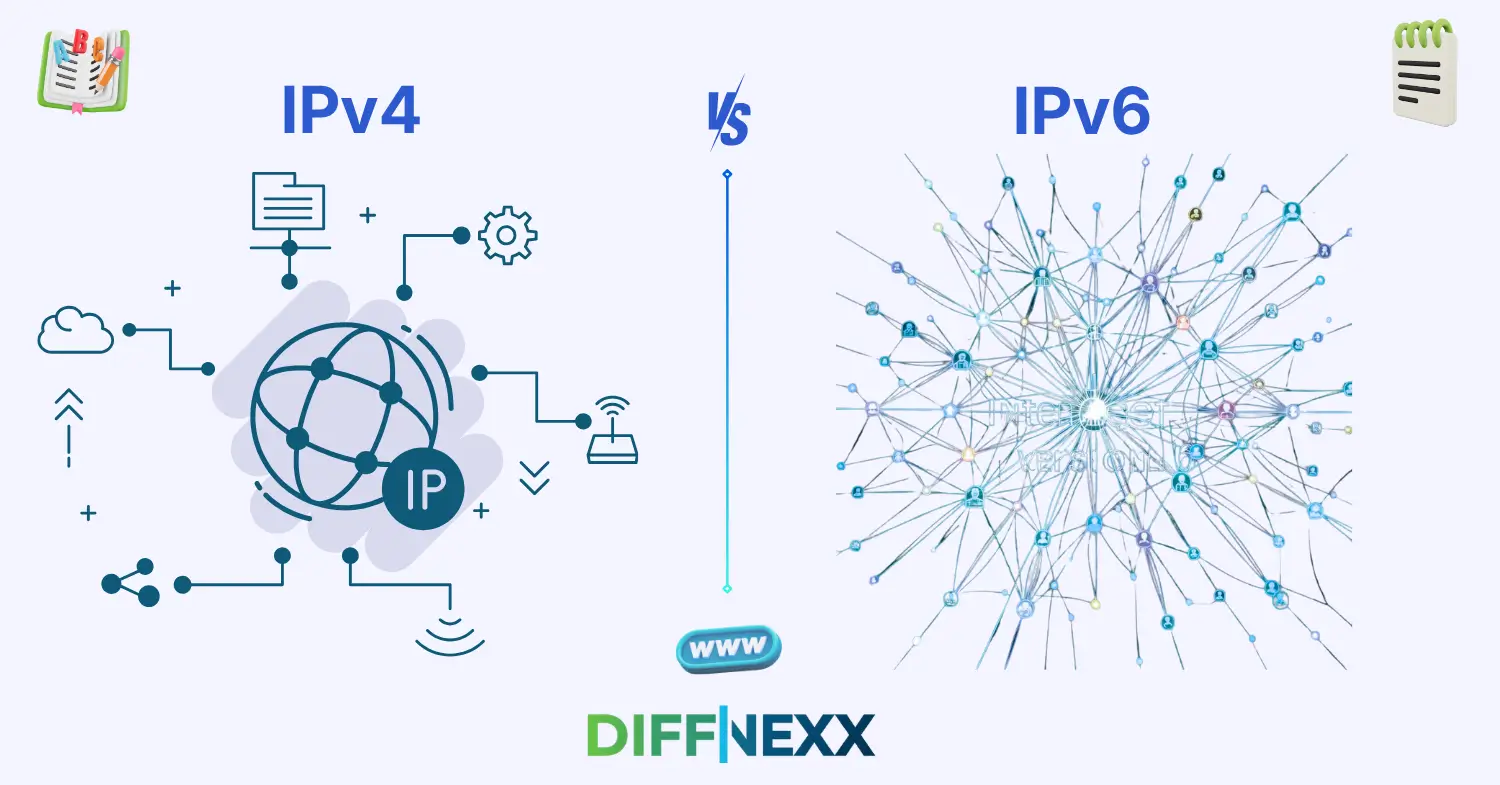
The difference between IPv4 and IPv6 lies in how they assign addresses to devices on the internet. IPv4 is the older system with limited addresses, while IPv6 is the newer version designed to support billions of devices.
Many users hear these terms but don’t fully understand them. Still, the difference between IPv4 and IPv6 affects how fast, secure, and scalable the internet can be.
Let’s explore what makes them different and why it matters today.
Key Difference Between the Both ⚡
The main difference between IPv4 and IPv6 is that IPv4 uses 32-bit addresses (limited supply), while IPv6 uses 128-bit addresses (almost unlimited supply).
IPv6 also offers better security and efficiency compared to IPv4.
Importance – Why Knowing the Difference Matters 📚
Understanding the difference between IPv4 and IPv6 helps both beginners and experts in technology.
For learners, it builds basic knowledge of how the internet works. It also helps in studies related to networking and IT.
For professionals, especially network engineers, the difference is critical. It helps them design modern systems, improve performance, and handle large networks.
In society, IPv6 supports the growing number of internet users and devices like smartphones, smart homes, and IoT. Without it, the internet could run out of addresses.
🔊 Pronunciation Section
IPv4
US: /ˌaɪ.piːˈviː.fɔːr/
UK: /ˌaɪ.piːˈviː.fɔː/
IPv6
US: /ˌaɪ.piːˈviː.sɪks/
UK: /ˌaɪ.piːˈviː.sɪks/
Now that you know how to say them, let’s define them clearly.
📚 Core Definitions
IPv4
IPv4 (Internet Protocol version 4) is the original system used to assign unique addresses to devices online. It uses a 32-bit format, which limits the number of available addresses.
Example:
192.168.1.1 is a common IPv4 address.
IPv6
IPv6 (Internet Protocol version 6) is the newer version designed to replace IPv4. It uses a 128-bit format, allowing a huge number of unique addresses.
Example:
2001:0db8:85a3:0000:0000:8a2e:0370:7334 is an IPv6 address.
📚 10 Clear Differences Between IPv4 and IPv6
1. Address Length
IPv4 uses 32-bit addresses. IPv6 uses 128-bit addresses.
- Example for IPv4: The address is short and easy to read.
- Example for IPv6: The address is long and more complex.
2. Address Capacity
IPv4 supports about 4.3 billion addresses. IPv6 supports trillions of trillions.
- Example for IPv4: Limited addresses cause shortages.
- Example for IPv6: Enough addresses for every device.
3. Address Format
IPv4 uses numbers separated by dots. IPv6 uses hexadecimal numbers separated by colons.
- Example for IPv4: 192.168.0.1
- Example for IPv6: 2001:db8::1
4. Speed and Efficiency
IPv6 is more efficient in routing. IPv4 can be slower due to older design.
- Example for IPv4: Data may take longer paths.
- Example for IPv6: Data flows more directly.
5. Security
IPv6 has built-in security features like IPsec. IPv4 needs extra setup.
- Example for IPv4: Security must be added manually.
- Example for IPv6: Security is part of the system.
6. Configuration
IPv4 often requires manual or DHCP setup. IPv6 supports automatic configuration.
- Example for IPv4: You may need to configure settings.
- Example for IPv6: Devices configure themselves.
7. Network Address Translation (NAT)
IPv4 relies heavily on NAT. IPv6 does not need NAT.
- Example for IPv4: Multiple devices share one IP.
- Example for IPv6: Each device gets its own IP.
8. Broadcast vs Multicast
IPv4 uses broadcast to send data to all devices. IPv6 uses multicast.
- Example for IPv4: Network traffic increases due to broadcast.
- Example for IPv6: Traffic is more controlled.
9. Header Complexity
IPv4 has a complex header. IPv6 has a simpler header for faster processing.
- Example for IPv4: More processing time is needed.
- Example for IPv6: Faster packet handling.
10. Future Support
IPv4 is slowly being phased out. IPv6 is the future standard.
- Example for IPv4: Older systems still use it.
- Example for IPv6: New networks prefer it.
🎯 Why Knowing the Difference Matters
Students must understand IPv4 and IPv6 to build a strong base in networking. It helps them in exams and practical learning.
Professionals need this knowledge to manage modern systems. Many companies are shifting to IPv6 for better performance.
In daily life, the difference affects how devices connect to the internet. Better understanding leads to smarter tech decisions.
Real-world consequences of confusion
If a network does not support IPv6, it may struggle with modern applications. Misunderstanding can also cause setup errors in networks.
🧠 Why People Get Confused
Similar Naming
Both terms look almost the same. Only the numbers differ, which causes confusion.
Technical Nature
The concepts are technical and not easy for beginners.
Context-Based Usage
People hear these terms in IT discussions but don’t always learn their meaning.
Informal Speech
Some users use IPv4 and IPv6 interchangeably, which is incorrect.
🎭 Connotation & Emotional Tone
Connotation = the emotional meaning associated with a word.
IPv4
- Positive: Familiar, widely used
- Neutral: Standard protocol
- Negative: Limited and outdated
Example: IPv4 still works but feels old.
IPv6
- Positive: Modern, advanced
- Neutral: New standard
- Negative: Slightly complex for beginners
Example: IPv6 is powerful but harder to read.
🗣 Usage in Metaphors, Similes & Idioms
These terms are technical, but simple comparisons exist:
- “IPv4 is like an old phonebook with limited entries.”
- “IPv6 is like an endless digital contact list.”
These comparisons help explain their differences.
📊 Comparison Table
| Feature | IPv4 | IPv6 |
|---|---|---|
| Meaning | 32-bit IP system | 128-bit IP system |
| Tone | Traditional | Modern |
| Usage | Older networks | New networks |
| Context | Limited addressing | Large-scale connectivity |
| Formality | Standard | Advanced standard |
⚖️ Which Is Better in What Situation?
When to Use IPv4
Use IPv4 in older systems or where compatibility matters. Many existing networks still depend on it.
When to Use IPv6
Use IPv6 for modern networks and large-scale systems. It supports more devices and better performance.
Situational Clarity
IPv4 fits legacy environments. IPv6 fits future-ready systems.
Contextual Correctness
Choose based on network needs and device compatibility.
📖 Literary or Cultural References
- Book: Computer Networking: A Top-Down Approach by James F. Kurose (Education, 2000)
- Movie: The Social Network (USA, 2010) – shows growth of internet technologies
These works reflect the evolution of networking concepts.
❓ FAQs
1. What is the main difference between IPv4 and IPv6?
The main difference is address size. IPv4 uses 32-bit addresses, while IPv6 uses 128-bit addresses.
2. Why is IPv6 replacing IPv4?
IPv4 cannot support the growing number of devices. IPv6 solves this with a much larger address space.
3. Can IPv4 and IPv6 work together?
Yes, they can run together using dual-stack systems. This allows smooth transition.
4. Is IPv6 faster than IPv4?
In many cases, yes. IPv6 can offer better routing and efficiency.
5. Do I need IPv6 at home?
Most modern networks already support IPv6. It helps future-proof your internet connection.
🏁 Conclusion
The difference between IPv4 and IPv6 is not just technical it shapes the future of the internet. IPv4 served the world for decades, but its limited address space cannot handle today’s demand. IPv6 solves this problem with a massive number of addresses and improved efficiency.
Understanding this difference helps students learn networking basics and helps professionals build better systems. It also helps everyday users understand how their devices connect online.
As the internet continues to grow, IPv6 will become more common. Learning about it today prepares you for tomorrow’s digital world. Stay curious, keep learning, and explore how technology connects everything around you.

Aamer Shahzad is the founder of Distinly.com, a fast-growing educational platform focused on high-intent “difference between” topics. With over 8 years of experience in English language education and analytical writing, I specialize in breaking down complex “difference between” topics into clear, structured, and easy-to-understand explanations. Distinly.com is your go-to resource for enhancing English skills and writing with confidence.
I specializes in building search-optimized, research-driven comparison content designed for clarity, authority, and long-term digital asset value.