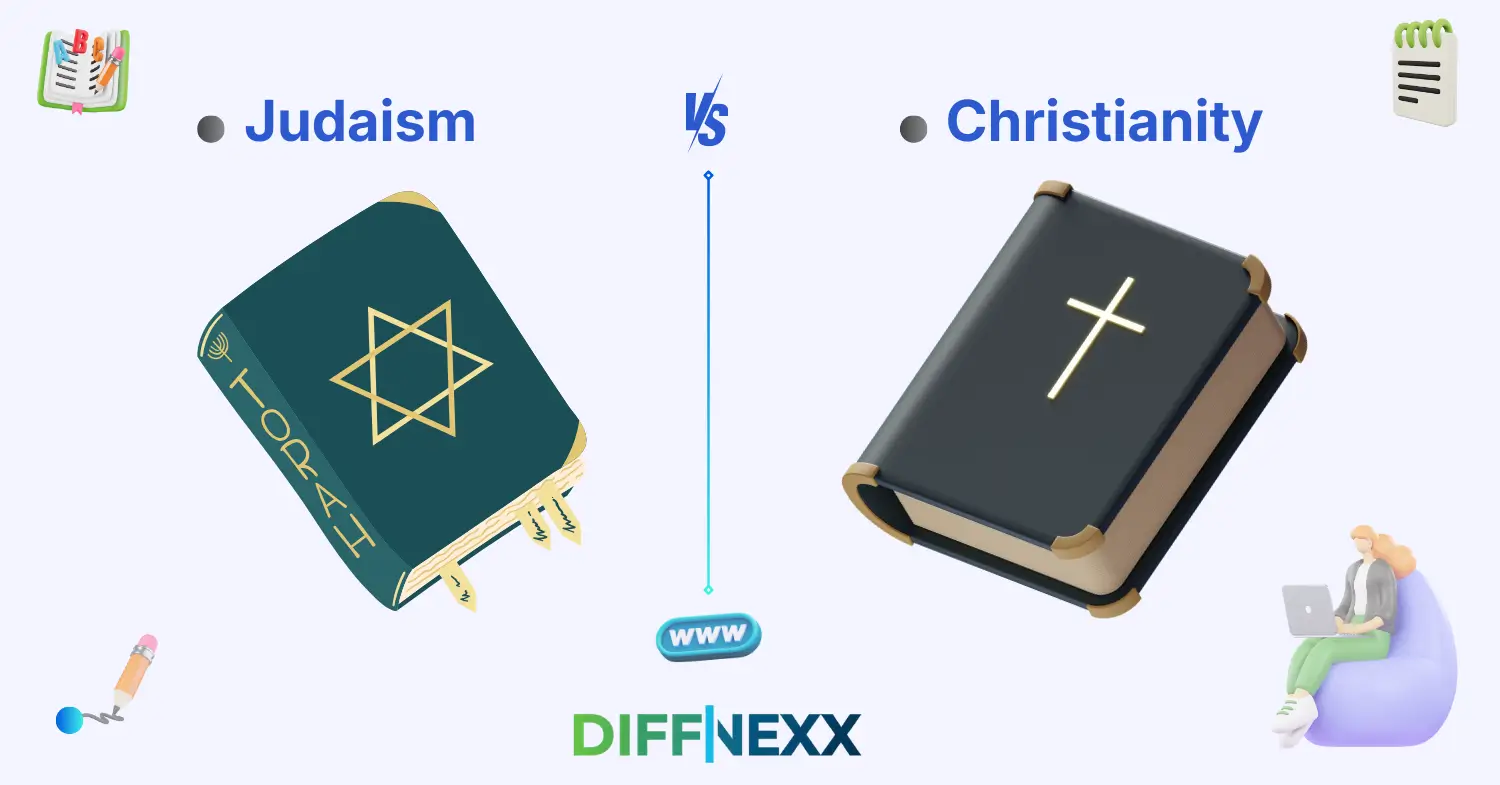
Difference between Judaism and Christianity often comes up in classrooms, documentaries, and everyday conversations. Imagine a student visiting a museum. One exhibit shows a menorah. Another displays a cross. The student wonders, “Are these religions connected?”
The difference between Judaism and Christianity begins with shared history but grows into distinct beliefs and practices. Judaism is one of the world’s oldest monotheistic religions. Christianity developed later and centers on the life and teachings of Jesus Christ.
Many people search for the difference between Judaism and Christianity because both faiths worship one God and share sacred texts. Yet their understanding of scripture, leadership, and salvation differs.
To understand clearly, we must explore their origins, beliefs, and practices step by step.
Key Difference Between the Two
The key difference centers on the identity of Jesus Christ.
Judaism does not accept Jesus as the Messiah or divine.
Christianity teaches that Jesus is the Son of God and the promised Messiah.
This theological difference shapes doctrine, worship, and identity in both religions.
Why Is Their Difference Necessary to Know
Students need clarity when studying world religions. Judaism and Christianity share historical roots, but they developed distinct paths. Knowing the difference strengthens religious literacy.
Experts in history, theology, and sociology analyze how both traditions shaped global culture. For example, Jewish law traditions differ greatly from Christian doctrines about grace and salvation.
In society, respectful dialogue depends on accurate understanding. Mislabeling beliefs can create tension. Clear knowledge builds empathy and informed discussion.
Now, let’s look at pronunciation before defining each religion fully.
🔊 Pronunciation
Judaism
US: /ˈdʒuːdiɪzəm/
UK: /ˈdʒuːdeɪɪzəm/
Christianity
US: /ˌkrɪstiˈænɪti/
UK: /ˌkrɪstʃiˈænɪti/
With pronunciation clear, we can move into core definitions.
📚 Core Definitions
Judaism
Judaism is an ancient monotheistic religion based on the covenant between God and the Jewish people. Its sacred texts include the Torah, part of the Hebrew Bible. Judaism emphasizes law, tradition, and community identity.
The tone of the word feels historical and cultural as well as religious.
Example:
Religious Practice: “She observes Judaism by celebrating Passover.”
Christianity
Christianity is a monotheistic religion centered on the life and teachings of Jesus Christ. Christians believe Jesus is the Messiah and Son of God. The Bible, including the Old and New Testaments, is sacred scripture.
The tone feels universal and faith-centered.
Example:
Religious Faith: “He practices Christianity and attends church weekly.”
📚 10 Clear Differences Between Judaism and Christianity
1. View of Jesus
Judaism sees Jesus as a historical figure, not the Messiah.
Christianity sees Jesus as divine and the Savior.
Example for Judaism:
Jesus is not central to worship.
Example for Christianity:
Jesus is the foundation of belief.
2. Sacred Texts
Judaism follows the Hebrew Bible (Tanakh).
Christianity follows both the Old Testament and the New Testament.
Example for Judaism:
The Torah guides religious law.
Example for Christianity:
The Gospels describe Jesus’ life.
3. Concept of Messiah
Judaism awaits a future Messiah.
Christianity teaches that Jesus fulfilled this role.
Example for Judaism:
The Messiah has not yet come.
Example for Christianity:
The Messiah has already come in Jesus.
4. Religious Law
Judaism emphasizes following commandments (mitzvot).
Christianity often emphasizes faith and grace.
Example for Judaism:
Dietary laws remain important.
Example for Christianity:
Faith in Christ brings salvation.
5. Worship Place
Judaism worships in synagogues.
Christianity worships in churches.
Example for Judaism:
They gather at synagogue on Sabbath.
Example for Christianity:
They gather at church on Sunday.
6. Religious Leadership
Judaism has rabbis as teachers.
Christianity has priests, pastors, or ministers.
Example for Judaism:
The rabbi teaches Torah.
Example for Christianity:
The pastor delivers a sermon.
7. Holy Day
Judaism observes Sabbath from Friday evening to Saturday evening.
Christianity typically observes Sunday as a holy day.
Example for Judaism:
Work stops on Sabbath.
Example for Christianity:
Sunday worship honors resurrection.
8. Salvation Understanding
Judaism focuses on righteous living and covenant.
Christianity emphasizes salvation through Jesus.
Example for Judaism:
Good deeds express faithfulness.
Example for Christianity:
Faith in Christ brings redemption.
9. Global Spread
Judaism is both a religion and ethnic identity.
Christianity is primarily a global missionary religion.
Example for Judaism:
Jewish identity can be cultural.
Example for Christianity:
Christianity spreads through evangelism.
10. Expression of Faith
Judaism blends religion and heritage.
Christianity centers on personal belief in Christ.
Example for Judaism:
Traditions pass through family.
Example for Christianity:
Conversion emphasizes personal choice.
🎯 Why Knowing the Difference Matters
Students must distinguish historical roots from theological differences. Clear knowledge prevents oversimplification.
Professionals in education, diplomacy, and media must speak accurately about both religions. Misunderstanding sacred beliefs damages trust.
In everyday life, respectful awareness strengthens interfaith relationships. Knowledge promotes peace and informed dialogue.
Real-World Consequences of Confusion
Confusing Judaism with Christianity can lead to misrepresentation. For example, assuming Jewish people accept Christian theology ignores core Jewish beliefs. Such mistakes may create cultural tension.
🧠 Why People Get Confused
Shared Origins
Christianity began within a Jewish context. Early followers of Jesus Christ were Jewish.
Shared Scriptures
Both traditions value parts of the Hebrew Bible.
Context-Based Usage
People sometimes use “Judeo-Christian” to describe shared moral heritage, which blends distinctions.
Clear education separates connection from identity.
🎭 Connotation & Emotional Tone
Connotation = the emotional meaning attached to a word.
Connotation = the emotional meaning associated with a word.
Judaism
Positive:
Ancient, resilient tradition.
Example: “Judaism preserves rich history.”
Negative:
May be misunderstood through stereotypes.
Example: “Some wrongly generalize Judaism.”
Neutral:
A monotheistic religion.
Example: “Judaism began thousands of years ago.”
Christianity
Positive:
Associated with compassion and faith.
Example: “Christianity teaches love.”
Negative:
Sometimes linked to historical conflicts.
Example: “People debate Christianity’s past.”
Neutral:
A global religion centered on Christ.
Example: “Christianity has many denominations.”
🗣 Usage in Metaphors, Similes & Idioms
Phrase: “Judeo-Christian values.”
Example Sentence:
“Both Judaism and Christianity teach moral responsibility, but their theology differs.”
There are few idioms directly using the religion names. Usage remains formal and respectful.
📊 Comparison Table
| Feature | Judaism | Christianity |
|---|---|---|
| Meaning | Ancient monotheistic religion | Faith centered on Jesus Christ |
| Tone | Historical, cultural | Universal, faith-centered |
| Usage | Religion and ethnic identity | Global religious identity |
| Context | Covenant and law | Salvation through Christ |
| Formality | Formal religious term | Formal religious term |
⚖️ Which Is Better in What Situation?
When to Use Judaism
Use Judaism when discussing Jewish religion, culture, or law. For example, “She studies Judaism in university.”
When to Use Christianity
Use Christianity when discussing belief in Jesus Christ.
Situational Clarity
Choose the correct term based on theology, not shared history.
Contextual Correctness
Accuracy shows respect. Each religion stands on its own identity.
📖 Literary or Cultural References
- “The Sabbath” (Theology, Abraham Joshua Heschel, 1951) — Explores Jewish spiritual life.
- “Mere Christianity” (Theology, C. S. Lewis, 1952) — Explains core Christian beliefs.
These works show the distinct spiritual perspectives of each tradition.
❓ FAQs
1. Did Christianity come from Judaism?
Yes. Christianity developed within a Jewish historical setting. However, it formed distinct beliefs about Jesus as Messiah.
2. Do Jews believe in the New Testament?
No. Judaism does not accept the New Testament as scripture.
3. Do both religions believe in one God?
Yes. Both traditions are monotheistic. However, Christianity teaches the Trinity, while Judaism strictly emphasizes God’s oneness.
4. Can someone practice both religions?
Typically, no. Their theological beliefs differ, especially regarding Jesus.
5. Why are they often linked together?
They share historical roots and parts of scripture. Yet their doctrines developed separately.
🏁 Conclusion
The difference between Judaism and Christianity centers on theology, scripture, and the identity of Jesus Christ. Judaism maintains ancient covenant traditions and awaits a Messiah. Christianity teaches that Jesus fulfills that role and offers salvation through him.
Understanding this distinction strengthens religious literacy and respectful communication. Both traditions shaped history, ethics, and culture worldwide. Yet each stands as a unique faith.
Learning these differences helps us speak accurately and think critically. Knowledge builds respect across communities and traditions.

Eliza Marlowe is a passionate content strategist and comparison writer at diffnexx.com. She specializes in breaking down complex “difference between” topics into clear, reader-friendly guides. With a background in linguistics and digital research, Eliza focuses on accuracy, clarity, and content that helps readers make informed decisions with confidence.