Difference between discrete and continuous often becomes confusing when students study math, science, or statistics for the first time. Imagine counting the number of students in a class and then measuring the height of each student. Both give numbers, but they are not the same type of numbers.
The difference between discrete and continuous is about how values are counted or measured. Some values come in separate steps, while others can change smoothly without limits. This idea is very important in mathematics, physics, computer science, and everyday life.
Many learners struggle to understand the difference between discrete and continuous because both are related to numbers and data. However, once you see real-life examples, the idea becomes simple and clear.
In this guide, we will explain the meaning, comparison, and importance of these two concepts step by step.
Key difference between the both
The main difference between discrete and continuous is that discrete values can be counted one by one, while continuous values can be measured and can take any value within a range.
Discrete data has gaps between values.
Continuous data has no gaps and can change smoothly.
For example, the number of books is discrete, but the weight of books is continuous.
Why is the difference necessary to know for the learners and experts in society ?
Understanding the difference between discrete and continuous is important for students, teachers, scientists, engineers, and data analysts.
In society, we use discrete values when counting people, objects, or events. We use continuous values when measuring time, distance, speed, temperature, and many other things.
Without knowing this difference, it becomes difficult to study statistics, programming, physics, economics, and research.
Knowing when to count and when to measure helps people make correct decisions in real life.
🔊 Pronunciation Section
Discrete
US (US): /dɪˈskriːt/
UK (UK): /dɪˈskriːt/
Continuous
US (US): /kənˈtɪnjuəs/
UK (UK): /kənˈtɪnjuəs/
Now that we know how to say the words correctly, let us understand their meanings before comparing them.
Core Definitions
Discrete
Discrete means separate and countable. The values do not come between numbers.
We can list them one by one.
Example:
Number of cars in a parking lot.
You cannot have 2.5 cars.
Continuous
Continuous means something that can change smoothly and can have any value.
The values can include fractions and decimals.
Example:
Height of a person.
A person can be 170.2 cm tall.
10 Clear Differences Between Discrete and Continuous
1. Nature of values
Discrete values are separate.
Continuous values are smooth.
Example for Discrete:
5 students in a class
Example for Continuous:
5.5 liters of water
2. Counting vs Measuring
Discrete is counted.
Continuous is measured.
Example for Discrete:
Number of apples
Example for Continuous:
Weight of apples
3. Possible values
Discrete has fixed values.
Continuous has unlimited values.
Example for Discrete:
1, 2, 3, 4
Example for Continuous:
1.1, 1.12, 1.123
4. Gaps between values
Discrete has gaps.
Continuous has no gaps.
Example for Discrete:
Pages in a book
Example for Continuous:
Length of the book
5. Use in mathematics
Discrete math deals with countable numbers.
Continuous math deals with real numbers.
Example for Discrete:
Graph with points
Example for Continuous:
Graph with line
6. Precision
Discrete has exact values.
Continuous can be very precise.
Example for Discrete:
10 chairs
Example for Continuous:
10.245 kg
7. Real-life usage
Discrete is used for objects.
Continuous is used for measurements.
Example for Discrete:
Number of people
Example for Continuous:
Body temperature
8. Data type in statistics
Discrete data is count data.
Continuous data is measurement data.
Example for Discrete:
Number of goals
Example for Continuous:
Time taken
9. Graph style
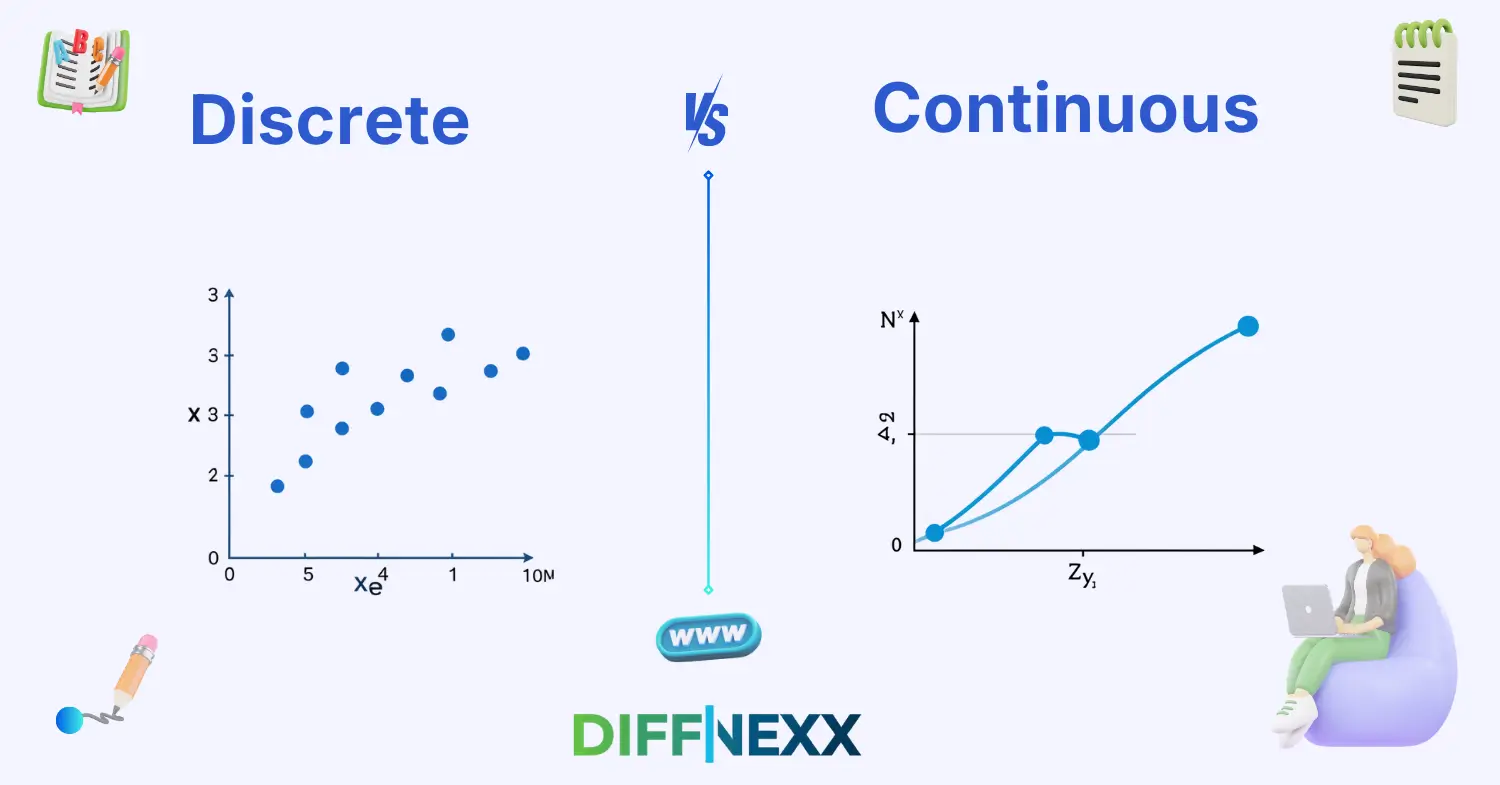
Discrete shows dots.
Continuous shows lines.
Example for Discrete:
Bar chart
Example for Continuous:
Line graph
10. Computer science usage
Discrete is used in digital systems.
Continuous is used in analog systems.
Example for Discrete:
Binary numbers
Example for Continuous:
Sound waves
Why Knowing the Difference Matters
Students must know the difference between discrete and continuous to understand math, statistics, and science correctly. Without this knowledge, solving problems becomes difficult.
Professionals like engineers, programmers, and researchers must also know this difference. Their work depends on correct data types.
In society, wrong understanding can lead to wrong calculations, wrong results, and wrong decisions.
Real-world consequences of confusion
If a scientist treats continuous data as discrete, the results can be incorrect.
Software may fail if a programmer mixes them.
If students confuse them, exams become harder.
Why People Get Confused
Similar meaning
Both are related to numbers and data, so learners think they are the same.
Context-based usage
In daily life, people do not think about counting vs measuring.
Technical terms
The words sound formal, so beginners feel confused.
Informal speech
People say numbers without thinking if they are discrete or continuous.
Connotation & Emotional Tone
Connotation = the emotional meaning attached to a word.
Discrete
Neutral meaning.
Used in math and science.
Example:
Discrete values in statistics.
Positive when used for clarity.
Negative when misunderstood.
Continuous
Neutral meaning.
Used in science and measurement.
Example:
Continuous signal.
Positive when showing smooth change.
Negative when showing never-ending problem.
Example:
Continuous noise.
Usage in Metaphors, Similes & Idioms
These words are mostly technical but can be used in comparisons.
Example with discrete:
His ideas were discrete steps toward success.
Example with continuous:
Her effort was continuous like flowing water.
Comparison Table
| Feature | Discrete | Continuous |
|---|---|---|
| Meaning | Countable values | Measurable values |
| Tone | Neutral | Neutral |
| Usage | Counting | Measuring |
| Context | Math, stats, CS | Math, physics, stats |
| Formality | Formal | Formal |
Which Is Better in What Situation?
When to use Discrete
Use discrete when counting objects, people, or events.
Example: number of students.
When to use Continuous
Use continuous when measuring length, time, weight, or speed.
Example: distance traveled.
Situational clarity
Choose discrete for exact numbers.
Choose continuous for changing values.
Contextual correctness
In statistics, using the correct type gives correct results.
Literary or Cultural References
Book:
Discrete Mathematics and Its Applications
(Science book, Kenneth Rosen, 1989)
Movie example:
A Beautiful Mind (USA, 2001)
Shows mathematics where discrete and continuous ideas are used.
FAQs
1. What is the simple difference between discrete and continuous?
Discrete means countable values.
Continuous means measurable values.
Discrete has gaps, continuous does not.
2. Is age discrete or continuous?
Age is continuous because it can include months, days, and seconds.
3. Is number of students discrete?
Yes, because students are counted, not measured.
4. Why is continuous data important?
It helps in science, physics, and measurement where values change smoothly.
5. Why do students confuse discrete and continuous?
Because both use numbers and both appear in math and statistics.
Conclusion
The difference between discrete and continuous is simple but very important. Discrete values can be counted one by one, while continuous values can be measured and can take any value within a range. This difference helps students understand mathematics, statistics, and science more clearly.
Knowing when to use discrete and when to use continuous makes problem-solving easier. It also helps professionals avoid mistakes in research, programming, and real-life calculations.
With practice and real examples, this concept becomes easy to understand. Keep learning, keep observing numbers around you, and you will use these terms correctly with confidence.

Eliza Marlowe is a passionate content strategist and comparison writer at diffnexx.com. She specializes in breaking down complex “difference between” topics into clear, reader-friendly guides. With a background in linguistics and digital research, Eliza focuses on accuracy, clarity, and content that helps readers make informed decisions with confidence.