Difference between rats and mice often comes up when you spot a small rodent in your home or garden. You may see something run across the floor and wonder, was it a rat or a mouse?
The difference between rats and mice is not just about size. These two animals belong to the same rodent family, but they have different features, behaviors, and habits. Knowing this helps you understand what you are dealing with.
Many people confuse them because they look similar at first glance. However, once you learn the difference between rats and mice, you can easily tell them apart.
Let’s break it down in a simple and clear way 🐭.
🔍 Key Difference Between the Both
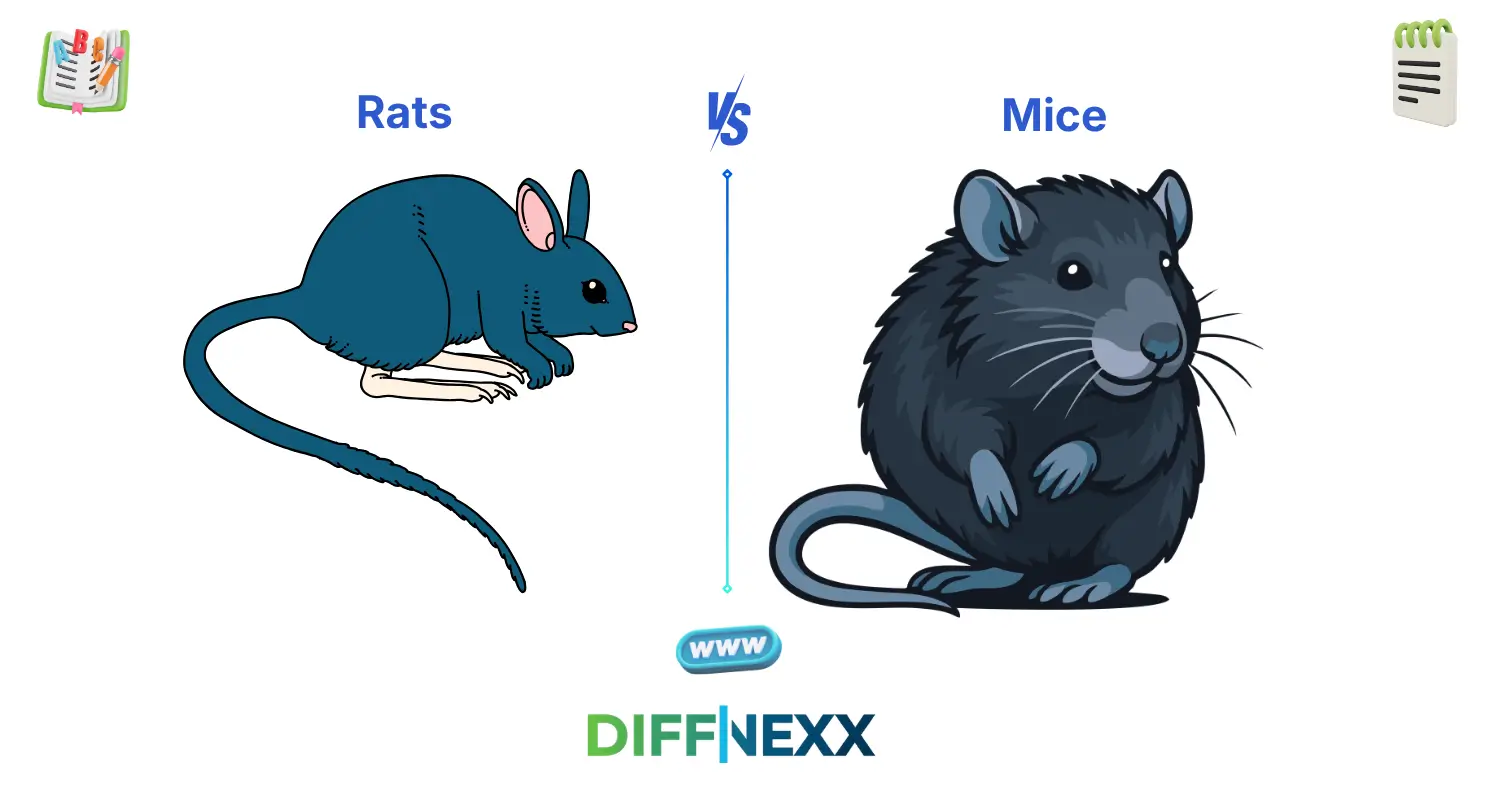
The main difference is size and behavior.
- Rats are larger, stronger, and more cautious.
- Mice are smaller, quicker, and more curious.
🌍 Importance
Understanding this difference helps learners identify animals correctly. It builds basic knowledge of nature and biology.
For professionals like pest control experts, this knowledge is essential. It helps them choose the right methods for control and prevention.
In society, knowing the difference improves hygiene and safety. Rats and mice can spread diseases, so correct identification matters.
🔊 Pronunciation Section
Rats
US: /ræts/
UK: /ræts/
Mice
US: /maɪs/
UK: /maɪs/
Now that you can say both words clearly, let’s define them before comparing.
📚 Core Definitions
Rats
Rats are medium-sized rodents with long tails and strong bodies. They are often seen as pests and are known for their intelligence. The tone is usually negative due to their association with dirt.
Example: A rat was seen near the garbage area.
Mice
Mice are small rodents with tiny bodies and pointed noses. They are often seen as harmless or even cute. The tone can be neutral or slightly positive.
Example: A mouse ran quickly under the table.
📚 10 Clear Differences Between Rats and Mice
1. Size
Rats are much larger than mice. Mice are small and lightweight.
- Example (Rats): A rat can grow up to 9–11 inches.
- Example (Mice): A mouse is usually 2–4 inches long.
2. Body Shape
Rats have thick, heavy bodies. Mice have slim and delicate bodies.
- Example (Rats): Strong and bulky look.
- Example (Mice): Thin and tiny appearance.
3. Tail
Rats have thick, scaly tails. Mice have thin and smooth tails.
- Example (Rats): Heavy tail.
- Example (Mice): Fine tail.
4. Behavior
Rats are cautious and avoid new things. Mice are curious and explore quickly.
- Example (Rats): Avoid traps at first.
- Example (Mice): Approach new objects quickly.
5. Intelligence
Rats are highly intelligent. Mice are less intelligent but still clever.
- Example (Rats): Learn from experience.
- Example (Mice): Act quickly but less strategically.
6. Habitat
Rats prefer basements and sewers. Mice live inside walls and small spaces.
- Example (Rats): Found in drains.
- Example (Mice): Found in kitchens.
7. Feeding Habits
Rats eat large amounts and varied food. Mice eat small portions frequently.
- Example (Rats): Consume big food scraps.
- Example (Mice): Nibble small bits.
8. Reproduction Rate
Mice reproduce faster than rats. Rats reproduce at a slower rate.
- Example (Rats): Fewer offspring.
- Example (Mice): Many babies quickly.
9. Damage Level
Rats cause more damage due to size. Mice cause smaller but frequent damage.
- Example (Rats): Chew wires heavily.
- Example (Mice): Damage small items.
10. Fear Response
Rats are careful and alert. Mice are more active and less fearful.
- Example (Rats): Hide quickly.
- Example (Mice): Move around openly.
🎯 Why Knowing the Difference Matters
Students need this knowledge to understand animal classification. It improves their science learning.
Professionals like pest controllers must identify the rodent correctly. It helps them use the right control methods.
In daily life, correct identification helps protect homes and health. It reduces risks linked to infestations.
Real-world consequences of confusion
If you mistake rats for mice, you may use the wrong solution. This can lead to bigger infestations and more damage.
🧠 Why People Get Confused
Similar Appearance
Both animals look alike at a quick glance. This causes confusion.
Semantic Overlap
People use “rat” and “mouse” as general terms. This mixes meanings.
Context-Based Usage
In stories and cartoons, the terms are used loosely.
Influence of Informal Speech
Everyday language often ignores the difference.
🎭 Connotation & Emotional Tone
Connotation = the emotional meaning associated with a word.
Rats
- Positive: Intelligence (in research contexts)
- Negative: Dirt, disease
- Neutral: Animal species
Example: Rats are used in scientific studies.
Mice
- Positive: Cute and harmless
- Negative: Household nuisance
- Neutral: Small rodent
Example: A mouse can be a pet.
🗣 Usage in Metaphors, Similes & Idioms
- “Like rats leaving a sinking ship” (escaping trouble)
- “Quiet as a mouse” (very silent)
Example Sentences:
- People ran like rats leaving a sinking ship.
- The room was quiet as a mouse.
📊 Comparison Table
| Feature | Rats | Mice |
|---|---|---|
| Meaning | Larger rodents | Smaller rodents |
| Tone | Negative | Neutral/positive |
| Usage | Pest control context | General or pet context |
| Context | Dirty environments | Homes and fields |
| Formality | Scientific/common | Scientific/common |
⚖️ Which Is Better in What Situation?
When to use Rats
Use “rats” when referring to larger rodents. This is common in pest control or scientific discussion.
When to use Mice
Use “mice” when talking about smaller rodents. It is also used in casual or pet contexts.
Situational clarity
Choose the word based on size and behavior. This keeps communication clear.
Contextual correctness
Correct usage avoids confusion in real-life situations, especially in health and safety discussions.
📖 Literary or Cultural References
- Book: Of Mice and Men (Fiction, John Steinbeck, 1937)
- Book: The Tale of Despereaux (Children’s Fiction, Kate DiCamillo, 2003)
- Movie: Ratatouille (USA, 2007) – features a rat character
- Movie: Stuart Little (USA, 1999) – features a mouse character
❓ FAQs
1. Are rats more dangerous than mice?
Yes, rats are generally more dangerous. They are larger and can cause more damage. They also carry more serious health risks.
2. Can mice turn into rats?
No, mice and rats are different species. A mouse cannot grow into a rat. They are separate animals.
3. Which is more common in homes?
Mice are more common in homes. They can enter through very small holes. Rats usually need larger openings.
4. Do rats and mice live together?
No, they usually do not live together. Rats may even attack mice. They compete for space and food.
5. How can I identify them quickly?
Look at size and tail thickness. Larger body and thick tail means rat. Small body and thin tail means mouse.
🏁 Conclusion
The difference between rats and mice is easy to understand once you know the basics. Rats are larger, stronger, and more cautious. Mice are smaller, quicker, and more curious.
Knowing this difference helps you make better decisions in daily life. It also improves your understanding of animals and their behavior.
Whether you are a student or a homeowner, this knowledge is useful. Keep observing and learning small details make a big difference

Aamer Shahzad is the founder of Distinly.com, a fast-growing educational platform focused on high-intent “difference between” topics. With over 8 years of experience in English language education and analytical writing, I specialize in breaking down complex “difference between” topics into clear, structured, and easy-to-understand explanations. Distinly.com is your go-to resource for enhancing English skills and writing with confidence.
I specializes in building search-optimized, research-driven comparison content designed for clarity, authority, and long-term digital asset value.