Difference between heat and temperature often confuses students in science class. Imagine touching a metal spoon and a wooden spoon left in the same room. They feel different, even though both stayed in the same place. That moment shows why understanding the difference between heat and temperature is important.
The difference between heat and temperature is a basic idea in physics. Heat is energy that moves from one object to another. Temperature tells how hot or cold something is. Many people think they mean the same thing, but they do not. Knowing the difference between heat and temperature helps you understand weather, cooking, machines, and science experiments.
You see these words in school, news, and daily life. So learning the correct meaning makes communication clearer.
Now let’s look at the idea step by step.
🔑 Key Difference Between the Both
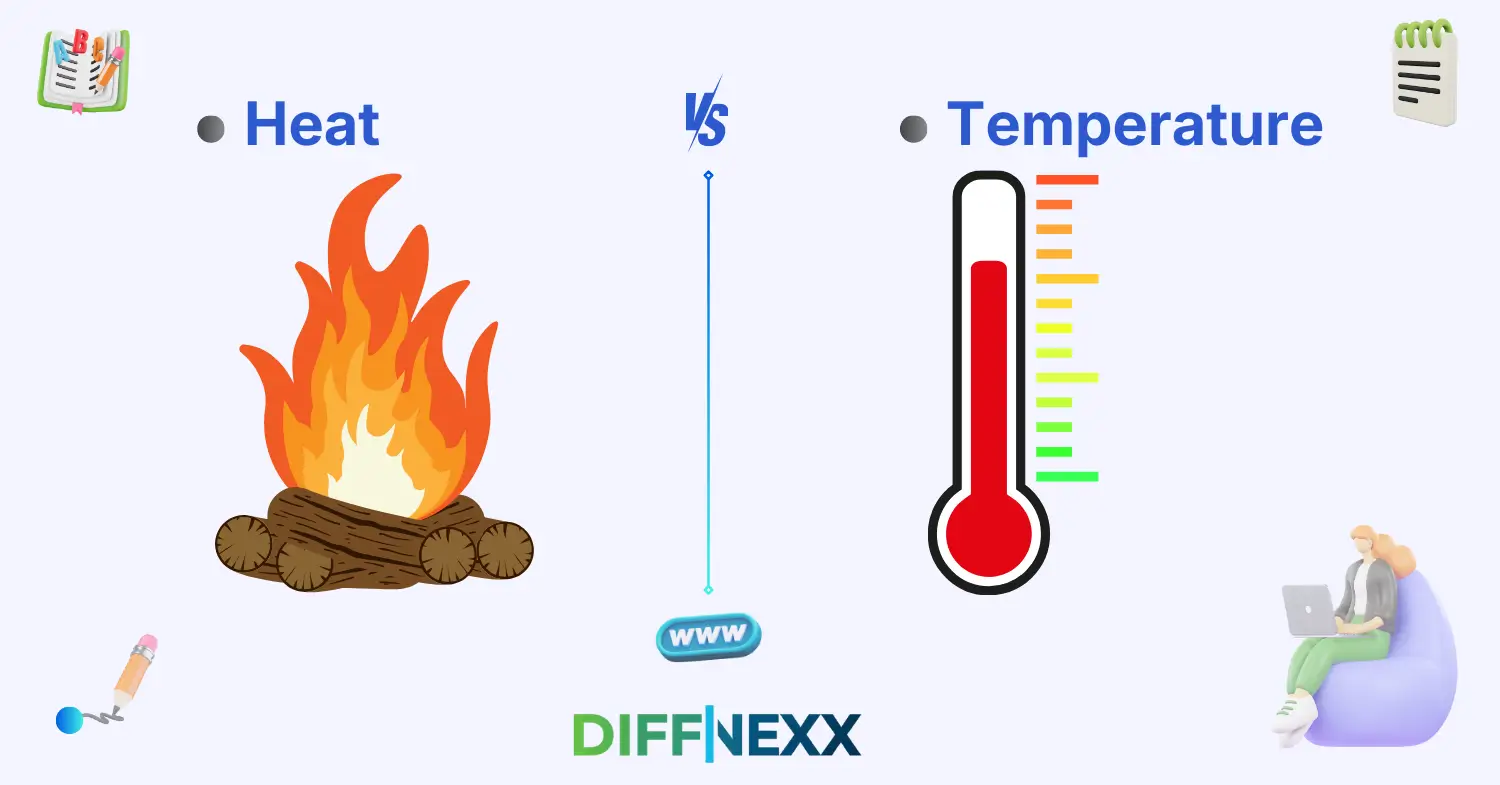
Heat is energy that flows from a hot object to a cold one.
Temperature is a measurement of how hot or cold something is.
Heat can move.
Temperature only shows the level of hotness or coldness.
🌍 Why Is Their Difference Necessary to Know for Learners and Experts in Society
Students must know this difference to understand science correctly. Physics, chemistry, and biology all use these terms.
Experts need accuracy when working with machines, medicine, or weather systems. A wrong understanding may cause serious mistakes.
In society, people talk about climate, cooking, and health. Clear knowledge helps people explain things correctly.
🔊 Pronunciation Section
Heat
US (Heat): /hiːt/
UK (Heat): /hiːt/
Temperature
US (Temperature): /ˈtemprətʃər/
UK (Temperature): /ˈtemprətʃə/
Both words are common in science and daily life. Before comparing them deeply, let us define them clearly.
📚 Core Definitions
🔥 Heat
Heat is a form of energy. It moves from a hotter object to a colder object. It always flows until both objects reach the same temperature.
Example: The stove gives heat to the pan.
🌡️ Temperature
Temperature is the measurement of how hot or cold something is. It shows the average energy of particles in a substance. It does not move like heat.
Example: The temperature of water is 30°C.
📚 10 Clear Differences Between Heat and Temperature
1️⃣ Energy vs Measurement
Heat is energy transfer.
Temperature is a measurement.
- Example 1 for Heat: The fire gives heat to the room.
- Example 2 for Temperature: The room temperature is 25°C.
2️⃣ Movement
Heat moves from hot to cold.
Temperature does not move.
- Example 1 for Heat: Hot tea gives heat to the cup.
- Example 2 for Temperature: The cup has a lower temperature.
3️⃣ Dependence on Amount
Heat depends on the amount of substance.
Temperature does not depend on amount.
- Example 1 for Heat: A large pot holds more heat.
- Example 2 for Temperature: Both pots have the same temperature.
4️⃣ Units Used
Heat is measured in joules or calories.
Temperature is measured in Celsius, Fahrenheit, or Kelvin.
- Example 1 for Heat: The heater produces 500 joules.
- Example 2 for Temperature: The air is 20°C.
5️⃣ Scientific Role
Heat explains energy transfer.
Temperature shows particle motion level.
- Example 1 for Heat: Heat flows in engines.
- Example 2 for Temperature: Temperature controls reactions.
6️⃣ Daily Usage
Heat is used when talking about warmth.
Temperature is used when talking about numbers.
- Example 1 for Heat: The sun gives heat.
- Example 2 for Temperature: The temperature is high today.
7️⃣ Physical Meaning
Heat relates to energy movement.
Temperature relates to energy level.
- Example 1 for Heat: Boiling water gives heat to air.
- Example 2 for Temperature: Water temperature is 100°C.
8️⃣ Measurement Tools
Heat uses calorimeters.
Temperature uses thermometers.
- Example 1 for Heat: Scientists measure heat in labs.
- Example 2 for Temperature: Doctors use thermometers.
9️⃣ Effect on Objects
Heat can change state.
Temperature shows the state.
- Example 1 for Heat: Heat melts ice.
- Example 2 for Temperature: Ice melts at 0°C.
🔟 Expression Style
Heat describes energy flow.
Temperature describes condition.
- Example 1 for Heat: Heat entered the metal.
- Example 2 for Temperature: The metal is hot.
🎯 Why Knowing the Difference Matters
Students must know this difference to solve science problems correctly. Many exams test this concept.
Professionals use these terms in engineering, medicine, and climate science. Wrong usage may cause errors.
Clear understanding improves communication in daily life.
⚠️ Real-world consequences of confusion
If someone confuses heat and temperature, they may misunderstand safety instructions, cooking steps, or machine settings.
🧠 Why People Get Confused
🔤 Similar Meaning
Both relate to hot and cold, so people think they are the same.
🔄 Semantic Overlap
Heat and temperature often appear together in science.
📍 Context-Based Usage
In daily speech, people use them as if they are equal.
🗣 Informal Speech
People say “high heat” when they mean “high temperature.”
🎭 Connotation & Emotional Tone
Connotation = emotional meaning attached to a word.
🔥 Heat
Positive: Warmth, comfort.
Example: The heat of the sun feels nice.
Negative: Danger, burning.
Example: The heat caused damage.
Neutral: Scientific energy.
🌡️ Temperature
Positive: Balance, control.
Example: The temperature is perfect.
Negative: Fever, illness.
Example: His temperature is high.
Neutral: Measurement term.
🗣 Usage in Metaphors, Similes & Idioms
Heat in idioms:
- Feel the heat = feel pressure
Example: He felt the heat at work.
Temperature in idioms:
- Take someone’s temperature = check mood
Example: The teacher took the class temperature.
📊 Comparison Table
| Feature | Heat | Temperature |
|---|---|---|
| Meaning | Energy transfer | Measure of hotness |
| Tone | Physical energy | Measurement term |
| Usage | Science, daily talk | Science, weather |
| Context | Energy flow | Condition level |
| Formality | Scientific | Scientific |
⚖️ Which Is Better in What Situation?
🔥 When to Use Heat
Use heat when talking about energy moving from one object to another.
🌡️ When to Use Temperature
Use temperature when talking about how hot or cold something is.
🎯 Situational Clarity
If you can measure with a thermometer, use temperature.
If energy moves, use heat.
📌 Contextual Correctness
Science writing needs exact terms. Choose carefully.
📖 Literary or Cultural References
- A Brief History of Time (Science, Stephen Hawking, 1988) – Explains heat and energy in physics.
- Interstellar (Film, USA, 2014) – Shows temperature and heat in space science.
These works show how science terms matter.
❓ FAQs
1. Is heat the same as temperature?
No. Heat is energy transfer. Temperature is measurement.
2. Why does metal feel colder than wood?
Metal moves heat faster from your hand. Temperature may be the same.
3. Can two objects have same temperature but different heat?
Yes. A big object holds more heat than a small one.
4. Which one is measured with thermometer?
Temperature is measured with a thermometer.
5. Why is this difference important in science?
It explains how energy moves and how matter changes.
🏁 Conclusion
The difference between heat and temperature is simple but very important. Heat is energy that moves between objects. Temperature tells how hot or cold something is. These ideas help us understand cooking, weather, machines, and science.
Students need this knowledge for school. Experts need it for work. Everyday life also uses these words often. When you remember that heat flows and temperature measures, the confusion disappears.
Keep practicing, and your science vocabulary will become stronger and clearer every day. 🔥🌡️

Anton Reyes is a contributing writer at DiffNexx.com, where he explores meaningful differences in language, culture, and everyday concepts. With a background in creative nonfiction, Anton brings clarity and balance to complex comparisons. His writing helps readers understand subtle distinctions in words and ideas, making learning both insightful and engaging.