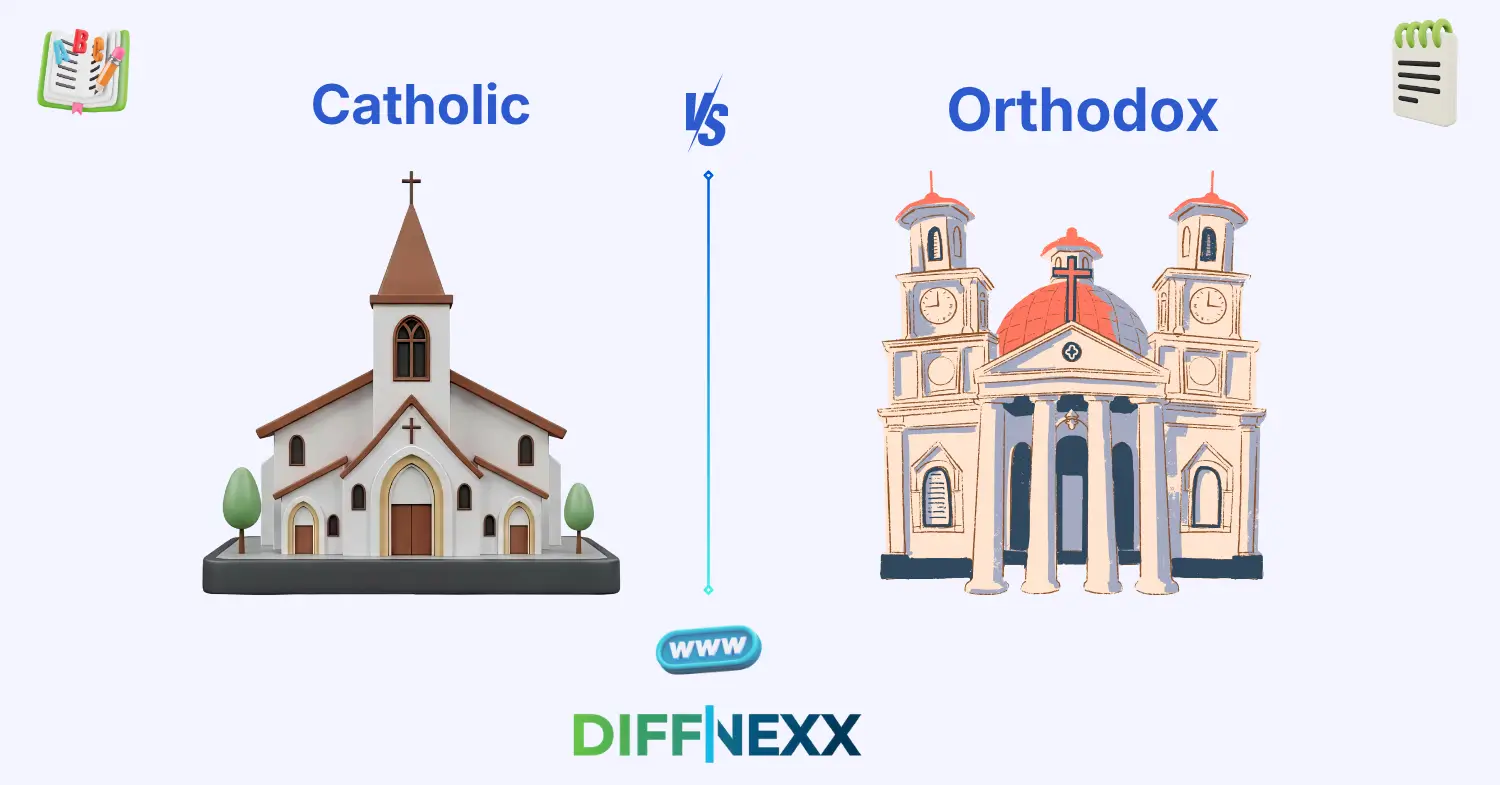
Difference between catholic and orthodox often comes up when someone visits different churches while traveling. You might notice similar prayers, icons, and traditions but also some clear differences in style and leadership.
The difference between catholic and orthodox is rooted in history, beliefs, and church structure. Both belong to Christianity and share many core teachings, but they developed separately over time.
Many learners feel confused because both traditions look alike and follow ancient practices. However, once you understand the difference between catholic and orthodox, their unique identities become clear.
Let’s explore these differences step by step.
Key Difference Between the Both ⚖️
The main difference between Roman Catholic Church and Eastern Orthodox Church is authority and leadership:
- Catholic Church is led by the Pope as the central authority.
- Orthodox Church follows a group of bishops with no single global leader.
This difference shapes many other beliefs and practices.
Importance – Why Knowing the Difference Matters 🎯
Understanding the difference between catholic and orthodox helps learners build clear knowledge of world religions.
For students, it improves historical and cultural understanding. It also helps in exams and general knowledge.
For scholars and religious experts, the distinction is important for theology, interfaith dialogue, and academic research.
In society, this knowledge promotes respect and better communication among different communities.
Pronunciation Section 🔊
Catholic
US: /ˈkæθ.lɪk/
UK: /ˈkæθ.lɪk/
Orthodox
US: /ˈɔːr.θə.dɑːks/
UK: /ˈɔː.θə.dɒks/
Now that you can pronounce both terms, let’s define them clearly.
Core Definitions 📚
Catholic
The Roman Catholic Church is the largest Christian church, led by the Pope in Rome. It emphasizes unity under one leader and follows a structured global system.
Example: A Catholic attends Mass led by a priest in communion with the Pope.
Orthodox
The Eastern Orthodox Church is a group of independent churches that share the same faith and traditions. It values tradition and collective leadership by bishops.
Example: An Orthodox Christian attends a liturgy led by a bishop or priest in a local church.
10 Clear Differences Between Catholic and Orthodox ✝️
1. Leadership Structure
Catholics follow one central leader (the Pope). Orthodox Christians follow multiple leaders.
- Example for Catholic: The Pope guides the global church.
- Example for Orthodox: Bishops share leadership.
2. Historical Development
The split happened in the Great Schism.
- Example for Catholic: Developed mainly in Western Europe.
- Example for Orthodox: Developed in Eastern regions.
3. Authority
Catholics believe in papal authority. Orthodox reject a single supreme authority.
- Example for Catholic: Pope decisions influence doctrine.
- Example for Orthodox: Decisions are made collectively.
4. Worship Style
Catholic services are more structured and shorter. Orthodox services are longer and more ceremonial.
- Example for Catholic: Mass lasts about an hour.
- Example for Orthodox: Liturgy can last longer.
5. Language in Worship
Catholics often use local languages. Orthodox may use ancient languages.
- Example for Catholic: Service in English or local language.
- Example for Orthodox: Greek or Church Slavonic used.
6. Clergy Rules
Catholic priests usually remain unmarried. Orthodox priests may marry before ordination.
- Example for Catholic: Priests take celibacy vows.
- Example for Orthodox: Some priests have families.
7. Theological Differences
There are small differences in beliefs, such as the Holy Spirit’s origin.
- Example for Catholic: Includes “Filioque” in creed.
- Example for Orthodox: Does not include it.
8. Calendar Use
Catholics use the Gregorian calendar. Orthodox may use the Julian calendar.
- Example for Catholic: Christmas on December 25.
- Example for Orthodox: Christmas may fall later.
9. Church Structure
Catholic Church is centralized. Orthodox Church is decentralized.
- Example for Catholic: One unified system.
- Example for Orthodox: Independent churches.
10. Cultural Influence
Catholicism influenced Western culture. Orthodoxy shaped Eastern traditions.
- Example for Catholic: Strong presence in Europe and Americas.
- Example for Orthodox: Strong presence in Eastern Europe.
Why Knowing the Difference Matters 🎯
Students need this knowledge to understand religious history and global cultures better.
Professionals, such as historians and theologians, rely on these distinctions for accurate study and communication.
Socially, this awareness promotes tolerance and reduces misunderstandings.
Real-world Consequences of Confusion
Confusion may lead to incorrect assumptions about beliefs, practices, or traditions.
Why People Get Confused 🤔
Similar Names
Both terms relate to Christianity, so they sound connected.
Shared Beliefs
They share many teachings, which creates overlap.
Context-Based Usage
People often use “Christian” without specifying type.
Informal Speech
In casual talk, differences are often ignored.
Connotation & Emotional Tone 🎭
Connotation = the emotional meaning associated with a word.
Catholic
- Positive: Unified, global
- Neutral: Traditional religious system
- Example: Catholic suggests structured faith.
Orthodox
- Positive: Ancient, authentic
- Neutral: Traditional belief system
- Example: Orthodox suggests strong tradition.
Usage in Metaphors, Similes & Idioms 🗣
- “Orthodox thinking” → traditional or conventional ideas
- “Catholic taste” → wide or inclusive preference
Examples:
- He has orthodox views on education.
- She has a catholic taste in music.
Comparison Table 📊
| Feature | Catholic | Orthodox |
|---|---|---|
| Meaning | Pope-led church | Bishop-led churches |
| Tone | Unified, structured | Traditional, collective |
| Usage | Global Christianity | Eastern Christianity |
| Context | Central authority | Shared authority |
| Formality | Religious | Religious |
Which Is Better in What Situation? ⚖️
When to Use Catholic
Use “Catholic” when referring to the global church led by the Pope. For example, in discussions about Vatican decisions.
When to Use Orthodox
Use “Orthodox” when referring to Eastern Christian traditions. For example, when discussing Eastern European churches.
Situational Clarity
Choose based on region, leadership, and tradition.
Contextual Correctness
Use the correct term to avoid misunderstanding in religious discussions.
Literary or Cultural References 📖
- Book: The Orthodox Church by Kallistos Ware (Religion, 1993)
- Movie: The Two Popes (UK/USA, 2019)
These works explore religious traditions and leadership.
FAQs ❓
1. Are Catholic and Orthodox the same religion?
They both belong to Christianity and share many beliefs. However, they differ in leadership, traditions, and some teachings.
2. Why did they split?
The split happened in 1054 due to political, cultural, and theological disagreements. This event is known as the Great Schism.
3. Do they have the same Bible?
They share most of the Bible, but there are small differences in accepted books.
4. Can Catholics and Orthodox marry?
Yes, but it may involve special permissions depending on church rules.
5. Which is older?
Both trace their roots to early Christianity. They developed together before splitting.
Conclusion 🏁
The difference between catholic and orthodox mainly lies in leadership, authority, and historical development. While Catholics follow the Pope as a central leader, Orthodox Christians rely on shared leadership among bishops.
Despite these differences, both traditions share deep roots in Christianity and maintain rich spiritual practices. Understanding these distinctions helps you appreciate religious diversity and communicate more clearly.
Keep learning about cultures and beliefs; it builds respect, knowledge, and global awareness.

Anton Reyes is a contributing writer at DiffNexx.com, where he explores meaningful differences in language, culture, and everyday concepts. With a background in creative nonfiction, Anton brings clarity and balance to complex comparisons. His writing helps readers understand subtle distinctions in words and ideas, making learning both insightful and engaging.