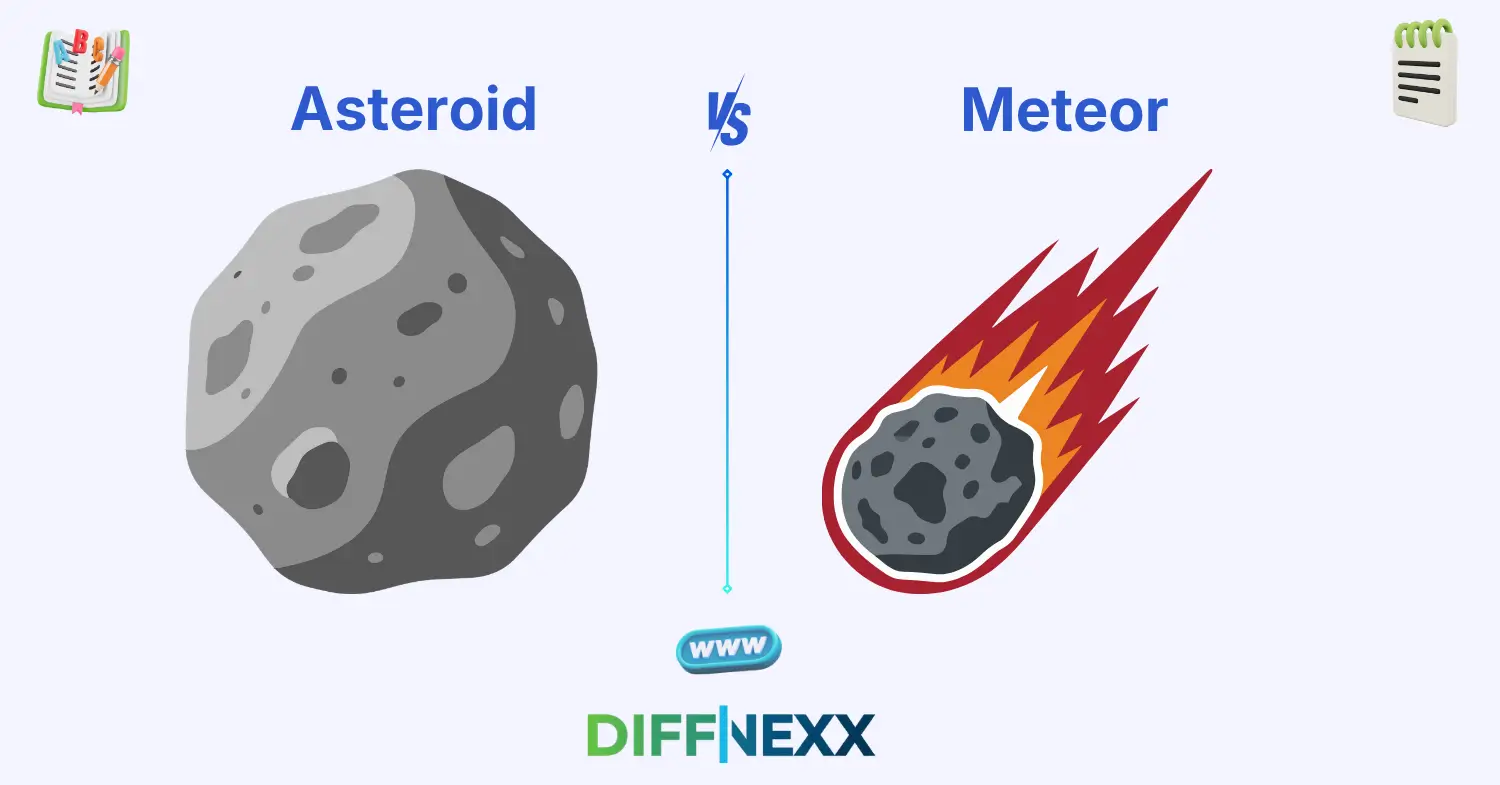
Difference between asteroid and meteor often comes up when you look at the night sky and see a sudden streak of light. You might think, “Was that an asteroid or a meteor?” Many people use these words the same way, but they actually mean different things.
The difference between asteroid and meteor is about where the object is and what it is doing. Both are space objects, but they behave differently and appear in different ways.
Understanding the difference between asteroid and meteor helps you describe space events correctly. It also makes science easier to understand and more interesting.
Let’s explore these terms step by step so you can clearly tell them apart.
Key Difference Between the Both
The main difference is simple:
- An asteroid is a rocky object that orbits the Sun in space.
- A meteor is the bright streak of light you see when a small space rock burns in Earth’s atmosphere.
So, asteroids stay in space, while meteors are seen when something enters our atmosphere and glows.
Importance – Why Knowing the Difference Matters
Knowing this difference is important for learners, experts, and society.
For students, it builds a strong base in astronomy. It helps them understand space concepts correctly without confusion.
For scientists and educators, clear terms are essential. They help explain space events, track objects, and predict possible risks.
In society, correct knowledge prevents misinformation. It also increases interest in space science and awareness of natural events.
🔊 Pronunciation Section
Asteroid
US: /ˈæs.tə.rɔɪd/
UK: /ˈæs.tə.rɔɪd/
Meteor
US: /ˈmiː.ti.ɔːr/
UK: /ˈmiː.ti.ə/
Now that you know how to say them, let’s understand their meanings clearly.
📚 Core Definitions
Asteroid
An asteroid is a rocky body that orbits the Sun, mostly found in the Asteroid Belt. These objects vary in size and remain in space.
Example: A large asteroid traveling between Mars and Jupiter.
Meteor
A meteor is the visible streak of light that appears when a small space rock enters Earth’s atmosphere and burns up. It is often called a “shooting star.”
Example: A bright flash across the sky during a meteor shower.
📚 10 Clear Differences Between Asteroid and Meteor
1. Location
Asteroids stay in space. Meteors appear in Earth’s atmosphere.
- Example (Asteroid): Orbiting the Sun.
- Example (Meteor): Burning in the sky.
2. Form
Asteroids are solid rocks. Meteors are light phenomena.
- Example (Asteroid): A rocky body in orbit.
- Example (Meteor): A glowing streak.
3. Visibility
Asteroids are not usually visible without a telescope. Meteors can be seen with the naked eye.
- Example (Asteroid): Seen by astronomers.
- Example (Meteor): Seen during meteor showers.
4. Duration
Asteroids exist for millions of years. Meteors last only seconds.
- Example (Asteroid): Long-term orbit.
- Example (Meteor): Quick flash of light.
5. Size
Asteroids can be very large. Meteors come from small particles.
- Example (Asteroid): Kilometers wide.
- Example (Meteor): Tiny fragments.
6. Movement Context
Asteroids move in stable orbits. Meteors fall into Earth’s atmosphere.
- Example (Asteroid): Orbiting the Sun.
- Example (Meteor): Entering Earth’s air.
7. Scientific Study
Asteroids are studied as objects. Meteors are studied as events.
- Example (Asteroid): Measured and tracked.
- Example (Meteor): Observed during entry.
8. Impact Risk
Asteroids can pose long-term collision risks. Meteors usually burn up.
- Example (Asteroid): Potential Earth impact.
- Example (Meteor): Harmless light streak.
9. Public Perception
Asteroids are seen as distant threats. Meteors are seen as beautiful events.
- Example (Asteroid): News about space risks.
- Example (Meteor): Enjoyed during showers.
10. Terminology Use
Asteroid is a scientific term. Meteor is used in everyday language too.
- Example (Asteroid): Used in astronomy studies.
- Example (Meteor): Common in casual speech.
🎯 Why Knowing the Difference Matters
Students need this knowledge to understand space science clearly. It helps avoid mixing up important terms in exams and discussions.
Professionals rely on accurate terms for research and communication. Astronomers track asteroids carefully and study meteors for atmospheric data.
In daily life, clear understanding improves communication. People can describe what they see in the sky correctly.
Real-world consequences of confusion
Confusing these terms can spread misinformation. For example, calling a meteor an asteroid may create unnecessary fear about space threats.
🧠 Why People Get Confused
Similar Names
Both words sound scientific and similar, which leads to confusion.
Semantic Overlap
Both involve space rocks, so people think they are the same.
Context-Based Usage
Media sometimes uses the terms loosely, adding to confusion.
Influence of Informal Speech
People often call meteors “shooting stars,” which adds another layer of misunderstanding.
🎭 Connotation & Emotional Tone
Connotation = the emotional meaning associated with a word.
Asteroid
- Neutral to slightly negative
- Often linked to danger or impact
- Example: “An asteroid could hit Earth.”
Meteor
- Positive or exciting
- Associated with beauty and wonder
- Example: “We watched a meteor shower.”
🗣 Usage in Metaphors, Similes & Idioms
These terms appear in creative language:
- “His idea hit like an asteroid.” (strong impact)
- “Her smile flashed like a meteor.” (quick and bright)
These metaphors highlight strength vs quick beauty.
📊 Comparison Table
| Feature | Asteroid | Meteor |
|---|---|---|
| Meaning | Rocky object in space | Light streak in atmosphere |
| Tone | Scientific/serious | Visual/expressive |
| Usage | Astronomy | Everyday + science |
| Context | Space orbit | Atmospheric entry |
| Formality | Formal | Both formal and informal |
⚖️ Which Is Better in What Situation?
When to use Asteroid
Use “asteroid” when talking about objects in space. It is correct for scientific discussions and space studies.
When to use Meteor
Use “meteor” when describing the light streak in the sky. It fits everyday conversation and observation.
Situational clarity
Choose based on location. If the object is in space, say asteroid. If it is glowing in the sky, say meteor.
Contextual correctness
Using the correct term improves clarity. For example, in a science class, saying “meteor” instead of “asteroid” can change the meaning completely.
📖 Literary or Cultural References
- Book: Asteroids: Relics of Ancient Time (Science, Clark R. Chapman, 2002)
- Movie: Armageddon (USA, 1998) – focuses on an asteroid threat to Earth.
❓ FAQs
1. Is a meteor the same as an asteroid?
No, they are different. An asteroid is a space rock, while a meteor is the light seen when a rock burns in the atmosphere.
2. What is a shooting star?
A shooting star is another name for a meteor. It is not actually a star.
3. Can asteroids become meteors?
Yes, if a piece of an asteroid enters Earth’s atmosphere, it becomes a meteor.
4. Are meteors dangerous?
Most meteors burn up before reaching the ground. They are usually harmless.
5. Where are most asteroids found?
Most asteroids are located in the Asteroid Belt between Mars and Jupiter.
🏁 Conclusion
The difference between asteroid and meteor is simple but important. Asteroids are rocky objects in space, while meteors are the bright streaks seen when those rocks enter Earth’s atmosphere.
Understanding this difference helps you speak clearly and learn science correctly. It also reduces confusion and improves your knowledge of space.
Next time you see a flash in the sky, you will know exactly what to call it. Keep learning and exploring space is full of amazing wonders waiting to be understood.

Aamer Shahzad is the founder of Distinly.com, a fast-growing educational platform focused on high-intent “difference between” topics. With over 8 years of experience in English language education and analytical writing, I specialize in breaking down complex “difference between” topics into clear, structured, and easy-to-understand explanations. Distinly.com is your go-to resource for enhancing English skills and writing with confidence.
I specializes in building search-optimized, research-driven comparison content designed for clarity, authority, and long-term digital asset value.